Sarah Ngare remembers when her company was still a fledgling business, operating with just a handful of machines in a market undergoing a major transformation after Kenya banned the manufacture, sale and use of single-use plastic carrier bags in August 2017.
The regulatory decision disrupted an established industry while creating commercial space for enterprises that could supply practical alternatives.
Rather than sit on the sidelines as the market changed, Sarah and her team moved into non-woven bag production to supply consumers, traders, and businesses seeking carrier bag substitutes. As customers embraced the alternative packaging, steady demand enabled the business to reinvest in production and expand its factory capacity.
“We thought we could start producing non-woven bags, which had been introduced into the market. We started with small machines and gradually grew,” she says.
Founded in 2018, New Dawn Non-Woven Company Manufacturing Limited has expanded its product range to include spoons, forks, cable clips and plastic seats, serving households as well as hotels, churches, institutions, event organisers, traders and artisans such as plumbers.
“Our starting capital was approximately Sh12 million, which we raised through loans and savings. The growth has been funded through profits and bank financing, with the company investing about Sh50 million in machinery and equipment since its establishment,” she says.
Reinvesting earnings in production, she adds, has enabled the business to increase its capacity without taking on significant debt.
This has also translated into employment, with the manufacturer now having 30 workers, some of whom joined with technical training while others acquired practical skills through their work at the company.
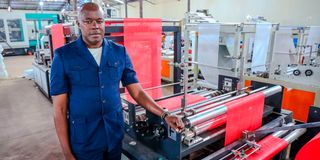
New Dawn Non-Woven Company Limited CEO Ngari Njogu (right) checks non-woven carrier bags with worker Francis Njue at the company’s production plant along Mutarakwa Road in Thigio, Ndeiya, Limuru, Kiambu County, on September 23, 2026.
Photo credit: Bonface Bogita | Nation Media Group
The manufacturer sources its raw materials from a mix of local suppliers and overseas markets. She adds that they place orders based on production requirements and maintain stocks of key materials to avoid interruptions.
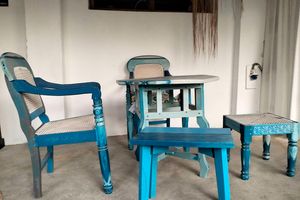
Among its latest additions is a plastic seat manufactured using polycarbonate (PC). She says some specialised materials remain unavailable in the domestic market, making imports necessary to support production.
“After we have installed the mould of the seat that we want, we take our PC material and pour it into the machine, then we allow it four minutes before the seat is ready,” she says.
The production cycle yields about 120 seats during an eight-hour shift, giving the line the capacity to serve household, institutional, and commercial buyers while establishing an additional revenue stream.
The seats are manufactured in different varieties for children, events, and religious or corporate institutions, with supplies dispatched according to client specifications.
The investment in machinery has enabled New Dawn to expand beyond non-woven bags into several product categories, with the business now operating 10 machines. Prices vary across the product range, from Sh1,600 to Sh9,000, depending on the product and specifications.
“For the non-woven bags, we target mama mbogas or the local markets around. For the cable clips, we target plumbers or fundis, and for the spoons, forks, and knives, we target hotels,” she says, adding that the products have received a positive market reception across the country.
The enterprise operates in a competitive market where locally made products compete with imported alternatives. Sarah says the company differentiates its products through price, quality and shorter delivery times.
The factory also uses automated dosing equipment to ensure consistent colour distribution in its polycarbonate seats. The system mixes colour master batch with virgin resin at controlled ratios, helping minimise colour variation across large orders.
During production, defective seats, misprinted non-woven bag sections and plastic offcuts are channelled into an internal recycling process. The factory uses crushers and granulators to process the waste into regrind, which is blended with virgin polymer and fed back into production.
Before products leave the factory, workers inspect them to ensure they meet the required specifications. Products that fail inspection are recycled, depending on the confirmed process. She explains that the checks help identify faults during production and prevent substandard products from reaching customers.
“Operating an in-house reprocessing system protects raw material margins, which account for a major portion of unit production costs in plastic manufacturing,” she says, adding that reclaiming floor scrap prevents material loss, reduces waste disposal costs and helps the business manage fluctuations in polymer prices.
Energy use is another consideration for the manufacturer, particularly when running injection moulding equipment. “Operating heat-heavy injection moulding equipment requires continuous electrical draw to maintain polymer melting temperatures across heater bands and hydraulic pumps,” she says.
New Dawn Non-Woven Company Limited CEO Ngari Njogu interacts with workers as they sort and package plastic components at the company’s production plant along Mutarakwa Road in Limuru, Kiambu County, on September 23, 2026.
Photo credit: Bonface Bogita | Nation Media Group
Power interruptions and voltage fluctuations remain an operational challenge, particularly for energy-intensive injection moulding equipment. The company uses voltage regulators and backup power systems to limit production losses and equipment damage while scheduling some energy-intensive operations to manage electricity costs.
As a manufacturing enterprise, Sarah notes that job creation extends beyond direct payroll roles, as production generates demand for raw materials, transportation, equipment maintenance, and distribution services that spread economic activity throughout the surrounding community.
According to her, the enterprise shows how growing manufacturers fit into Kenya’s industrialisation goals, as domestic production strengthens local supply chains while reducing reliance on imported finished goods.
“We are advocating to reduce plastic waste, and at the same time, create livelihood programs for everyone. And we are helping the Earth heal,” she notes.
Looking beyond the company’s current operations, plans are underway to establish regional branches and diversify the product range, bringing the firm closer to customers and expanding its distribution network.
Since Kenya’s 2017 ban transformed the packaging market, businesses have continued to develop alternatives. For New Dawn, the policy change provided an entry point into manufacturing, and the venture has gradually expanded its machinery, workforce and product range.
As the company prepares for its next phase, Sarah says the focus remains on steady growth, using higher production capacity and a wider distribution network to expand its presence across the countrywide.
‘’Looking back, there is nothing I would have done differently,” she concludes.