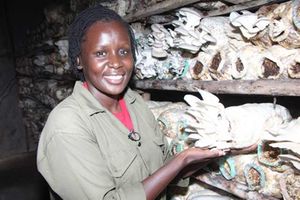
Mushrooms that would otherwise lose their market value because they are too large or have opened caps have become a business opportunity for Vera Mburugu.
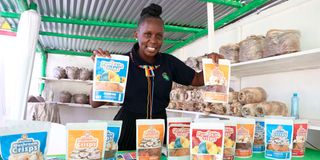
Vera is the founder of Kaganki Ventures, a business anchored on value addition. She turns surplus and lower-grade mushrooms into products with a longer shelf life, whereby she processes oyster and button mushrooms into crisps by blending them with cassava flour to make dough, which is flattened, cut into pieces and fried before being packaged for the market.
She also dries mushrooms and makes pumpkin crisps, with carrot crisps in the pipeline, as she seeks to create longer-lasting products from agricultural produce while tapping into the growing market for healthy snacks. The processing business currently outputs about 50kg of mushroom crisps a week, an increase from the 5kg she was experimenting with when she started developing the product two years ago.
The idea emerged from a problem confronting mushroom farmers, as not every healthy mushroom is suitable for the fresh product market. For instance, once the button mushroom cap opens, its value falls. Instead of discarding the mushrooms, Vera, 37, began experimenting with different recipes to find ways of giving them a second life.
She initially made fried mushrooms, inspired by the way they are prepared as a meat substitute. However, the product had a short shelf-life because of the moisture and oil content. She then settled on a formulation that blends mushrooms and cassava flour, with support from the Kenya Industrial Research and Development Institute, eventually arriving at the mushroom crisps now being sold by Kaganki Ventures.
The process involves blending the mushrooms with water and cassava flour to make a dough. The dough is flattened, cut into pieces and fried to produce the crisps. The same principle is used for pumpkin crisps, although the pumpkin is first boiled until soft before being blended with cassava flour.
“My target market is mainly people aged between 25 and 45, particularly working consumers looking for healthier snacks,” she says.
She showcased the products at this year's Nairobi International Trade Fair organised by the Agricultural Society of Kenya (ASK), where she sought to expose the brand to more consumers and potential buyers.
Vera Mburugu of Kaganki Ventures sprays mushrooms at Jamhuri Park Showground in Nairobi during the Nairobi International Trade Fair on September 30, 2026.
Photo credit: Sila Kiplagat | Nation Media Group
The business can currently process about 50kg of mushrooms each week, with Vera hoping to increase the volume as demand grows.
A major challenge is balancing processing with the company’s fresh mushroom business. It produces about five tonnes of button mushrooms and four tonnes of oyster mushrooms a month. Only about 10 per cent of this production currently goes into processing, with the bulk sold fresh. Vera explains that fresh mushrooms remain important because they provide regular cash flow, allowing the business to finance day-to-day operations. Moving more of the crop into value addition therefore requires higher production volumes. The need for processing became more apparent when she compared the returns from fresh and dried mushrooms.
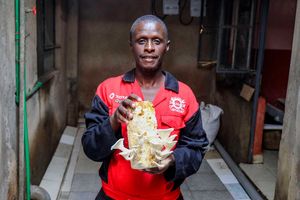
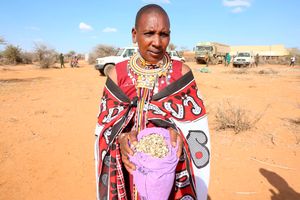
For farmers, the labour required to dry mushrooms makes the process unattractive, meaning the produce that fails to find a fresh market is discarded. It is this gap that Vera wants to address through processing.
Her journey into mushroom farming began several years ago after she left employment in the hospitality industry, where she worked as a bar and restaurant manager.
The long working hours pushed her to consider building a business of her own. “I was employed, but I always knew I wanted to do business,” she says.
She first tried her hand at yoghurt but struggled to understand the business model and cash flow. After about a year, she decided to explore mushroom farming after a friend introduced her to the enterprise.
She started in her mother’s laundry room, using a space of about 10 by 10 feet. “My seed capital was a Sh100, 000 loan, which I repaid within one year of mushroom farming,” she says.
Her first production yielded about 100 mushroom bags, and money generated from this was reinvested into additional bags, allowing gradual expansion. Today, her mushroom operation occupies about half an acre. The company is also involved in other parts of the mushroom value chain, including selling oyster mushroom spawn, compost and mushroom-growing bags.
The young agripreneur now employs five people, having started the business as a one-woman operation where she handled planting, harvesting, processing and packaging.
She plans to add three more employees before the end of the year and eventually introduce contract farming so that farmers can supply mushrooms, pumpkins and carrots specifically for processing. The expansion is being driven by demand that the company is currently unable to fully meet.
One of its first large orders was for about 2,000 packs, but the business could only supply 600 because of limitations in capital and labour. Vera deliberately chose gradual expansion rather than rapid growth, increasing production in small steps and stabilising each level before moving higher.
Challenges of mushroom farming include bacterial and viral infections, while pests such as small flies and snails can damage the crop. Because chemical treatment is unsuitable for mushrooms intended for consumption, an infected crop may have to be discarded. To reduce the risk, Vera staggers production instead of planting one large batch at once. Her experience has also changed her understanding of entrepreneurship.
“When I started selling the fried mushrooms, I never thought we could do something like mushroom crisps,” she says.
She says that getting started before everything is perfect, remaining resilient during difficult periods and building a network of fellow entrepreneurs are among the valuable lessons she has learnt.
Her next phase, she says, is to increase production while moving more of her mushroom harvest into value addition. Vera wants the company to supply the fresh produce market while reserving a growing share of its production for crisps and other processed products.