For years, contractor Gakuru Muraguri watched newly completed public projects he had helped build lose their sheen within months of completion as roofing sheets faded prematurely, leaving new buildings looking weathered long before their time.
The deterioration challenged his belief that buildings should be built to endure and retain their value for generations.
Rather than accept premature deterioration as an unavoidable industry problem, Muraguri spent much of 2024 investigating the underlying causes.
His research took him beyond Kenya's construction sites and into the global steel supply chain, where he examined how raw material specifications, protective coatings and manufacturing processes influence product performance.
Juja Mabati Factory Limited Founder and CEO Gakuru Muraguri poses with a selection of roofing sheets and products at the factory in Juja, Kiambu County, on August 13, 2026. The factory produces roofing sheets in various colours, designs and profiles.
Photo credit: Bonface Bogita | Nation
The investigation eventually led him to China, the world's largest producer and exporter of steel, where he sought to understand why products supplied to different markets appeared to deliver varying levels of performance over time.
The findings reshaped Muraguri's understanding of the industry and informed the establishment of Juja Mabati Factory.
"Steel coils form the foundation of every corrugated sheet, making the composition of the substrate and its protective coatings fundamental to the lifespan of the finished product," he says.
The research challenged his earlier assumption as a contractor that imported steel delivered comparable performance regardless of origin. He concluded that manufacturers produce steel to different technical specifications based on customer requirements and price points.
"China manufactures for every market. If a buyer wants the lowest price, manufacturers can produce to that specification. If the buyer requires a higher specification, that is also available. The difference is determined long before the steel reaches the factory," he says.
The company has since built its procurement strategy around sourcing higher-specification steel coils from suppliers it believes meet more demanding quality standards, despite the additional costs and longer lead times involved.
"Such lead times require careful demand forecasting and tie up substantial working capital in inventory before products are converted into revenue," he says, adding that maintaining sufficient stock levels while protecting cash flow remains a delicate balance for a young manufacturer.
Muraguri views the additional costs as a necessary investment in building a quality-focused brand, with customers increasingly assessing construction materials based on lifecycle value rather than initial purchase prices. He recalls construction projects where delays in receiving roofing materials extended timelines, increased labour costs and disrupted project delivery schedules.
Those experiences influenced the company’s emphasis on supply reliability, with the company promising delivery of stocked products within 48 hours in an effort to address one of the construction sector's persistent bottlenecks. Muraguri says the emphasis on delivery speed stems from a distinct commercial strategy.
Rather than simply supplying materials, the goal, he says, is to solve operational inefficiencies across the construction sector.
The factory's manufacturing process begins with the importation of coated steel coils from China, the primary raw material used in producing corrugated sheets. Once the coils arrive at the plant, they undergo slitting and roll-forming through specialised profiling machines that shape the steel into different designs before being cut to customer specifications. The finished products are then inspected, packaged and prepared for delivery.
He says the sourcing decision is critical to maintaining consistency throughout the manufacturing process, from raw material preparation to the final product. The company has diversified its product portfolio and now manufactures five lines, including box profile sheets, Decrastone-coated finishes, corrugated profiles, matte-finish designs and Roman tile styles. Depending on the profile, gauge and coating specifications, its products retail from approximately Sh250 per metre to Sh630per metre.
The company also supplies related accessories, including roll tops, washers and nails. The experience gained from working with contractors has shaped Juja Mabati Factory's longer-term growth direction.
Juja Mabati Factory Limited Founder and CEO Gakuru Muraguri checks the production of roofing sheets at the company’s production facility in Juja, Kiambu County, on August 13, 2026.
Photo credit: Bonface Bogita | Nation
The factory currently employs 12 people across manufacturing, logistics, sales and administration, with the workforce expanding in line with production requirements.
Muraguri attributes much of the company's development to a decentralised management structure built around autonomy, accountability and trust. Rather than closely directing day-to-day operations, he prioritises recruiting individuals capable of exercising judgement within their respective roles, allowing management to focus on longer-term strategic priorities.
"I hire smart people so they can tell me what we should do next. If I have to tell everyone exactly what to do every day, then I have probably hired the wrong people," he notes.
He says the structure encourages initiative and problem-solving among employees while ensuring decisions are made closer to where operations take place. Rather than concentrating on individual shortcomings, Muraguri prefers assigning responsibilities based on employees' strengths, a practice he says has contributed to stronger engagement and organisational performance.
"The market is gradually placing greater emphasis on lifecycle value, particularly as developers and project owners seek to minimise future replacement costs, maintenance requirements and construction disruptions," he notes.
While roofing remains its principal business line, the company is adding complementary construction inputs, including structural steel, gutters and gypsum products, as it seeks to transition from a specialised manufacturer into a broader construction materials enterprise. The expansion aims to give customers a wider range of solutions while reducing reliance on a single product category.
"Having operated on both sides of the value chain, manufacturers often underestimate the financial impact of unreliable supply.
Delays in receiving materials can translate into idle labour, extended equipment costs and postponed project handovers, pressures that can quickly erode construction margins," he says.
Like many manufacturers, however, the company has faced the financial pressures that come with extending trade credit as it has grown. Contractors frequently seek payment terms after receiving materials, effectively shifting part of the financing burden to suppliers, he explains.
Managing receivables remains a critical operational challenge, with raw materials often requiring payment well before finished products generate revenue, creating a working-capital gap that manufacturers must carefully manage.
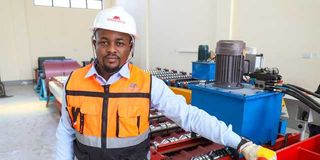
Juja Mabati Factory Limited Founder and CEO Gakuru Muraguri at the company’s production facility in Juja, Kiambu County, on August 13, 2026, where he is pictured beside machinery used in the manufacture of roofing materials.
Photo credit: Bonface Bogita | Nation
He continues to cultivate relationships across the construction and manufacturing sectors, viewing partnerships and industry networks as important drivers of market credibility.
As competition intensifies among local roofing manufacturers, he believes reputation will increasingly depend on product performance, reliability and customer confidence. His experience has also shaped a measured view of manufacturing as a long-term investment.
“Entrepreneurs entering the sector often underestimate the capital requirements, operational demands and patience needed to establish a sustainable manufacturing operation. The early years are typically defined by process refinement, supplier development and building market trust before meaningful returns emerge,” he notes.
Looking ahead, the company plans to increase production capacity, strengthen its distribution network across Kenya and neighbouring markets, and build the operational infrastructure required to support expansion.
The long-term objective is to establish Juja Mabati Factory as a recognised regional manufacturer of construction materials, competing on supply reliability, operational efficiency, and service delivery rather than price alone.
"People think they can open a factory today and tomorrow it will pay their rent or finance their lifestyle. Manufacturing does not work that way. It takes years to overcome the challenges, build systems and eventually reach the point where the business begins to reward the investment."