On the outskirts of Nairobi at Ruai bypass, lorries reverse into a yard, their cargo consisting of rough stone blocks hauled from Kilifi, Mombasa, western Kenya, and inland quarries.
Within minutes, the blocks are placed under a diamond-tipped blade, which begins a steady, high-pitched cut. Slabs fall away in measured sheets, ready for trimming, splitting, or dispatch to building sites across the country. The yard belongs to Blessed Ventures Mazeras, a small natural stone processing firm founded by civil engineer Anthony Maina. Its output — mazeras cladding, coral, silver, and other decorative varieties — feeds into a construction sector that has grown steadily on the back of urbanisation, infrastructure expansion, and sustained housing demand.
“Kenya’s property market has evolved beyond the race to erect concrete frames. Increasingly, developers compete on finish. Boundary walls are articulated rather than plastered flat,” he says.
Apartment entrances are framed with textured panels rather than painted in neutral tones, while outdoor spaces are landscaped with cabro and pebbles. This trend indicates a market that is becoming increasingly sophisticated, where buyers scrutinise presentation as closely as price and floor area.
Maina says the gap he identified was not the lack of materials itself, but the absence of order.
“Natural stone has always been in the ground, but developers struggled with inconsistency — irregular sizing, unpredictable supply, and colour variations. Construction timelines do not accommodate that level of uncertainty,” he explains. Before starting the company, he worked as a civil engineer in residential and commercial construction, where he encountered persistent sourcing challenges. Contractors relied on informal suppliers, resulting in inconsistent deliveries and materials that often failed to meet specifications.
"Projects are frequently delayed because materials do not meet specifications. There is a clear need for a reliable supply, but the supply chain is inefficient," he notes.
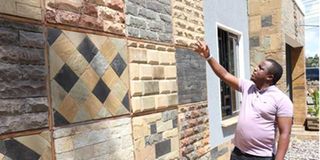
Blessed Ventures Mazeras office and showroom in Nairobi, pictured on March 4, 2026. The building is specifically designed to showcase a variety of natural stone products, including different varieties of Mazeras stones used for wall cladding and floor finishes.
Photo credit: Bonface Bogita | Nation Media Group
He launched the business with roughly Sh1.2 million from savings and family support, securing a rented yard, basic cutting equipment, and his first consignment. Initially serving individual homeowners, the firm operated project-by-project, with cash flow heavily dependent on contractor payments, often delayed for months.
“Late payment is just part of the game. You quickly learn to be disciplined with your working capital; otherwise, work stops,” he says.
Mazeras blocks come in black, grey, brown and sky blue. Coral, prized for its porous texture and ideal for external cladding, comes from Kilifi and Mombasa counties, silver from western Kenya, ruby varieties from the east, and wood-textured blocks from inland areas. Extraction methods vary by site, with some quarries using mechanically driven cutters and others relying on more labour-intensive techniques.
“The quality of the block at the quarry is critical for efficient processing in our Nairobi yard. Fractured blocks increase waste, and irregularly cut blocks create challenges in producing standard-sized slabs,” he explains. At the yard, the blocks are manually offloaded and inspected for cracks before being fed into a primary saw, which cuts them into slabs of uniform thickness. Because Mazeras is relatively soft, it is split along its natural lines to produce a roughly textured facing for cladding. Harder varieties require longer cutting and trimming times.
“Each type reacts differently under the blade. You cannot apply the same pressure or speed to every piece; wastage must be factored in,” he observes.
Dust control, blade maintenance and calibration are constant priorities. Many machine components are imported, exposing the business to currency fluctuations. Maina explains that equipment prices depend on the exchange rate. When the shilling weakens, repair costs increase. Completed units are then sorted according to client requirements before installation. Professional installation and operations are handled by a core team of four full-time employees, supplemented by contractors and daily labourers as workloads increase.
Pricing depends on colour, rarity and processing intensity. Standard Mazeras cladding ranges from Sh1,000 to Sh1,500 per square metre, coral averages Sh2,000, while premium silver and ruby variants can fetch up to Sh3,000. For a medium-sized apartment block, cladding costs can run into several hundred thousand shillings.
“This represents a significant consideration for developers operating in a competitive market, where price-sensitive customers increasingly demand both aesthetics and affordability,” he explains.
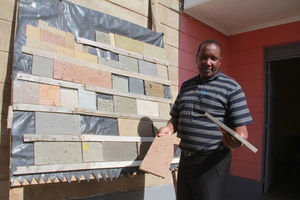
Machine-cut Mazera stones for sale at Blessed Ventures Mazera along Ruai Bypass, off the Eastern Bypass in Nairobi, on March 4, 2026.
Photo credit: Bonface Bogita | Nation Media Group
Stone is primarily a finishing material applied over concrete or masonry to enhance both durability and appearance. In mid- to high-end housing, finishing quality can influence how quickly units attract buyers or tenants.
“This is not a structural component, so you do not construct your frame with it. It is for finishing and for the longevity of its presence on the surface,” he says.
The pattern of demand follows broader trends in Kenya’s real estate market. Younger developers building townhouses and low-rise apartment blocks have become regular clients, paying close attention to finishing to distinguish their projects within dense residential areas. Hotels and resorts also contribute to the business, selecting external finishes to complement landscaping and overall design schemes.
Stone remains a premium finish and is often reconsidered when project financing tightens. Developers may substitute paint or tiles when budgets shrink. “Ultimately, it is a financial decision.”
Competition comes from both the informal and formal sectors, with informal traders offering cheaper, uncut blocks that lack standardisation and reliability. At the same time, imported engineered claddings or tiles are available at comparable prices, although their initial costs are often higher.
“Pressure for lower prices is high. Reliability also commands a premium, and contractors favour assured specification delivery,” Maina notes, adding that operational challenges extend beyond competition.
Limited access to affordable credit makes investment in automated cutting lines capable of increasing both volume and precision, while rising fuel prices and transportation costs further squeeze profit margins.
“With more cutting lines, we could double or triple production and quality, but equipment is expensive, imported at premium dollar rates, and loan interest is a significant factor,” he says.
Ongoing housing demand, particularly in urban and peri-urban areas, continues to support construction activity, while new infrastructure projects such as bypasses and highways open up additional residential zones. At the same time, macroeconomic variables, including exchange rates, interest rates, and political cycles, continue to have a strong influence on growth.
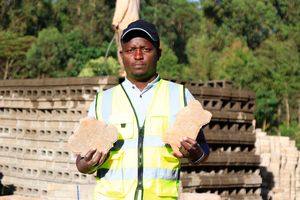
Anthony Maina, founder of Blessed Ventures Mazera at his business premises in Nairobi on March 4, 2026.
Photo credit: Bonface Bogita | Nation Media Group
Consistent supply remains a structural challenge. Quarrying practices differ widely, and careless extraction increases breakage during cutting. Some sites operate informally, lacking traceability and proper environmental management.
“We do not control how the blocks are extracted, and that affects wastage on our end. Poorly extracted material can break during cutting, which is a direct loss for us,” he notes.
The company processes several tonnes weekly during peak periods and cuts stone strictly against confirmed orders to avoid holding costly inventory, as large stock carries risk, he says.
To reduce the impact of market fluctuations, the company has diversified into walling with Mazeras, flooring in granite, marble and terrazzo, as well as cabro paving and outdoor structures.
They have completed projects in Nairobi, Kiambu, Kisumu, Eldoret, coastal towns, and occasionally in Uganda and Rwanda. Maina acknowledges that expanding into new territories requires thorough documentation and adherence to quality standards for cross-border tenders.
He notes that limited regulatory oversight of quarries affects quality and compliance, while formalising the sector could yield significant benefits. Any expansion in production, machinery, or property development will depend on consistent demand, access to financing, and reliable supply.
“Construction can be unpredictable, accelerating at times and slowing at others, so investment will proceed only if market conditions remain favourable,” he says.