France says it is ready to finance the rollout of Nairobi’s Bus Rapid Transit (BRT) project, signalling that the remaining hurdle is a green light from Kenya’s Cabinet.
Through Agence Française de Développement (AFD), Paris is backing Line 3 with loans and technical assistance to decongest the capital using zero-emission electric buses.
AFD has already put technical muscle on the table, including a Sh227.6 million (€1.5 million) grant for implementation support, while co-financing the project under a Team Europe package with the European Investment Bank (EIB) and the European Union (EU).
The financing package publicly outlined by European partners combines Sh6.83 billion (€45 million) in EU grants with concessional loans from the EIB and AFD, alongside a counterpart contribution from the Government of Kenya—bringing the total indicative financing to roughly Sh52.75 billion (€347.6 million).
AFD’s Country Director in Kenya, Anne-Gaël Chapuis, said the decision now rests with Nairobi. “The ball is not in our hands but with the Government of Kenya,” she said, adding that French approvals for the financing are already in place and AFD is currently funding technical assistance to keep the project moving.
Under the prevailing co-financing structure, European partners have signalled a financing mix of grant and concessional loan.
Paris’s push is part of a broader climate and infrastructure track that France has cultivated with Kenya since President Emmanuel Macron’s landmark March 2019 visit—the first by a French head of state to Nairobi—when he co-hosted the One Planet Summit and pledged deeper, greener economic ties.
France frames the BRT as a flagship of this cooperation: an urban-mobility project that pairs concessional capital with technical standards for e-fleets, safer stations and modern fare systems.
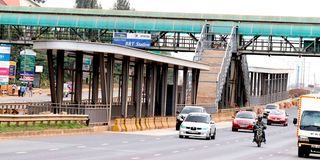
A red line showing the Bus Rapid Transit (BRT) along Thika Road in Nairobi in November 2018.
Photo credit: File | Nation
For Nairobi, the Cabinet’s pending sign-offs will unlock procurement for civil works, depot and systems contracts, and e-bus operations that integrate existing operators under NaMATA’s oversight.
For France and Team Europe, moving to execution would convert years of preparation into visible gains—faster trips for commuters, cleaner air for the city, and a replicable template for electric BRT across the region.
France is Kenya’s third-largest bilateral financier behind China and Japan, with a big share of the money going into energy, transport and water projects.
The 175-kilometre Nairobi–Nakuru–Mau Summit road was set to be the largest French-backed project. However, the Sh168.26 billion ($1.3 billion) project was terminated by the Government of Kenya, which argued that the toll fees were prohibitive.
The cancellation hurt Kenya-France relations, which in recent years, particularly under retired President Uhuru Kenyatta, had been anchored on the project’s fruition.
Relations between Kenya and France blossomed under the Uhuru regime as the European nation shed vestiges of “La Françafrique”—a murky arrangement that bound France’s business and political interests with those of rulers of its former colonies, mostly in West Africa.