Kenya’s avocado exports are projected to grow in 2026, driven by rising global demand, expanded acreage and improved quality controls, according to the United States Department of Agriculture (USDA).
The USDA’s Foreign Agricultural Service (FAS) forecasts exports to increase by about 7.4 per cent, supported by the resumption of sea shipments, entry into new markets and a shift to high oil-content varieties preferred internationally.
Production is expected to rise by 4.8 per cent to 727,000 tonnes in 2026, up from earlier estimates, on the back of improved yields and expansion of land under cultivation.
“FAS Nairobi projects Kenya’s avocado production to expand by 4.8 per cent in 2026 to 727,000 tonnes, supported by expanded area and yield recovery in key production zones,” the agency said.
Kenya, Africa’s largest avocado exporter, ships more than 60 per cent of its produce to Europe and the Middle East, with sea transport accounting for the bulk of exports due to its cost efficiency for large volumes.
With improved regulation, expanding markets and rising farmer interest, Kenya’s avocado sector.
Photo credit: File | Nation Media Group
The area under avocado cultivation is projected to increase by 5.6 per cent to about 37,600 hectares, as more farmers switch from traditional crops such as maize and tea to avocados, which offer higher returns.
“The outlook for avocado production in Kenya remains optimistic, bolstered by generally favourable weather and ongoing improvements in farm management practices,” the USDA said.
The positive outlook follows strong growth in recent years. Production rose by 34 per cent from 632,953 tonnes in 2023 to 848,122 tonnes in 2024, driven by expansion into new regions and sustained international demand.
The European Union remains Kenya’s largest market, followed by the Middle East and China, where exports have steadily increased since market access was granted in 2022.
However, the sector faced disruption in 2025 when the government temporarily suspended sea exports to curb the shipment of immature fruit that had raised quality concerns among international buyers.
The Agriculture and Food Authority (AFA) reopened the 2025/2026 export season on April 2, 2026, after confirming improved fruit maturity across key growing regions.
The regulator has since introduced stricter measures to safeguard quality. Exporters must now undergo mandatory packhouse inspections, submit lists of registered suppliers and comply with traceability requirements linking produce to its source and harvest period.
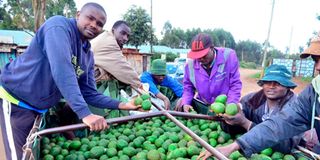
Loaders pack avocados into sacks at Ngariet trading centre in Sotik on March 4, 2026.
Photo credit: Boniface Mwangi | Nation Media Group
Authorities have also banned the use of open trucks and pickups to transport avocados, while farmers found harvesting immature fruit risk losing their licences.
The measures come amid increased scrutiny from key markets, including China and the European Union, which have raised concerns over quality standards.
Avocados remain Kenya’s leading fruit export, ahead of pineapples, mangoes, raspberries, passion fruits and lemons.
Production is concentrated in about 30 counties, mainly in the central highlands and surrounding regions. Murang’a leads in output, followed by Meru, Nyamira, Kisii, Nakuru, Kiambu, Nyeri, Kirinyaga and Embu.
The crop is also gaining ground in Uasin Gishu, Nandi, Trans Nzoia and parts of western Kenya, reflecting its growing importance as a commercial crop.
With improved regulation, expanding markets and rising farmer interest, Kenya’s avocado sector is poised for sustained growth, reinforcing its position as a key player in the global horticulture trade.