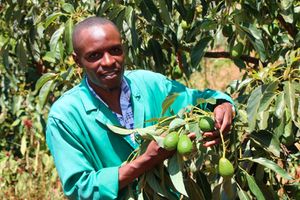
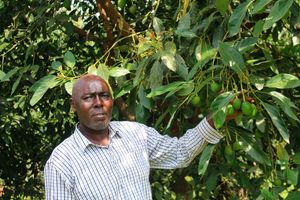
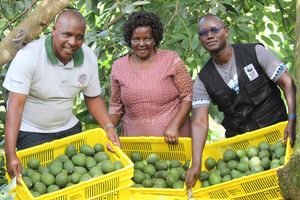
Isaiah Cheruiyot, sorts out avocado fruits before making a purchase at Kapingoken village, in Sotik, Bomet County on March 11, 2026.
On a chilly Saturday morning, Judy Chepkoech Chumo, a widow, leads two casual workers to pick green tea leaves at her half-acre farm.
Carrying gunny bags, they wade through the bushes picking the standard two leaves and a bud before the sun grows stronger and slows down their work.
Lost in thought, Judy plucks the green leaves without engaging the casual workers who are chatting nearby. She appears to regain her composure moments later, a smile crossing her face.
Judy Chepkoech Chumo, a farmer at Kimoso village in Sotik Constituency displays an avocado tree seedling for planting in this photo taken on March 11, 2026.
Judy is among the members of the AIC Kimoso Widows Self-Help Group in Sotik Constituency, Bomet County. The group brings together 360 widows, some of whom are small-scale tea growers, but who, in the spirit of diversification, have embraced growing avocado in the Rift Valley region.
Some farmers are inter-cropping tea and avocados, while others are uprooting tea altogether. A number are also reducing the acreage under tea as they seek alternative and more stable sources of income.
Bomet County is the highest tea-producing zone for small-scale farmers in the South Rift and also hosts the largest multinational tea plantations in the region.
Loaders pack avocados into sacks at Ngariet trading centre in Sotik on March 4, 2026.
“With the declining tea prices, we have decided to embrace avocados, which have huge market potential and better returns,” Judy says.
She reveals that she had planted 30 avocado seedlings on her farm within the past week. The seedlings were part of the 7,200 issued to the group by the county government and donors under the Financing Locally Led Climate Action (FLLoCA) programme.
Her decision to diversify was influenced by a visit to a farmer who was earning a good income from avocado farming, enough to educate his children and feed his family, something she felt tea farming could no longer guarantee.
“The cost of production for tea growers is increasingly rising, with tea pickers taking the lion’s share of Sh10 per kilogramme of green leaf, while the Kenya Tea Development Agency (KTDA) pays an average of Sh20 per kilogram,” Judy says.
“In effect, the farmer shares the gross income equally with the casual workers. But the farmer still has to pay for fertiliser, pruning and weeding, reducing the income further to between Sh5 and Sh7 per kilogramme,” she adds.
Betty Chirchir, a member of the AIC Kimoso Widows Self Help Group in Kaplong, Bomet County, displays avocado seedlings at her farm on March 11, 2026, which she is planting in place of tea bushes.
Betty Cherono Chirchir, another member of the group, says she decided to plant avocados after an agronomist explained the benefits on a Sunday afternoon after a church service.
“Apart from selling the fruits in the market, I realised one could also feed their family with them. The fact that I can practice inter-cropping with guidance from agronomists is an added advantage,” she says.
She has planted Hass avocado seedlings around her one-acre tea farm in Kimoso village, Sotik Constituency, combining environmental conservation with income generation.
The demand for Hass avocados in export markets has fuelled the expansion of avocado farming in most parts of the Rift Valley, which has favourable climate conditions for the crop.
Richard Maritim, a resident of Mugango village in Bomet Central, says he sourced 200 avocado seedlings from Kajiado County and planted them. Recently, he says, he earned Sh200,000 from fruits sold through a local cooperative society.
“I planted the seedlings at a spacing of seven by seven metres from one plant to the other and six metres between rows within my two-acre tea farm,” Mr Maritim says. “I was paid Sh200,000 for the produce, and I expect higher earnings in the next harvest season. I cannot get that kind of money from my one-acre tea farm in a year, which explains the shift to avocado farming.”
Mr Maritim says he uprooted two tea bushes to create space for each avocado seedling, but continues to harvest the remaining tea.
“The good thing about avocado is that one acre can earn up to a million shillings per year if good crop husbandry is practised and the produce is sold to exporters through cooperative societies that leverage volumes for better prices,” he said.
Berur Cooperative Society Chairperson Festus Ronoh confirms a noticeable shift as farmers scale down tea farming and expand avocado production.
“In Bomet and Narok counties, land under avocado trees has increased over the past six years, with exporters turning their attention to the region. Farmers, however, still require support from agronomists to improve the quality of their produce,” he says.
Bomet Governor Hillary Barchok said that under the county government and FLLoCA programme, a total of 125,000 avocado seedlings have been distributed to farmers.
“We are encouraging farmers to engage in avocado production on both commercial and subsistence scales to improve their incomes and boost food security,” Prof Barchok said.
The county government is also constructing an avocado pack-house in Boito, Konoin Constituency, an area traditionally known for tea farming but now witnessing increased avocado production.
Tea pickers at a farm in Sotik, Bomet County, in this photo taken on March 11, 2026. Farmers in the region are diversifying by planting avocados to replace tea as a major source of income.
Previously, the county distributed more than 150,000 avocado seedlings to farmers in the four sub-counties of Bomet East, Bomet Central, Sotik and Konoin under a separate subsidy programme. Chepalungu sub-county and parts of Sotik received 25,000 mango seedlings because the areas are not suitable for avocado farming.
Solomon Kimetto, the Chief Officer for Water, Environment, Natural Resources and Climate Change, said avocados offer both environmental and economic benefits.
“Apart from addressing health and nutrition issues, avocado is a high-value crop that also contributes to climate change mitigation while providing a significant income source for farmers,” Mr Kimetto said. He urged farmers to market their produce through cooperatives to strengthen their bargaining power with exporters.
Dr Kibet Sitienei, the Chief Officer for Agriculture, encouraged farmers to seek professional guidance.
“There is huge commercial potential for avocado production in the county. Both the county and national governments are partnering with stakeholders to support farmers and enable them to access certified seedlings so they can target the export market,” Dr Sitienei said.
KTDA Vice-Chairperson Mosonik Menjo urged farmers not to uproot tea bushes, saying reforms were underway to address challenges facing the sector.
“KTDA and the government are jointly addressing the issues affecting the tea sector, and we are confident that with the new leadership at the agency, farmers will eventually receive better prices for green leaf,” Mr Menjo said.
He added that the agency is promoting value addition before tea is sold in the international market, a move expected to improve earnings for small-scale growers.
Bomet East Constituency currently leads in avocado production in the South Rift region, but there has also been a significant increase in planting in Konoin and Bomet Central constituencies.
Follow our WhatsApp channel for breaking news updates and more stories like this.