Kenya’s flower export volumes dipped by a massive 12 per cent last year, revealing the impact of snubs by international airlines, which opted for more lucrative routes.
Fresh data by the Agriculture and Food Authority (AFA) showed that the volume of Kenya’s flower exports declined by Sh72.1billion from 116,273 tonnes in 2024.
“The corresponding export value dropped by Sh1.4 billion, primarily due to a combination of logistical and regulatory challenges,” said the AFA.
“One of the major contributing factors was the cargo crisis at Jomo Kenyatta International Airport (JKIA), exacerbated by the ongoing Red Sea security situation, which forced the diversion of shipping routes from the Suez Canal to the Cape of Good Hope.”
Several international airlines withdrew their freight services at JKIA in 2024, citing low returns and opting for more lucrative routes. For example, Qatar Airways withdrew two freighters carrying flowers from Nairobi to Liege, Belgium, resulting in a 200-tonne drop in capacity. Turkish Airlines removed one freighter per week service from Nairobi to Maastricht, Netherlands, affecting flower exports by a further 100 tonnes.
Most of Kenya’s flowers are sold to the Netherlands (about 70 per cent), followed by the UK. Other significant markets are Germany, Italy, and France.
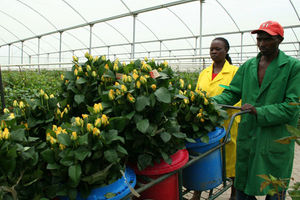
A worker packs flowers for export at Finlays in Naivasha, Nakuru County
The snub of Kenya last year came as cargo airlines enjoyed hefty returns on key routes such as Asia. For instance, from Asia to the US, the cargo airlines got up to $8(Sh1,033.92) per kilogramme, compared to Kenya, they were getting from $2.5 (Sh323.10) to $2.8(Sh361.87) per kilogramme.
Kenya’s export of flowers has been heavily dependent on rose flower exports, whose market share has been shrinking over the years. However, it still accounted for about 70.2 per cent of the total value of flower exports in 2024.
“In 2024, flowers remained Kenya’s leading horticultural export, generating Sh72.1 billion, which accounted for 53 per cent of the total export value. This marks a slight decline compared to Sh73.5 billion in 2023, where flowers comprised 47 per cent of the total export value,” said the regulator.
The transport disruptions led to increased global demand for airfreight cargo space, particularly for high-value perishables such as fruits. As a result, flower exporters faced elevated airfreight costs, squeezing profit margins. Additionally, stricter European Union (EU) phytosanitary regulations have significantly impacted Kenya’s flower exports.
“In particular, the EU’s intensified monitoring for false codling moth resulted in 95 export rejections and 48 interceptions in 2024 alone” said the AFA.
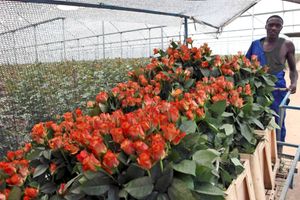
Workers at the Maridadi Farm in Naivasha, prepare rose flowers for export to Europe.
Photo credit: File | AFP
These incidents affected approximately 2.1 million stems of flowers, with an estimated value of €1.1 million (Sh167.17million),” said the AFA.
“As part of heightened border surveillance, roses from Kenya are now subjected to increased inspection rates at EU entry points, with the border check rate rising from 10 per cent to 25 per cent. Compliance with these stringent phytosanitary measures has imposed a substantial cost burden on growers.”
These higher costs to farmers include investments in insect-proof netting, additional labour, and staff training on pest detection and mitigation at the farm level.
“As part of heightened border surveillance, roses from Kenya are now subjected to increased inspection rates at EU entry points, with the border check rate rising from 10 percent to 25 percent. Compliance with these stringent phytosanitary measures has imposed a substantial cost burden on growers,” it added.
These higher costs to farmers include investments in insect-proof netting in greenhouses, additional labour, and staff training on pest detection and mitigation practices at the farm level. Growers are currently working towards full compliance, with the EU deadline set for April 26,2025.