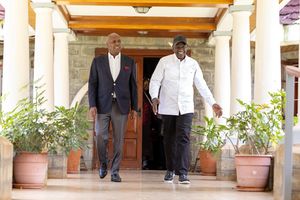
President William Ruto has sought to take a different path from that charted by his predecessor, Uhuru Kenyatta, with a first term that seeks to create a legacy through housing, food security initiatives, and community-based projects.
While he has extended a trajectory set by Mr Kenyatta in huge investments in roads, a look at the current government’s priority projects reveals a changing look of Kenya’s economic direction - one that seeks to cement the legacy of President Ruto around his affordable housing programme, MP-patronised projects and food productivity.
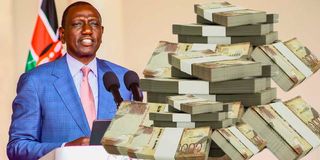
By the time his first term ends next year, the President will have spent Sh1.2 trillion on roads, housing, food security initiatives, and projects implemented through the National Government Constituency Development Fund (NG-CDF).
This will be about 47 per cent of the Sh2.8 trillion the current government will have put into projects since coming into office in 2022, underlining its focus around the sectors.
It would mean that for every Sh100 put into projects over the five years President Ruto will have been in power, Sh47 will have gone into roads, housing, fertiliser and seed subsidies, and NG-CDF projects such as school infrastructure and police stations.
Workers offload bags of fertiliser at the National Cereals and Produce Board depot in Eldoret, Uasin Gishu County.
Photo credit: File I Nation Media Group
This is a stark deviation from the economic areas Mr Kenyatta created a legacy around, which were majorly in roads, railway, power and health sectors.
The fourth President splashed Sh1.6 trillion in the four sectors in his final term in office, looking at the budgets from 2017/2018 to 2021/2022.
While the two leaders have had roads as their biggest focus in funding projects, actual spending in the current administration has dropped by nearly a third of what Mr Kenyatta spent during his 2017-2022 term.
President William Ruto lays the foundation stone for the construction of affordable housing units in Buuri, Meru County, on January 25, 2024.
Photo credit: Courtesy | PCS
Over the five financial years between July 2017 and June 2022, the government splashed Sh862 billion for the construction, maintenance and rehabilitation of roads.
“A total of 5,324 Km of roads were added to the existing road network, 59 new bridges were constructed, 333 Km of existing roads were rehabilitated, and 120,144 Km of roads were maintained,” previous budget documents show, covering just three years to June 2022.
Annual spending on roads during Mr Kenyatta’s second term in office averaged Sh172 billion, peaking at Sh214 billion in 2020.
By June 2027, when President Ruto’s last full financial year in office ends, he will have spent Sh590 billion on roads, about Sh271 billion less than Mr Kenyatta spent in the term to 2022.
Spending on roads between July 2022 and June last year averaged Sh87.8 billion, with the highest spending of Sh101 billion in the 2024/2025 fiscal year, falling below the lowest spending of Sh121 billion during the 2017–2022 period, budget documents show.
President William Ruto launches the dualling of 175km Rironi-Mau Summit road at Mau Summit in Nakuru County on November 28, 2025.
Photo credit: Boniface Mwangi | Nation Media Group
Should the government spend on roads according to current budget projections, the sector funding will average Sh118 billion over the five years to June 2027, about Sh54 billion less annually.
While President Ruto has been less enthusiastic on roads as was his predecessor, he has, however, gone full throttle in the implementation of affordable houses, and will have splashed about Sh220 billion into the programme by June 2027.
During a speech after signing the Finance Bill 2026 last Tuesday, he maintained that the initiative remains one of his government’s major focus areas, with a Sh138 billion commitment for the affordable housing and urban development in 2026/27.
“Affordable housing remains a key pillar of our economic transformation, with 274,000 housing units under construction and more than 640,000 jobs supported directly and indirectly,” President Ruto said.
The current administration has scaled up the implementation of affordable homes since coming into office, through more funding after introducing the housing levy for formal workers.
Through the programme, it is constructing thousands of houses for low-income Kenyans, institutional housing units, hostels for university and college students, and markets.
The growing focus in the housing sector has been witnessed through government budgets, which have grown from Sh64.2 billion over three years to 2022, to Sh102 billion over a similar period to June 2025.
Annual spending on the sector has exploded from a modest Sh26.6 billion during Mr Kenyatta’s tenure to a high of Sh138 billion proposed during the fiscal year starting July 1.
Another area where President Ruto has shown a keen interest has been the implementation of projects patronised by MPs, mostly run under the NG-CDF.
The initiatives, which include school infrastructure such as classrooms, laboratories and other infrastructure, police stations and smaller projects such as boda boda sheds, have formed part of huge budgetary recipients since 2022.
Implemented under the State Department for Economic Planning, the projects under community development will have used upwards of Sh278 billion by the end of June next year, the second-highest amount after roads.
“The overall actual expenditure amounted to Sh51.1 billion in FY 2022/23, Sh50.1 billion in FY 2023/24 and Sh74 billion in FY 2024/25,” the state department notes in budget documents.
Funding to MP-patronised NG-CDF has won the President's favour with legislators, who often get an opportunity to use a good chunk of the funding to issue school bursaries, often in pursuit of political mileage among the electorate. In the agriculture sector, the government has focused on budgetary allocations towards seed and fertiliser subsidies, and other initiatives aimed at attaining food security.
The State Department for Agriculture says it provided 1.1 million tonnes of fertiliser to some 3.16 million farmers over three years to June 2025.
“We have set aside Sh20 billion for seed and fertiliser subsidies, up from zero funding in 2022. Already, 6.5 million farmers are benefiting,” the President said on Tuesday.
By the end of June next year, the current government will have spent Sh103 billion on food security initiatives such as the fertiliser subsidy, setting the initiative as one of its biggest focus areas during President Ruto’s 2022-2027 term in office.
The spend by President Ruto’s administration on housing, food security and constituency projects is a shift from his predecessor, whose economic priorities leaned towards transport, power and health.
During his final term in office, Mr Kenyatta spent Sh1.6 trillion to fund the three sectors.
Roads were Mr Kenyatta’s main legacy in power, and he spent Sh882 billion to fund their construction, maintenance and rehabilitation during his last five years in office.
During his tenure, some of the major roads he implemented were the Nairobi Expressway, several bypasses cutting across Nairobi and neighbouring counties, and he started the construction of roads such as the Nyeri-Marua.
The fourth President’s second focus was the construction of railway lines, where the standard gauge railway (SGR) project has gone down as potentially the project he is remembered for.
Implemented between 2013, when he came into office, the first phase of SGR between Nairobi and Mombasa was constructed during Mr Kenyatta’s first term, while its second phase, running 120 kilometres to Naivasha, came during the second term in office.
President Rut wants to leave a mark in housing and food security areas, whereas Mr Kenyatta’s biggest impact was in power and roads.
Overall, the government splashed Sh354 billion on railway projects between July 2017 and June 2022.
This follows the signing of the contract for the project by the China Road and Bridge Corporation (CRBC), and budgeting for the implementation starting in the next fiscal year.
M Kenyatta also left a mark in the distribution of electricity to households, where millions of Kenyans were connected to the national grid through the last-mile connectivity programme.
During his second term in office, the government spent Sh220 billion to fund power generation, transmission and distribution, setting the energy sector as his third biggest focus from a funding perspective.
The State focused on the drilling of a number of power generation plants while Kenya Power led a programme to expand connectivity to households, leaving Kenyans connected to the grid at about 9 million.
“Major achievements during the review period include installation of 165.4 MW of electricity generation capacity from Olkaria V geothermal power plant, 310MW from Lake Turkana wind power plant and 50MW from Garissa solar power plant. The number of customers connected to electricity increased by 1, 655,729,” the Ministry of Energy said in a three-year review to 2021.
Artist’s impression of Nairobi to Mau Summit toll road once it is completed
Photo credit: File
With the first term ending in a year’s time, he appears to have borrowed a leaf from his predecessor in the roads sector, where he is currently implementing the Rironi-Mau Summit road and making pronouncements on other roads across the country, but he appears to be reading from a different script in the other sectors Mr Kenyatta was keen on.