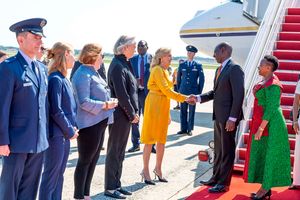
President William Ruto's arrival in Evian, France, for the G7 Leaders’ Summit has once again thrust into the spotlight his vigorous diplomatic agenda — praised by supporters as strategic economic diplomacy but criticised by opponents as an expensive and relentless cycle of foreign travel.
The visit, where he is expected to represent Africa and push for reforms in global finance, climate funding, trade and artificial intelligence governance, reinforces President Ruto’s growing profile as a continental voice on the international stage.
As Deputy President, he mostly confined himself to local politics, at one stage accused by his boss, President Uhuru Kenyatta, of ‘tangatanga’ (loitering) around the country.
On coming to office, Dr Ruto fashioned himself as the champion of the things that matter on the continent, including continental reform, intra-African trade, reform of the African Union, Africa's representation on global bodies, climate change, global financial infrastructure reform and multilateralism, among other areas.
While insiders say his decision to back the late Raila Odinga for the AU commission chair was part of his agenda to reform the organisation, with Kenya in charge, his critics saw it as an attempt to get rid of a potential competitor.
Dr Ruto is said to have started pushing for Raila to take over AUC back in 2017 when the Jubilee regime embarked on its second term.
State House says the President's invitation to the G7 meeting reflects Kenya’s strategic leadership role globally and the confidence the international community has placed in President Ruto’s advocacy for Africa’s interests.
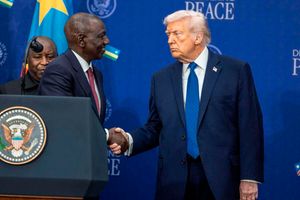
President William Ruto shakes hand with US President Donald Trump in Washington DC on December 5, 2025.
Photo credit: PCS
Yet back home, the trip has reignited a debate that has followed him since he took office in September 2022: Are the President’s numerous foreign visits yielding sufficient benefits to justify their cost, or has Kenya become accustomed to a head of state who spends too much time abroad?
The question has increasingly become a political fault line as critics accuse the president of overdoing international engagements while supporters argue that economic diplomacy is central to his administration’s development agenda.
They also say his counterparts have equally made several trips to Kenya and other competing nations.
From the onset of his presidency, Dr Ruto made it clear that foreign policy would be a key pillar of his administration.
Unlike some of his predecessors who focused largely on regional diplomacy, Dr Ruto quickly expanded Kenya’s engagement with major global powers, international financial institutions, climate forums and emerging economic blocs.
US President Donald Trump, French President Emmanuel Macron, Canadian Prime Minister Mark Carney, Italian PM Giorgia Meloni, Japanese PM Sanae Takaichi, European Commission President Ursula von der Leyen, European Council President Antonio Costa, German Chancellor Friedrich Merz, Egyptian President Abdel Fattah al-Sisi, South Korea's President Lee Jae Myung, India's PM Narendra Modi, Brazilian President Luiz Inacio Lula da Silva, Kenya's President William Ruto and British PM Keir Starmer during the G7 summit, in Evian-les-Bains, France, June 16, 2026.
Photo credit: Isabel Infantes | Reuters
His administration has pursued five broad objectives through foreign engagements: elevating Kenya’s global profile, attracting investments and trade opportunities, championing climate action, strengthening peace and security initiatives, and diversifying partnerships beyond Kenya’s traditional allies.
The approach has seen him travel extensively across Africa, Europe, Asia, North America and the Middle East.
State House has consistently argued that the trips are not ceremonial but are designed to unlock investments, jobs, market access and financing opportunities for Kenyan businesses.
Indeed, at the G7 Summit, President Ruto is expected to push for affordable access to capital, reforms of global financial institutions, climate financing and partnerships in digital technology and artificial intelligence.
“The engagements will also focus on attracting investments into manufacturing, renewable energy, infrastructure, agribusiness, healthcare, housing and digital services,” says State House Spokesperson Hussein Mohamed.
Voice for African nations
Prime Cabinet Secretary and Foreign Affairs Cabinet Secretary Musalia Mudavadi argues that President Ruto’s participation at the summit is a recognition of Kenya’s growing diplomatic stature.
“President Ruto has become a significant continental voice for African nations,” said Mr Mudavadi.
According to him, the President will use the three-day summit to articulate Africa’s position on debt, peace and security, climate change and the economic consequences of global conflicts, particularly the Middle East crisis, on African economies.
Kenya's President William Ruto, Kenya's first lady Rachel Ruto, European Commission President Ursula von der Leyen, and European Commission President's husband Heiko von der Leyen arrive before a family photo prior to a gala dinner as part of the G7 summit in Evian-les-Bains, France, June 16, 2026.
Photo credit: Ludovic Marin | Reuters
The President has addressed the United Nations General Assembly, participated in multiple climate conferences, attended summits of the World Economic Forum, the African Union, the United Nations Climate Change Conference (COP), and engaged leaders across Europe, Asia and North America.
Presidents William Ruto (Kenya) and Joe Biden (US) hold talks at the White House, Washington, DC.
Photo credit: PCS
This was a highly significant diplomatic milestone, as Dr Ruto was the first African head of state to receive an official state visit from the US in 16 years, following Ghana's President John Kufuor in 2008.
President Ruto’s administration has also aggressively marketed Nairobi as a regional hub for finance, technology, climate innovation and diplomacy.
The Africa Climate Summit hosted in Nairobi in 2023 elevated Kenya’s profile as a leader in climate action, while the recent Africa Forward Summit sought to consolidate a common African agenda on economic transformation, financial reform and digital development.
At the same time, Kenya has strengthened relations with Gulf countries, particularly Saudi Arabia and the United Arab Emirates, where thousands of employment opportunities for Kenyan workers have been negotiated.
The government argues that such engagements are impossible without sustained presidential diplomacy.
The President has emerged as one of Africa’s strongest advocates for climate financing, renewable energy and carbon markets.
He has repeatedly called for reforms in global financial institutions to make climate financing more accessible to developing countries.
His argument is that Africa contributes the least to global emissions but bears a disproportionate burden from climate-related disasters such as droughts and floods.
This position has earned him invitations to high-level climate and sustainability forums where he has consistently pushed for greater equity in global financing systems.
Supporters say the visibility has strengthened Kenya’s reputation as a leader in green growth and clean energy.
President Ruto has also sought to project Kenya as a stabilising force in regional and international security.
Kenya’s diplomatic profile
Under his leadership, Kenya has remained active in mediation efforts in Sudan, South Sudan and the Democratic Republic of Congo.
The Haiti mission significantly elevated Kenya’s diplomatic profile, placing Nairobi at the centre of an international security initiative backed by the United Nations and key Western allies.
Supporters argue that such engagements strengthen Kenya’s influence globally and reinforce its longstanding reputation as a regional peace broker.
State House says bilateral meetings held during international visits have resulted in investment commitments, trade agreements and financing arrangements across key sectors.
“I am not travelling as a tourist. I am travelling to organise Kenya’s affairs, create jobs and attract investments across the globe,” he said on Saturday, in response to criticism from opposition leaders.
Speaking recently in Finland, the President reiterated that he is Kenya’s “chief diplomat” and that international engagement is part of his constitutional responsibility as Head of State.
According to State House, his G7 engagements alone are expected to unlock opportunities in manufacturing, renewable energy, agribusiness, housing, healthcare, digital services and value-added exports.
Despite the government’s defence, criticism has intensified.
Opposition leaders argue that the President’s travel schedule has become excessive at a time when many Kenyans are grappling with high taxes, unemployment and rising living costs.
Former Deputy President Rigathi Gachagua recently accused the president of spending too much time abroad instead of focusing on domestic challenges.
“Anatembea kila siku,” Mr Gachagua remarked during a rally in Bungoma, questioning the frequency of the President’s travels and suggesting leadership requires a stronger presence at home.
Wiper Patriotic Front leader Kalonzo Musyoka has also questioned the value of some foreign engagements, arguing that international visibility should not come at the expense of addressing local problems.
Similarly, People’s Liberation Party Chief Martha Karua has challenged the government to disclose the full costs of presidential travel and compare them with measurable benefits generated from the trips.
Critics point to reports of large delegations accompanying the President on some trips and allegations that chartered aircraft have occasionally been used for long-haul travel.
The opposition argues that in a period of economic austerity, the government should minimise travel expenditure and prioritise domestic programmes.
Questions have also been raised about whether investment pledges announced during foreign visits eventually materialise into actual projects and jobs.
President William Ruto and his Korean counterpart Lee Jae Myung meet on the sidelines of the G7 Summit in France.
Photo credit: PCS
Analysts note that while diplomatic engagements often produce long-term benefits, governments must demonstrate clear outcomes to justify expenditure.
Belgut MP Nelson Koech, the Chairperson of the National Assembly's Departmental Committee on Defence, Intelligence and Foreign Relations, cautions against judging foreign travel solely by immediate financial returns, noting that this misses the broader picture.
“Kenya’s enhanced global visibility, expanded diplomatic networks, improved market access, and growing influence in international decision-making forums are positive for the country.”
The administration also credits diplomatic engagements with helping secure investment commitments in energy, manufacturing, housing, agriculture and technology.
The President’s defenders further argue that Kenya cannot afford diplomatic isolation in an increasingly interconnected world.
As Mudavadi notes, global issues such as debt, climate financing, trade barriers and regional security directly affect Kenya’s economy and require active engagement at the highest levels.
The debate surrounding Ruto’s diplomatic forays reflects a broader tension between global leadership and domestic expectations.
On one hand, Kenya has gained unprecedented visibility on the international stage, with President Ruto emerging as a prominent African voice on climate change, economic reforms and global governance.
On the other hand, many Kenyans facing economic hardships are asking about the tangible benefits of such travels.