President William Ruto’s ambition to run a government that “lives within its means” appears to have backfired, as he is set to close his first term in office with about Sh2.3 trillion loans that have no projects linked to them.
At the end of his last full financial year in office in June next year, Treasury will have borrowed over Sh5 trillion, looking at net borrowing, which the law requires to be used to fund development projects only.
Of the borrowing between July 2022 and June 2027, the government will have spent about Sh2.7 trillion on development projects, shows a Nation's analysis of borrowing and development spending records.
This will leave about Sh2.3 trillion of the cash borrowed by the government over the five years untraced to any project, a major backpedal for a government that swore to never borrow to pay salaries or fund other recurrent activities.
The Sh2.3 trillion debt used for recurrent activities over the five years is enough to fund about 11 roads of the Rironi-Mau Summit magnitude or fund Kenya’s health sector for 13 years, based on the 2026/27 budget estimates.
The Nation analysis shows that between July 2022 and April this year, the government borrowed Sh3.8 trillion from the domestic and external markets.
Over the same period, spending on projects and programmes was Sh1.9 trillion, meaning that half of the cash borrowed was used to fund recurrent operations in government, such as paying salaries and running offices.
The budget unveiled by Treasury Cabinet Secretary John Mbadi last Thursday also laid down plans to borrow Sh1.146 trillion in the year starting July, though spending on projects has been capped at Sh750 billion.
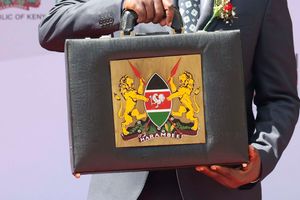
Cabinet Secretary for the National Treasury and Economic Planning John Mbadi displays his briefcase before reading the 2026/27 budget at Parliament Buildings, Nairobi, on Thursday, June 11, 2026.
Photo credit: DENNIS ONSONGO | NATION
“The fiscal deficit will be financed by net external borrowing of Sh116.2 billion equivalent to 0.6 per cent of GDP and net domestic borrowing of Sh1,030.1 billion, which is equivalent to 4.9 per cent of GDP,” CS Mbadi said.
Should Treasury stick to the original budget during the year, this will see President Ruto close his first term with a net borrowing of about Sh5 trillion, but just above half of this, Sh2.7 trillion, will have actually been used to fund development.
This marks a rude awakening for the Head of State, whose entry into office was marked by tough statements on how he would cut reliance on public borrowing as he pitched to the country a government that would “live within its means.”
In a speech delivered to mark the opening of the current Parliament in September 2022, the President castigated his predecessor, Uhuru Kenyatta, for leading a government that for a decade borrowed to accomplish its investment needs.
“This year alone, we budgeted to borrow Sh900 billion to finance both development and recurrent expenditure. The government should never borrow to finance recurrent expenditure. This is not right, prudent or sustainable. It is simply wrong. We must bring ourselves back to sanity,” the President told MPs.
He then instructed Treasury to institute austerity measures that would chop Sh300 billion from spending plans across ministries during his first year in office alone, promising further austerity in the coming years.
“Over the next three years, we must reverse this and go back to the situation where government contributes to the national savings effort by keeping recurrent expenditure below revenue,” he promised.
About four years later, the government appears not to have only grown its borrowing appetite, with a trend of taking loans to fund largesse extending from the previous administration.
It prohibits the government from using borrowed funds to pay salaries, allowances or fund other non-development activities.
“Over the medium term, the national government's borrowings shall be used only for the purpose of financing development expenditure and not for recurrent expenditure,” the Public Finance Management (PFM) Act of 2012 states.
The Nation analysis, however, shows that at the end of President Ruto’s first term in office, the government will have spent at least Sh2.3 trillion (46 per cent) of the new loans taken over the five years, funding recurrent activities.
This mirrors a trend set during former President Kenyatta’s tenure, where the public auditor also revealed that she could not pinpoint projects funded with Sh1.13 trillion borrowed over 11 years to 2021.
The current government came to office with a promise to rely more on taxes and private capital to fund its development agenda, criticising debt as a means of driving Kenya to the “upper middle-income country”.
“The era of financing every road, every power line, and every dam through government borrowing and taxation is over, not because we lack ambition, but because we have learnt from the consequences of that model,” CS Mbadi said last Thursday.
“We are shifting from a model where government borrows to build, to enhanced use of the Public Private Partnerships and the recently established National Infrastructure Fund in funding priority infrastructure through private sector finances,” he added.
The CS said this as he outlined a Sh4.82 trillion budget for the 2026/27 fiscal year that has gone heavy on borrowing with a plan to use Sh1.146 trillion loans to plug the financing gap, while at the same time allocating just Sh750 billion to development projects.
The difference between the current administration and the previous one is that this has gone heavy on borrowing from the domestic market, while the previous one borrowed heavily from external markets.
In the next fiscal year, for instance, Treasury plans to borrow Sh1.03 trillion from the domestic market and just Sh116 billion from external lenders.
The heavy reliance on domestic borrowing has not only raised the domestic public debt service but also served to further deviate from the Public Financial Management law, since much of the domestic borrowing is going to fund recurrent activities.
Interestingly, in the budget unveiled last week, Treasury is only invested in accounting for externally-funded projects, ignoring accountability for domestic debt-funded projects.
Members of the National Assembly follow proceedings during the presentation of the FY 2026/27 Budget Highlights by Cabinet Secretary for the National Treasury and Economic Planning John Mbadi at Parliament Buildings, Nairobi, on June 11, 2026.
Photo credit: Dennis Onsongo | Nation Media GroupTION
CS Mbadi said that Treasury has spearheaded the development of a “Development Project Management Information System” that will strengthen transparency in the implementation of externally funded projects.
“This innovative digital platform will serve as a centralised repository for real-time tracking of project implementation, monitoring of disbursements, and alignment of outcomes with national development priorities.
“By enhancing project oversight and accountability, this system represents a significant step forward in ensuring that externally mobilized resources are utilized effectively, and that every shilling delivers value for money and tangible impact for our citizens,” the CS said.
A similar pronouncement with regard to domestic debt, where the government owes more and spends even more on debt service, was, however, missing.
Experts have cautioned on the government’s growing reliance on domestic debt due to its high cost and short maturity periods as compared to concessional borrowing.
“Progressively, we need to look at domestic debt as a much bigger problem due to the accountability of how proceeds are used and factors such as the high interest and shorter maturity,” says Michael Oloo, an economist.
Mr Oloo, however, acknowledges the dilemma the government finds itself in as the window for external concessional borrowing closes, with the flowing funds coming with tough conditions.
As of the end of April 2026, domestic debt constituted 55.9 per cent of Kenya’s Sh12.85 trillion public debt, latest Treasury records show.