As President William Ruto consolidates power ahead of the 2027 polls, murmurs of betrayal are emerging from Kanu, raising fresh doubts over the fate of a political deal that was meant to return the Moi family to the centre of power.
The studious silence from State House, the absence of appointments and growing unease within Kanu have reignited questions over whether the political pact between Dr Ruto and Kanu Chairman Gideon Moi ever truly took off — or whether it has already unravelled.
What was billed as a strategic return of Kanu to the heart of government after a decade in the cold is now shrouded in uncertainty.
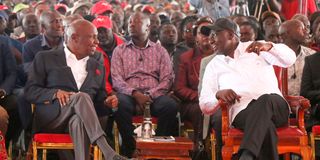
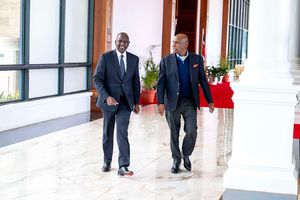
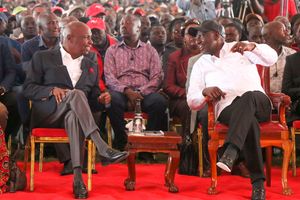
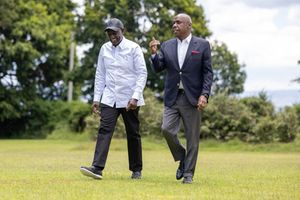
Kanu chairman Gideon Moi when he met with President Ruto at State House
Behind the public affirmations of cooperation lies growing frustration within Kanu ranks, with senior party officials accusing President Ruto of failing to honour commitments that persuaded Mr Moi to shelve his bid for the Baringo Senate seat and align the once-dominant independence party with the government.
“Kasongo alitucheza (Ruto played us),” a senior Kanu official told the Daily Nation on Tuesday, speaking on condition of anonymity due to the sensitivity of the matter.
“There was no written agreement, but the President made a commitment to bring us into government and give us positions. Our boss is not happy.”
According to the official, Mr Moi deliberately opted for a gentlemen’s agreement, resisting pressure to reduce the deal into writing.
“Chairman refused anything written. Gideon preferred to take Ruto at his word and even invited him to speak to his people,” the official said. “Now there is zero implementation. There is no indication anything will happen soon.”
The remarks lay bare the growing unease within Kanu, which believed it had struck a politically consequential bargain following President Ruto’s high-profile engagement with the Moi family last October.
Return to the centre of power
The original deal, insiders say, was brokered through the mediation of the late Raila Odinga and sealed after several meetings between President Ruto and Mr Moi, including one in Dubai. It was meant to mark Kanu’s return to the centre of power after years in political cold storage.
President William Ruto and Kanu chairman Gideon Moi after a meeting at State House, Nairobi.
Photo credit: PCS
The agreement also allegedly included the appointment of Kanu loyalists as principal secretaries and ambassadors, alongside the settlement of nearly Sh3 billion owed to companies linked to Mr Moi for geothermal works under the Geothermal Development Company (GDC).
Mr Moi, insiders say, was frustrated by delayed payments that left him exposed to tax demands from the Kenya Revenue Authority despite not receiving funds for completed work.
Should the deal be implemented, it could also trigger a broader government reorganisation, potentially elevating Mr Chirchir to chief of staff and head of public service — a move that would open space for Kanu’s entry into Cabinet.
The deal’s most visible outcome was Mr Moi’s abrupt withdrawal from the Baringo senatorial by-election, a move that stunned both supporters and rivals.
The Independent Electoral and Boundaries Commission (IEBC) had scheduled the poll for November 27, 2025, following the death of Senator William Cheptumo.
Former Baringo Senator Gideon Moi.
Photo credit: File | Nation Media Group
Yet on September 9, 2025, he failed to submit nomination papers — a day after meeting President Ruto at State House.
UDA’s Kiprono Chemitei went on to win the seat unopposed by Kanu, reinforcing perceptions that a political pact, similar to the one that saw Raila Odinga’s Orange Democratic Movement join government, had been struck.
At the time, multiple sources told Nation that Mr Moi’s withdrawal was part of a broader agreement that would see Kanu formally incorporated into the broad-based government through Cabinet, principal secretary and ambassadorial appointments.
Kanu Secretary-General George Wainaina, however, has moved to calm speculation that the deal has collapsed. Asked directly whether the agreement had died, Mr Wainaina declined to be drawn.
“We will give a comment in the course of next week,” he said.
He also dismissed claims that UDA hoodwinked Kanu into withdrawing from the Baringo race only to renege on its commitments.
“We were not conned and we are not stranded,” Mr Wainaina said. “We are in the broad-based government.”
Kanu Secretary-General George Wainaina at a past event.
Photo credit: Evans Habil | Nation Media Group
Pressed on the purported technical committee that was meant to operationalise the cooperation, the SG remained guarded.
“That’s what I have told you — we shall address that next week,” he said.
President Ruto’s UDA has similarly insisted that the cooperation remains intact. Party National Chairperson Cecily Mbarire on Tuesday said the delays were procedural rather than political.
“We only did the by-election at the end of November. December was short,” she said. “We are going to proceed after our grassroots elections this month.”
The exercise, scheduled for Saturday, is widely seen as a political litmus test ahead of 2027, especially in Mt Kenya, where support has softened following the impeachment of former Deputy President Rigathi Gachagua in October 2024.
President William Ruto (right) and his former deputy Rigathi Gachagua.
Photo credit: File | Nation Media Group
UDA National Elections Board chairman Anthony Mwaura told the Daily Nation that interest in the polls “has been overwhelming”, forcing the party to extend registration deadlines three times. By December 23, nearly 100,000 members had applied to contest for various polling centre-level positions.
Political observers say President Ruto’s immediate focus on consolidating his party machinery may be partly explaining the delay in accommodating Kanu — but that patience within Moi’s camp is wearing thin.
The delay had fuelled internal dissent within Kanu. Samburu East MP Naisula Lesuuda publicly criticised Mr Moi for withdrawing from the Baringo race without consulting party structures.
“Kanu is a big political party with structures from the grassroots to the national level,” she said. “It would have been better if he carried members along.”
Other insiders accused the Kanu chairman of acting unilaterally, deepening internal fissures even as the promised political dividends remain elusive.
Yet for President Ruto, the Kanu rapprochement fits squarely into his broader strategy of building a broad-based government — first formalised in March 2025 with ODM, following a framework agreement signed with the late Odinga at KICC, Nairobi.
That deal brought several ODM figures into Cabinet— including John Mbadi, Opiyo Wandayi, Wycliffe Oparanya, Ali Hassan Joho and Beatrice Askul, reinforcing Dr Ruto’s narrative of inclusivity.
“This is not about individuals or regions. It is about Kenya,” President Ruto said during his visit to Kabarak.
“I need more hands, and that is why I formed the broad-based government. Now I need Gideon to help me move the country forward.”
Whether that promise will translate into tangible appointments for Kanu remains the unanswered question.
For Gideon Moi, the stakes are high. A successful deal would restore the Moi family’s relevance and give Kanu a new lease of life. Failure, however, risks leaving the party more weakened, divided and exposed ahead of the 2027 elections.
As whispers of betrayal grow louder within Kanu, the fate of the Ruto–Moi pact may soon hinge on whether political goodwill, once extended on trust alone, can survive prolonged silence.
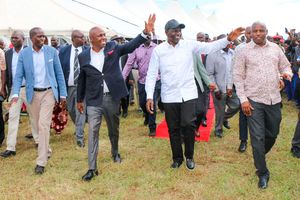
President William Ruto at Kanu Chairman Gideon Moi's Kabarak home on October 10, 2025.
Photo credit: PCS
For much of the post-2022 period, Mr Moi appeared politically stranded—overshadowed by President Ruto’s sweeping victory. He seemed weighed down by Kanu’s long and painful decline.
Once a formidable force that ruled Kenya for nearly four decades, Kanu had been reduced to a historical footnote, its revival under the junior Moi seemingly stalled by indecision and a shrinking support base.
But October 2025 had marked a quiet, calculated turning point—one defined less by rallies and rhetoric, and more by deals, symbolism and survival.
The breakthrough in October last year, came through a pragmatic rapprochement between Moi and President Ruto, sealing what insiders describe as a political survival pact rather than an ideological union.
After years of rivalry and open hostility, the two leaders appeared to have found a common cause.
President Ruto needed regional balance, institutional memory and symbolic closure to old Rift Valley rivalries; Moi needed relevance, protection and a clear path back to the national political table.
The result had been Kanu’s cautious re-entry into the political conversation—subtle, disciplined and strategic.
Under the pact, Kanu had avoided noisy declarations, choosing instead to rebuild from within government-friendly spaces.
That strategy was on full display late October when Mr Moi took the podium at the 2025 Democracy Union of Africa (DUA) forum in Nairobi.
He was not just a host, but a politician redefining his path. Beneath his philosophical reflections on Africa’s place in a changing global order lay a deeper political message: a careful justification for his new working relationship with President Ruto, which now remains in limbo.
Addressing a high-profile international audience that included former Ghanaian President Nana Akufo-Addo, South Africa’s Deputy Transport Minister Mkhuleko Hlengwa and senior officials from the Konrad Adenauer Foundation, Moi struck a tone of diplomacy and self-defense.
Long viewed as one of Ruto’s fiercest rivals within the Rift Valley political landscape, the Kanu boss had in recent months softened his stance—culminating in what insiders described as a working arrangement built around “national unity and development.”
The DUA forum, which ran between October 26 and 29, provided Moi the perfect stage to frame that partnership in ideological terms rather than raw political arithmetic.
Party Leader Gideon Moi makes his address on October 10, 2025 after President William Ruto visited Kabarak Home in Nakuru County.
Photo credit: Boniface Mwangi| Nation Media Group
“Africa must not be a spectator, but a strategic player by asserting its interests, redefining its partnerships, and shaping the terms of its engagement,” Moi said—words that, to keen listeners, doubled as a metaphor for his own repositioning in Kenya’s evolving political order.
He spoke of balance—between freedom and responsibility, between individual ambition and collective well-being—echoing themes that resonate with President Ruto’s narrative of bottom-up economic transformation and broad-based unity.
“At its heart, the centre-right philosophy is about building bridges, not walls; creating opportunity, not dependency; and advancing prosperity that leaves no one behind,” Moi added, signalling that Kanu’s return to national governance would be collaborative rather than confrontational.
It was not lost on political observers that days after the Ruto-Moi rapprochement, media outlets linked to the Kanu supremo, which had sustained critical coverage of UDA administration since 2022 elections, toned down and appeared to shift their focus away from the government.
Those close to the former Baringo Senator say the forum marked a strategic turning point for Moi, whose political star dimmed sharply after the 2022 General Election, but the uncertainty that has now shrouded his deal with president Ruto is the major cause for concern.