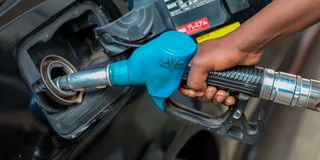
Energy Cabinet Secretary Opiyo Wandayi’s assurance that Kenya has sufficient fuel stocks has deepened confusion over the true state of supply, even as an increasing number of petrol stations across the country run dry.
Mr Wandayi on Tuesday sought to calm public anxiety, insisting there was no shortage and that the government had contingency plans in place in case of disruptions to the Government-to-Government fuel deal with Saudi Aramco, Abu Dhabi National Oil Company and Emirates National Oil Company.
“There is no crisis at the moment. We have enough stocks of all petroleum products. We wish to discourage Kenyans from engaging in panic buying. We have developed appropriate contingency plans to mitigate against the effects of the raging war in the Middle East,” said Mr Wandayi.
Energy and Petroleum Cabinet Secretary Opiyo Wandayi.
Photo credit: Dennis Onsongo | Nation Media Group
The CS also said the authorities were closely monitoring the impact of the ongoing Middle East conflict.
A spot check revealed that several retail stations owned by Vivo Energy, the country’s largest oil marketer with about 20 per cent market share, are already experiencing fuel disruptions.
A number of its outlets in Nairobi including Karen, Ongata Rongai, Kiserian and near Kipande House, have run out of either petrol or diesel, forcing motorists to seek alternatives.
The shortages are not confined to Nairobi. Stations in Kilifi and Mombasa counties, including those operated by other firms, have shut down after exhausting their stocks, even as industry players remain largely tight-lipped.
The unfolding disconnect between official assurances and market realities has raised concerns among industry executives, who warn that Kenya could be heading towards a supply crunch.
“There is no crisis at the moment, but we are headed for one in the first two weeks of April. We currently have no vessels on the high seas, and the earliest a fuel shipment is expected at the port of Mombasa is the first week of April,” said one oil executive.
This looming supply gap is already triggering panic buying, with motorists opting to fill their tanks in anticipation of further shortages. Some retailers, particularly those affected, have begun rationing fuel or prioritising cash purchases over credit customers.
The situation is compounded by geopolitical tensions in the Middle East where attacks on refineries have disrupted production and raised fears over the stability of supply routes through the Strait of Hormuz,a critical global oil transit corridor.
Kenya now joins a growing list of countries grappling with fuel uncertainty. Slovenia has already introduced rationing, limiting private motorists to 50 litres per day, while Sri Lanka and Bangladesh have implemented similar measures to conserve dwindling stocks.
With the next fuel pricing cycle less than three weeks away, the government faces a delicate balancing act pf ensuring adequate supply while shielding consumers from sharp price increases driven by rising global oil prices.
Last month, crude oil prices surged past $100 per barrel following the outbreak of the Middle East conflict.
To cushion consumers, the government applied subsidies of Sh6.53 per litre on diesel and Sh0.14 on petrol, with kerosene attracting the highest subsidy at Sh6.66 per litre.
Hass petrol station in Karen, Nairobi on March 21, 2026.
Photo credit: Bonface Bogita | Nation Media Group
However, oil marketers warn that even larger subsidies may be required in the coming weeks to prevent a spike in pump prices.
On Monday, Petroleum dealers threatened to halt the supply of fuel countrywide unless the Energy and Petroleum Regulatory Authority (EPRA) reviews fuel prices upwards.
The United Energy and Petroleum Association (UNEPA), through its chairperson Irene Kimathi, faulted the authority’s latest review of petroleum product prices for failing to take into account the prevailing supply challenges faced by suppliers due to the ongoing crisis in the Middle East.
“The current prices set by EPRA are no longer sustainable. Fuel dealers are therefore left with one optio to halt sales unless EPRA urgently reviews its pricing criteria for this month,” Ms Kimathi said.
“If customers are to continue receiving fuel, prices must reflect the actual market cost. It is also time for the country to reconsider its fuel infrastructure framework and strengthen its strategic reserve capacity in order to mitigate similar uncertainties in the future,” she added.
The association has urged EPRA to immediately suspend the current price regulation to allow the market to reflect the true cost of fuel.
“Failing this, we may have no alternative but to halt our services. Over the past few weeks, we have been operating at a loss, with our working capital being depleted daily. This situation is no longer sustainable,” Ms Kimathi warned.
On March 14, EPRA maintained retail prices for petroleum products for one month, up to April 15, despite the ongoing crisis in the Middle East.
This means that in Nairobi, Super Petrol, Diesel, and Kerosene will continue to retail at Sh178.28, Sh166.54, and Sh152.78 respectively until April 15.
According to EPRA, the prices are inclusive of 16 per cent Value Added Tax (VAT), in line with the Finance Act 2023, the Tax Laws (Amendment) Act 2024, and revised excise duty rates under Legal Notice No. 194 of 2020.
EPRA Director General Daniel Kiptoo said the decision was reached after a careful review of imported petroleum costs.
“The average landed cost of imported Super Petrol increased by 1.00 per cent, from US$576.34 per cubic metre in January 2026 to US$582.11 in February 2026. Diesel rose by 8.46 per cent, from US$586.80 to US$636.45 per cubic metre, while Kerosene increased by 6.79 per cent, from US$598.82 to US$639.48 over the same period,” Mr Kiptoo said.
EPRA noted that the calculations were based on vessels received and discharged between February 10 and March 9, 2026.
“Most of these vessels are February priced cargoes, and the impact of the Middle East situation has not yet been reflected in the prices,” Mr Kiptoo said.