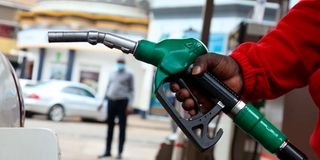
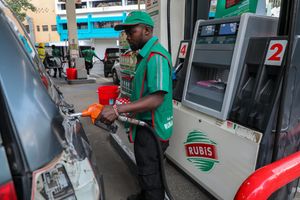
The government stands to lose another Sh27 billion over the next three months after the National Assembly voted to extend a tax relief measure on petroleum products amid turmoil in the Middle East that has disrupted crude oil supplies.
The National Assembly passed the Tax Laws (Amendment) Bill, 2026, retaining the reduced eight per cent VAT rate on petroleum products instead of allowing it to revert to the standard 16 per cent following the expiry of the relief on October 14, 2026.
“Notwithstanding the provisions of subsection (2), the rate of tax for the following items shall be eight per cent of the taxable value,” the Bill states.
The petroleum products covered by the reduced rate include petrol, kerosene and diesel.
The extension came on the day the Energy and Petroleum Regulatory Authority (Epra) was due to conduct its monthly review of fuel prices, which takes place on the 14th of every month.
President William Ruto in a past photo. The government can now sell loss-making and non-performing State corporations after President William Ruto signed the Privatisation Bill into law.
Photo credit: PCS
The Bill is expected to be transmitted to the President for assent on Thursday, October 15. Its provisions are to take effect retrospectively from October 14, 2026, cushioning consumers against a potential Sh16-per-litre increase in petrol and diesel prices.
“That the Bill be amended by deleting the words ‘shall come into effect upon publication’ and substituting therefor the words ‘shall be deemed to have come into effect on October 14, 2026’,” reads the amendment to Clause 1 that was passed by the House.
While the extension offers temporary relief to consumers at the pump, it also deals a multibillion-shilling blow to the government’s revenue collection targets.
The government has been losing about Sh9 billion a month since April 14, 2026, when it reduced VAT on petroleum products from 16 per cent to eight per cent through amendments to the VAT Act.
This means the government has forgone an estimated Sh54 billion in revenue over the past six months, a figure projected to rise to Sh81 billion by the end of the three-month extension.
The passage of the Bill was one of the rare occasions on which legislation was introduced, debated and passed by the National Assembly in a single sitting. The House approved it on the afternoon of October 14, highlighting the urgency of cushioning consumers against a potential fuel price shock.
The amendments to Section 5 of the VAT Act will remain in force for 90 days, during which the government hopes normalcy will return to the Middle East.
Cabinet Secretary for the National Treasury and Economic Planning John Mbadi appears before the National Assembly's Departmental Committee on Finance and National Planning, chaired by Molo MP Francis Kuria Kimani, at Bunge Tower, Nairobi, on Thursday, August 20, 2026.
Photo credit: Dennis Onsongo| Nation Media Group
The Cabinet Secretary for the National Treasury may also extend the reduced rate for a further 90 days through a gazette notice without seeking fresh approval from the National Assembly, as happened when the initial relief period expired.
The pressure on fuel prices comes amid disruptions to crude oil supplies linked to the crisis in the Middle East. Kenya’s reliance on imported petroleum products leaves it vulnerable to international price fluctuations, while the government’s limited strategic fuel reserves have raised concerns about its ability to cushion the economy against prolonged supply disruptions.
Fuel prices have been affected by disruptions to shipping through the Strait of Hormuz amid the conflict involving the United States, Israel and Iran.
Section 6(1) of the VAT Act states that the Cabinet Secretary for the National Treasury “may, by order published in the Gazette, amend the rate of tax by increasing or decreasing any of the rates of tax by an amount not exceeding 25 per cent of the rate specified”.
“Every order made shall be laid before the National Assembly without unreasonable delay,” the law states.
Such an order ceases to have effect if the National Assembly passes a resolution rejecting it within 20 days of the day on which the House next sits after the order is laid, without affecting anything previously done under the order.
The statutory limit on the extent to which the Cabinet Secretary can vary VAT rates prompted the Executive to introduce the Bill, which provides a legislative basis for the extended reduction.
The reduced VAT rate also comes against the backdrop of Kenya’s commitments to the International Monetary Fund (IMF), which has pushed for enhanced taxation of petroleum products as part of efforts to strengthen domestic revenue collection.
The extension could complicate the government’s efforts to meet those commitments. The IMF has warned of the risks posed by Kenya’s heavy public debt, which stands at Sh12.8 trillion.
Higher VAT on petroleum products was intended to help the government raise more revenue domestically, reduce reliance on borrowing and support fiscal consolidation.
Maintaining the reduced rate will therefore leave the government with less revenue to finance its operations, potentially increasing pressure to borrow to cover the resulting budget shortfall.
VAT on petroleum products has a long history in Kenya. The VAT Act of 2013 provided for the taxation of petrol, diesel, kerosene and jet fuel after a three-year grace period, which would have seen the measure take effect in 2016. Its implementation was subsequently deferred to September 1, 2018, following public opposition at a time when the economy was struggling.
The Finance Act of 2018 eventually introduced VAT on petroleum products at a reduced rate of eight per cent instead of the standard 16 per cent. The lower rate was intended to cushion consumers and the wider economy against the effects of taxing petroleum products.
The Strait of Hormuz, a narrow but strategically critical waterway linking the Persian Gulf to the Gulf of Oman and the Arabian Sea, has become a major flashpoint in the current crisis.
The strait is a key export route for oil-producing countries including Kuwait, Iraq, Saudi Arabia, the United Arab Emirates and Qatar. About 20 to 25 per cent of the world’s daily seaborne oil trade and roughly 20 per cent of global liquefied natural gas shipments pass through it.
Disruptions to shipping through the strait have heightened concerns about global energy supplies and contributed to rising oil prices, with consequences for countries such as Kenya that depend on imported fuel.