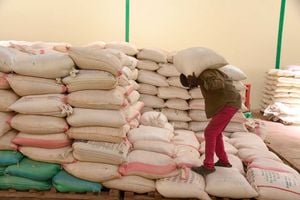
Small-scale farmers and traders are hoarding maize, causing an artificial shortage of the commodity on the market. This has forced millers to scale down operations, which is likely to result in consumers paying more for flour.
Maize supplies have been low for the past two months, pushing prices up to Sh3,600 per 90 kg bag, as farmers and traders stockpile the produce in anticipation of higher prices.
"Most small-scale farmers who harvested the crop two months ago are reluctant to sell, while traders are stockpiling, starving us of grain to sustain our operations and pushing prices up. In turn, this hurts consumers, who will have to pay more for flour," said Wilson Kosgei, a miller in Eldoret city.
A bumper harvest is expected in Ndaragwa, a traditionally dry area that relies on food relief. The maize crop was also planted in March. Photos taken on July 6, 2025.
Photo credit: Wailkwa Maina | Nation
The millers attribute the increased maize prices to an unstable supply of grain from Tanzania and Uganda, which is needed to supplement the existing stocks and ensure smooth operations.
“Most millers have been operating below capacity for the last two weeks due to the inconsistent maize supply, which has forced some to suspend operations until they have sufficient stocks," said David Maina, another miller.
While most small scale maize farmers have harvested the crop in many parts of the North Rift, the country’s food basket their large scale counterparts wait until February or March to harvest the crop.
“Large scale farmers are normally not in a rush to harvest the crop and wait up to February of March next year. In any case most of them have entered contracts to supply the produce to large scale millers,” added Mr Maina.
The projected below-average maize yield in Uganda, due to erratic weather during planting, and the disruption to maize and food supplies to Kenya caused by the post-election unrest in Tanzania following the November 2025 elections.
Security crackdowns in Tanzania have left many trucks carrying maize stranded at the Namanga and Taveta borders, contributing to the current grain shortage in Kenya.
According to the Kenya National Bureau of Statistics, Kenya has imported an average of 295,092 tonnes of maize annually over the past five years.
Maize dealers measure the moisture content of maize at Taveta airstrip field in this photo taken on June 9, 2025. The dealers buy the maize in Tanzania due to the shortage being experienced in Kenya.
Photo credit: Lucy Mkanyika | Nation Media Group
The country is expected to harvest 70 million bags of maize this season, up from 44 million bags in 2022 and 67 million bags in the 2024 season.
“The price of a 2kg packet of flour has fallen from Sh250 in 2022 to as low as Sh130 today. For millions of households, this is meaningful, daily relief,” said President William Ruto, attributing the increase to the distribution of subsidised fertiliser.
According to Agriculture Cabinet Secretary Mutahi Kagwe, the government distributed 21.3 million bags of fertiliser worth Sh53.25 billion.
It distributed 6.9 million bags of subsidised fertiliser for the long rains season, and plans are underway to scale up the farm inputs to 12.5 million bags next planting season.
The National Cereals and Produce Board (NCPB) targets to purchase up to 2 million bags at Sh3,500 per 90kg, amounting to Sh7 billion for the National Strategic Food Reserve.
It is, however, facing stiff competition from traders and millers who have raised maize prices by Sh2,600 in a cutthroat competition with the government agency to bolster their stocks.
The government plans to reserve either 4 million bags of maize, rice and beans as emergency stock, or the cash equivalent.
Maize production stood at 42.1 million bags in 2020, down from 44 million in 2022 and 67 million in 2024 and 70 million in 2025.
The country’s maize flour production over the last five years has averaged 2.8 million tonnes annually.