Iran has raised fresh concerns over Kenya’s failure to take action against officials and traders linked to a 2023 tea export scandal worth Sh2.6 billion.
A fallout from the contentious consignment led to the abrupt closure by Tehran of one of Kenya's crucial markets and left thousands of small-scale tea farmers without buyers.
Ambassador Ali Gholampour highlighted the prosecution by Tehran of Iranians implicated in the shady deal, urging Nairobi to move faster in addressing the issue, even as negotiations to unlock the trade standoff continue.
In an interview with Nation , the envoy stressed accountability and reiterated that Iran has already taken decisive legal action.
“In Iran, those involved in the fraudulent scheme have already been tried and punished by the courts, with senior officials and the mastermind receiving lengthy prison sentences and orders to repay billions of dollars to the State. Among them are ministers, CEOs, and private individuals,” said Mr Gholampour, underscoring Tehran’s decisive action on the matter.
He stressed that Kenya’s cooperation is now crucial to restoring confidence and reopening the tea trade.
The envoy said both governments are pursuing plans to increase bilateral trade fivefold to $1 billion (Sh129 billion) annually within a decade.
He emphasised that Iranian consumers still value Kenyan tea for its high quality and distinctive taste, insisting that demand remains strong despite the ban.
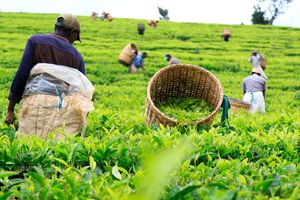
Tea plucking machines at Browns East Africa Plantations PLC estate in Kericho.
Photo credit: Vitalis Kimutai | Nation Media Group
The envoy noted that the resolution of the export impasse is dependent on ongoing negotiations. A committee was formed last August during the 7th Session of the Kenya-Iran Joint Commission for Cooperation to work out a roadmap to the resumption of tea exports.
The scandal centres on Iranian firm Debsh and Kenyan exporter Cup of Joe, whose dealings erupted in 2023 and led Tehran to ban Kenyan tea imports.
Cup of Joe secured a $20 million (Sh2.6 billion) deal with Debsh for the supply of premium tea, but the commodity was found to be low-grade tea imported into Kenya, blended and re-exported to Iran as premium Kenyan tea.
Iranian prosecutors revealed that Debsh drew $3.37 billion (Sh434.7 billion) from state foreign exchange reserves at subsidised rates—ostensibly to import tea and machinery—but instead diverted funds, purchased cheaper low-quality Kenyan tea, and imported no equipment.
Court records in Tehran described the scheme as involving “systematic deception, currency manipulation, and smuggling,” resulting in heavy sentences and asset recoveries.
Former Trade Minister Reza Fatemi-Amin was jailed for one year, while former Agriculture Minister Javad Sadatinejad received a two-year term. Debsh President Akbar Rahimi-Darabad was sentenced to 66 years and ordered to repay $2.38 billion (Sh307 billion).
An Iranian court ruled that the operation “caused extensive harm to public resources and market integrity,” adding that “those responsible must return the proceeds and face punishment.”
The outcome severely impacted Kenya’s tea sector. Iran had ranked among Kenya’s top 10 export destinations, purchasing 13 million kilograms worth Sh4.26 billion in 2024, according to data from the Tea Board of Kenya.
The ban eliminated a major market for a crop that sustains over 750,000 smallholder Kenyan farmers across 19 counties and supports livelihoods for about 6.5 million people.
Kenyan authorities revoked Cup of Joe’s license, and the Tea Board deregistered the firm. While the Directorate of Criminal Investigations completed its probe, findings have yet to be made public.
However, in a past interview with Nation , Cup of Joe director Kamau Kiminda denied the alleged involvement of his company in the fraud or importation of low-quality tea. He further stated that the company had no direct dealings with the Iranian government but with Debsh.
“We were contracted by Debsh to source tea, which we did in line with our clients’ instructions,” Mr Kamau said, adding that after signing a business agreement with the Iranian firm, Cup of Joe delivered the agreed quantities of tea. “What Debsh did with the consignment after delivery could not be attributed to Cup of Joe,” Mr Kamau stated.
The envoy affirmed Kenyan tea’s enduring popularity in Iran and his government’s desire to resume trade, describing it as a “win-win” scenario: “Iran regains access to high-quality tea, while Kenya re-enters a lucrative market”.
“The quality is exceptional, demand remains strong, and Iranians love Kenyan tea,” he said, though he cautioned that accountability must come first.
The ambassador also highlighted efforts to expand cooperation in trade, agriculture, academic exchange, cinema, and culture, arguing that broader collaboration would yield mutual benefits.
He said the two countries are exploring a partnership between universities in the two countries, exchanges of professors, students and scholarships as part of deepening ties.
“We want to see practical academic exchanges, including Kenyan professors coming to Iran and Iranian professors coming to Nairobi, alongside student exchanges and scholarships, so that cooperation goes beyond trade and builds lasting institutional links,” Ambassador Gholampour said.
Bilateral trade has risen from roughly $50 million to about $200 million in recent years, with Kenya enjoying a surplus due to tea and agricultural exports.
The two nations aim to boost trade to $1 billion through new agreements, investment, and sectoral cooperation in tea, agricultural machinery, fertiliser, health, energy, and industry, alongside improved logistics.
However, sanctions, banking constraints, and the absence of direct flights between Nairobi and Tehran continue to hinder transactions and raise costs for business and trade.
Despite these challenges, the latest Joint Cooperation Commission meeting in Nairobi in August 2025 yielded nine memoranda and a roadmap for agriculture, industry, health, and energy collaboration.
Kenya views Iran as a vast consumer market with a deep tea-drinking culture, while Iran sees Kenya as a gateway to East Africa and a partner for regional trade corridors.
Ambassador Gholampour emphasised that the immediate test lies in fostering cooperation and political will to unlock a stronger bilateral relationship.