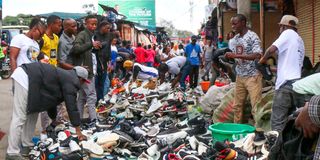
Footwear imports into Kenya grew by 63.42 per cent to 18.99 million pairs in the first nine months of 2025, buoyed by high production costs and stringent trade policies in the domestic market.
Data from the Kenya National Bureau of Statistics (KNBS) shows that in the nine months to September, Kenyans imported 18.99 million shoes, up from 11.62 million in the previous year.
The Kenya Association of Manufacturers (KAM) has linked the high imports to affordability, citing high production costs in the local market, including power, and the unavailability of raw materials.
“The sector faces a high cost of production, driven by expensive power, high cost of capital, limited access to financing, and inadequate availability of raw materials,” KAM Chief Executive Officer, Tobias Alando, said.
“Local manufacturers experience unfavourable competition from imported new and second-hand footwear. Unfavourable industrial and trade policies further constrain the competitiveness of domestic producers,” he added.
Additionally, data shows that the value of footwear imported into the country fell marginally to Sh5.29 billion from Sh5.36 billion in the previous year, despite the high volumes due to forex fluctuations.
The KNBS does not usually break down the type of footwear purchases from abroad, but past data by KAM indicated that shoes with rubber outer soles and leather uppers form a significant portion of the imports.
Kenya’s footwear imports are mainly sourced from China, Turkey, India and Jordan.
This sustained high volume of footwear imports casts doubts on President William Ruto’s pledge to discourage the importation of the products by building the capacity of local producers, but manufacturers remain optimistic, saying it does not make them less competitive.
Dr Ruto has repeatedly said Kenya should stop importing shoes and instead wear locally made ones, and his government has outlined plans to boost production, create more jobs and expand annual output. However, challenges in the leather value chain, including closed tanneries and raw material issues, have hindered progress.
“Kenya consumes approximately 34 million to 36 million pairs of shoes annually, of which about 26 million pairs are imported. The high level of imports does not necessarily indicate that local manufacturers are uncompetitive,” Mr Alando said.
The lobby says that “local manufacturers supply all footwear (specifically boots) to Kenya’s disciplined forces, which is a clear demonstration of the quality and reliability of locally manufactured products.”