National Treasury Cabinet Secretary John Mbadi has ruled out any possibility of the government enhancing its borrowing to finance the Sh4.82 trillion budget for the fiscal year 2026/27 after its projected additional revenue collection was significantly scaled down in concession to the Finance Bill 2026, now an Act of Parliament.
As originally published, it had projected an additional revenue collection of Sh120 billion on top of the Sh3.6 trillion in ordinary revenue and Appropriation-in-Aid (A-in-A) to help finance the Sh1.2 trillion deficit in the budget.
However, following its passage, it means that the projected revenue reduces from Sh120 billion to Sh98 billion, giving another headache on where the government will secure funding to finance the budget that remains unbalanced.
CS Mbadi has since affirmed that the government will not borrow more to plug the hole, as he also ruled out the possibility of introducing new tax measures to cover for the reduced revenue projections.
“We have not lost much revenue following the amendments to the Finance Bill,” said CS Mbadi adding: “No room for enhanced borrowing.”
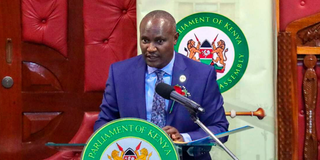
Treasury CS John Mbadi delivers the FY 2026/2027 Budget Highlights at Parliament Buildings, outlining the government's fiscal policy direction and priority spending areas for the coming financial year.
Photo credit: Dennis Onsongo | Nation Media Group
Asked how the government will balance its books given that the revenue projections have been scaled down as the expenditure projections remain intact, CS Mbadi, the accountant, said: “We will look at the actual possible loss, which may not be more than Sh15 billion.”
At a previous meeting with the National Assembly Committee on Budget and Appropriations (BAC) before MPs approved the Finance Bill, CS John Mbadi ruled out any possibility of rationalising the budget, despite calls by MPs.
“If you look at this budget, there is nothing to cut. Otherwise, I will be cutting salaries of government employees,” CS Mbadi told BAC, which is chaired by Alego Usonga MP Samuel Atandi.
“On that basis, we factored additional revenue yields from the Finance Bill 2026 and yields from administration reforms implemented by the Kenya Revenue Authority (KRA),” CS Mbadi revealed.
The MPs had proposed rationalisation of the budget so as not to overburden the taxpayer owing to the Middle East conflict that has led to a surge in global oil prices, which has affected the Kenyan economy.
The National Treasury is projecting Sh3.63 trillion in revenue targets for the 2026/27 period, which is about 17.4 percent of the GDP, upwards of Sh3.40 trillion, about 18.2 percent of GDP in the current financial year.
Of the revenue projections for the year, Sh2.99 trillion, about 14.3 percent of the GDP, is in ordinary revenue, which assumes a lower revenue base to adjust for the projected underperformance of Sh147.4 billion in the current financial year.
There is also (A-i-A) projected at Sh644 billion, a 4.8 percent growth from the current financial year’s approved budget.
At a recent meeting of the House Committee of Finance and National Planning, the legislators cast doubts on plugging the Sh1.2 trillion hole in the budget without overburdening the taxpayer with expensive loans amid debt repayment obligations, among others.
“It is possible to have a budget that reacts to the reality of life,” said Molo MP Kuria Kimani, who chairs the House’s Finance and National Planning Committee.
National Assembly Committee on Finance and National Planning Chairperson Kuria Kimani.
Photo credit: File| Nation Media Group
The country’s budget for the next financial year is an increase compared to the Sh4.6 trillion budgeted for the current fiscal year and exceeds the Budget Policy Statement (BPS) expenditure projections as approved by the National Assembly in March this year, by Sh64 billion.
Already, the National Treasury has revealed that it has scaled down its economic growth forecast for the 2026/27 period from 5.3 percent, before the Middle East tension, to 4.8 percent after the Gulf situation showed no signs of easing.
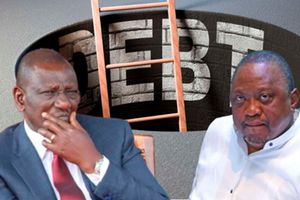
Details from the Central Bank of Kenya (CBK) show that the country’s public debt is almost crossing the Sh13 trillion mark, occasioned by increased borrowing, largely from the local market, to plug budget deficits on account of revenue shortfalls.
It is against this revelation that Butula MP Joseph Oyula, a former Financial Secretary at the National Treasury before briefly serving as acting Permanent Secretary in May 2004, told the National Treasury that it had no choice “but to relook into the budget.”
“The situation in the country is gloomy. We cannot pretend by budgeting as usual,” said Mr Oyula.
According to Homa Bay Town MP Peter Kaluma, Kenya Revenue Authority (KRA) targets are never met, “and certainly not in the foreseeable future.”
“I don’t understand this ambitious expenditure plan,” said Mr Kaluma.
“Despite the global constraints, the National Treasury still increased the budget compared to the BPS that we approved in the House,” said the Homa Bay Town legislator.
Homa Bay Town MP Peter Kaluma.
Mr Musa Kathanje, the Director, Macro and Fiscal Affairs at the National Treasury, says that before the situation in the gulf region erupted, leading to the blockade on the Strait of Hormuz, the economic growth had been projected at 5.3 percent.
This was later revised to 5 percent after the war in the Middle East erupted, but with the hope that the situation would ease.
However, with no indication that the war would come to an end any time soon, despite a fragile ceasefire, the economic growth projection was further reviewed to 4.8 percent.