Parliament budget experts have challenged the National Treasury to wake up and smell the coffee, warning that burdening Kenyans with taxes will not yield the desired revenue targets, potentially exposing the government to expensive loans.
This, as the Parliamentary Budget Office (PBO) in its Budget Watch report for the 2025/26 financial year, before parliament revealed that the government missed its revenue targets by Sh342 billion in the last two financial years.
The amount is more than what the National Treasury had projected Kenya Revenue Authority (KRA) to collect in additional revenue through new tax laws during the period.
To remedy the situation, the budget office, a technical body that advises parliament and its committees on fiscal matters, has identified a reconsideration of the taxation strategy to balance revenue generation with investment incentives as the missing link in low revenue collection.
“The government has, in recent years, embarked on an ambitious strategy to expand the tax base and strengthen revenue collection through the annual tax amendment laws. But it has witnessed poor revenue collection and widespread public dissatisfaction with the introduction of new tax proposals,” the PBO document says.
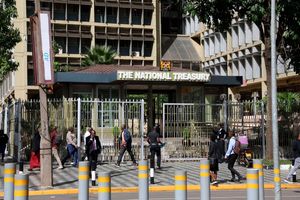
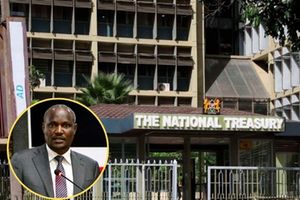
The National Treasury Building in Nairobi.
Photo credit: Pool
Other than the widespread public dissatisfaction during the last two financial years, the budget office has also attributed lower revenue to inefficiencies in tax administration, poor implementation of new policies, weak enforcement and widespread compliance issues.
According to PBO, poor revenue collection and widespread public dissatisfaction peaked in the financial years 2023/24 and 2024/25 following the introduction of new tax proposals.
For instance, in the 2023/24 fiscal period, the Finance Act 2023 aimed at collecting Sh211 billion in amendments to various tax measures.
However, this did not yield the desired results since the revenue target for the financial year was missed by Sh205 billion.
In the 2024/25 financial year, the Finance Bill 2024 had projected that KRA would collect Sh346 billion in additional revenue to finance the year’s budget.
But the Finance Bill 2024 fell through after Kenyans staged deadly protests against the punitive taxation measures, whose culmination was the storming of parliament buildings on June 25, 2024.
To address the situation, the government came up with the Tax Laws (Amendment) Act 2024, which targeted to collect Sh79 billion during the period.
However, the annual revenue target for the year was instead missed by Sh137 billion, piling more pressure on a government that was left with no alternative but an increased local and foreign borrowing to finance its expenditure obligations.
In the financial year 2025/26, the government saw the need to reconsider its taxation strategy, coming up with a projection of Sh30 billion as it targets Sh3.3 trillion revenue for the fiscal period through the amendment of various tax measures in the Finance Act 2025.
“The Act marked a strategic shift from previous tax amendment laws. Instead of imposing new tax burdens, it focused on strengthening revenue collection through administrative reforms and improved taxpayer compliance,” PBO says.
The parliamentary budget think-tank has also warned that the imposition of a five per cent withholding tax on all withdrawals from betting and gaming wallets has the risk of driving players away from formal betting platforms.
Times Tower, the Kenya Revenue Authority's head office in Nairobi.
Photo credit: Dennis Onsongo | Nation Media Group
PBO says although the government expects to raise between Sh5.4 billion to Sh11.4 billion, the tax may drive casual and small-scale bettors to unregulated betting sites for fear of the prospect of losing part of their initial deposits even without making a profit.
The PBO said the Finance Act, 2025, introduced a five per cent withholding tax on all withdrawals from betting and gaming wallets, a shift from the previous 20 per cent tax levied only on actual winnings.
“For example, if a player has deposited funds but decides to withdraw them without placing any bets, they could still face a five per cent tax on that withdrawal, despite not earning any income,” PBO said in the report.
“This lack of clarity and perceived unfairness could not only push players away from regulated platforms but also hurt industry growth and undermine the very revenue goals the government hopes to achieve.”
The team said even if a player deposits Sh1,000 and later withdraws it without placing a single bet, they would still lose Sh50 to the taxman.
“This blanket taxation is a potential blow to the fast-growing online gaming market, which has become a significant revenue source for mobile money operators and tech startups,” PBO said.
The Treasury says the new levy is designed to simplify enforcement and broaden the tax base, part of its wider reforms to improve compliance and reduce leakages through digital monitoring.
“The lack of clarity and perceived unfairness could hurt industry growth and undermine the very revenue goals the government hopes to achieve,” the report states.
“The number of active betting accounts will also serve as an indicator of whether players are abandoning formal platforms.”
The PBO said any legal challenges filed in court against taxing withdrawals will be critical in determining the sustainability of this approach.
To realise the Sh3.3 trillion revenue target for the year, the budget office says that the government will need to enhance tax administration through more robust enforcement of existing laws, the integration of advanced data analytics and the adoption of technology to improve compliance and operational efficiency.
At the core of the reforms critical in realising the revenue targets, according to PBO, include full digital transformation of revenue administration, upgrades to ICT infrastructure, streamlined tax procedures, improved data governance and the elevation of service delivery standards.
“These measures will create a more transparent, responsive and efficient tax ecosystem that aligns with the evolving needs of Kenya’s economy.”
This will require enhanced audit capabilities, collaboration with other government entities to ensure accurate taxpayer profiling and widespread deployment of digital tools like the Electronic Tax Invoice Management System (eTIMS) “to foster real-time compliance and secure consistent revenue flows.”