In the hot, dry landscape of Marigat Sub-county in Baringo County, where the sun beats relentlessly on the ground and water remains a precious resource, a quiet agricultural transformation is taking place.
Here, farmers are turning the challenges of rising waters of Lake Baringo and an arid environment into an opportunity to produce tomatoes for local and distant markets.
Among those leading this change is Peter Macharia, 28, a trained teacher and Kenyatta University graduate who has ventured into tomato farming after completing his studies in 2023.
His journey from the classroom to the farm is a story of resilience, determination and the search for economic independence in a country where securing formal employment can be a challenge for many graduates.
Mr Macharia's entry into agriculture was not entirely new territory. Having grown up in a family that practised tomato farming in Kampi ya Moto and Rongai in Nakuru County, he had acquired practical knowledge of the crop from an early age. What began as a family farming activity would later become his source of livelihood and a pathway towards building his own agricultural enterprise.
After completing his studies at Kenyatta University in 2023, the father of two hoped to secure employment as a teacher. However, opportunities did not come immediately, forcing him to consider alternative ways of earning a living.
Rather than remain idle while waiting for a teaching opportunity, he ventured into tomato farming as a worker. His initial role involved supervising farm employees and managing their work, with his earnings based on commissions from the profits made each season.
Although the arrangement offered him limited control over the farming enterprise, it gave him an opportunity to learn more about the business, understand its financial demands and gain experience in managing agricultural production.
His breakthrough came during the December 2024 and January 2025 season, when favourable market conditions enabled him to make meaningful savings from his work.
Peter Macharia tends to his young tomato crop in Marigat, Baringo County on October 9, 2026.
Photo credit: Boniface Mwangi | Nation Media Group
With the money earned, Mr Macharia invested in essential farming equipment, including a diesel-powered water pump and high-density polyethene (HDPE) pipes. The purchases marked an important step towards establishing his own tomato farming operation and reducing his dependence on others for critical farm equipment.
For Mr Macharia, choosing tomatoes was a natural decision.
“This is a crop we have grown since I was young. My parents introduced me to tomato farming, and I gained knowledge on how to grow and manage it properly,” he explains.
The experience acquired at home gave him a foundation to build on, demonstrating how traditional agricultural knowledge can be transformed into a modern business opportunity.
Although he hailed from their rural home in Solai, Nakuru County, Mr Macharia was able to convince a number of his friends from Nakuru County to go try farming in the neighbouring county, Baringo and take advantage of the rising waters, which many perceived to be a bad omen as it displaced many and consumed grazing land.
Marigat is characterised by a savannah climate, high temperatures and relatively dry conditions. Despite these challenges, the area has considerable agricultural potential, supported by fertile soils and favourable conditions for growing tomatoes.
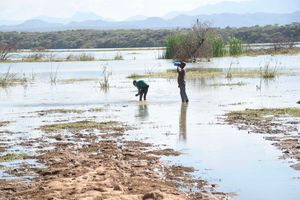
One of the most important resources sustaining this agricultural activity is Lake Baringo, a freshwater lake whose rising waters have become a blessing and a source of irrigation for farmers cultivating the surrounding land.
“98 percent of farmers cultivating both tomatoes and watermelon in this lake are not from Baringo. We normally rent land at Sh15,000 per acre for one season, which is about six months,” notes Mr Macharia.
If all goes well, he went on, and having spent like Sh350 in production of tomatoes, a farmer can comfortably get triple this amount.
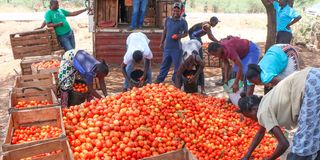
Peter Macharia (in black cap) and his colleague John Nderi offload freshly harvested tomatoes at Kambi Samaki in Marigat, Baringo County, on October 9, 2026.
Photo credit: Boniface Mwangi | Nation Media Group
As water levels rise, farmers in some areas adjacent to the lake can access land and water resources that support agricultural production.
And through irrigation, they are turning land that might otherwise remain unproductive into farms supplying tomatoes to various markets.
For farmers such as Mr Macharia, access to water is central to the entire production process. Without reliable irrigation, growing tomatoes in such a hot environment would be difficult.
Farmers have adopted furrow irrigation, an older method associated with the Perkerra Irrigation Scheme. The system involves directing water through channels running across the farm, allowing it to flow along the planting rows.
Unlike some modern irrigation systems that require more specialised equipment, furrow irrigation can be relatively affordable to operate where the land and water supply permit its use.
According to Mr Macharia, proper watering can sustain the crop for up to four days before the next irrigation, helping farmers reduce diesel consumption and the cost of pumping water.
However, effective water management remains essential, particularly as changing lake levels and weather conditions can influence access to irrigation water and the amount of land available for cultivation.
Tomato farmers in this area increasingly favour hybrid varieties because of their production potential, resistance or tolerance to common diseases, firmness and longer shelf life.
Among the varieties commonly grown are Ansal F1, Bigrock F1 and Harmony F1.
He says, “These varieties are attractive to farmers because firm fruits with a longer shelf life are better suited to transportation, especially when produce must travel long distances to reach consumers.”
In a business where the quality of the harvest directly influences income, selecting the right variety is an important decision.
Another farmer, Mellania Nduta also points to the area's high temperatures as an advantage in shortening the production cycle. While tomatoes may take approximately 90 days to mature under some growing conditions, farmers in Marigat can harvest certain crops in about 60 days after transplanting.
The shorter period can help reduce the duration of crop maintenance and some recurring production costs, although actual maturity depends on the variety, weather, water availability and farm management practices.
For farmers investing heavily in seedlings, fertilisers, pesticides, irrigation and labour, every day saved can make a difference.
Beyond production, the more than 250 farmers in Marigat have developed a marketing arrangement that helps them avoid some of the costs associated with transporting perishable produce.
Rather than ferrying tomatoes to distant markets themselves, many sell directly at the farm.
Under this arrangement, he says, brokers identify buyers, bring them to the farms and negotiate purchases. The tomatoes are then bought at the point of production, saving farmers the additional expense of hiring transport and handling the produce along the way.
The system provides convenience, especially for small-scale farmers who may lack vehicles or the capital required to organise their own distribution.
However, it also exposes farmers to the influence of brokers and fluctuations in market prices. When supply is high, farmers may have little bargaining power and can be forced to accept prices that barely cover production costs.
For Mr Macharia, their venture into tomato and other fast-growing crops have also benefited the locals- who normally get jobs in the farms.
“I have employed four workers on a permanent basis, but during the period of tending the crops and harvesting, I normally employ more than 30 workers. Harvesting being one stage that one requires more labourers,” he affirms.
Despite its potential, tomato farming in Marigat remains a high-risk enterprise.
One of the biggest challenges is the poor state of feeder roads. During rainy periods, roads can become difficult or impossible to navigate, disrupting the movement of produce. Since tomatoes are highly perishable, delays can result in substantial losses, particularly when farmers have a ready harvest but buyers cannot reach their farms.
Land availability is another growing concern. As more farmers turn to tomato production, Mr Macharia says suitable land becomes increasingly scarce. Some are forced to clear new areas using heavy machinery, adding to their initial investment.
The coexistence of crop farming and pastoralism presents further difficulties. In a community where nomadic pastoralism is widely practised, livestock can stray into cultivated fields, damaging tomato plants and consuming crops. Farmers must therefore invest in fencing and other protective measures, which increase production costs.
Pests and diseases also threaten the sector. One of the most troublesome pests is Tuta absoluta, commonly known as the tomato leaf miner. Its larvae attack tomato plants and fruits, causing serious damage. Infested produce may lose quality, discouraging buyers and leaving farmers with unsold harvests.
Market instability compounds these challenges. During periods of oversupply, tomato prices can fall sharply, forcing farmers to sell their produce at throwaway prices. After investing heavily in production, some end up making losses that discourage them from planting another season.
The financial burden is particularly heavy for farmers who must raise money for seedlings, fertilisers, pesticides, irrigation fuel and workers' wages before earning anything from the harvest.
Mr Macharia and other farmers must therefore balance agricultural knowledge with careful financial planning, pest management and an understanding of market trends.
For Mr Macharia, the firstborn in his family, tomato farming represents more than an alternative to formal employment. It is an opportunity to turn skills acquired from his family into a productive enterprise while contributing to the growing agricultural economy of Marigat.
His experience illustrates how young graduates can explore agriculture as a viable career, even in areas where harsh climatic conditions might appear to limit economic opportunities.
Yet the long-term success of tomato farming in Baringo will depend on addressing the structural challenges facing farmers. Better feeder roads, access to affordable credit, improved pest-control services, stronger farmer organisations and more reliable markets could help reduce losses and increase profitability.
Investment in storage, aggregation and processing facilities could also help farmers manage periods of oversupply instead of being forced to sell immediately at low prices.
As Lake Baringo's rising waters continue to support irrigation in the surrounding area, farmers like Mr Macharia and Ms Nduta are demonstrating the potential of combining natural resources, practical experience and entrepreneurship to create economic opportunities.
From a young graduate who once hoped to secure a teaching job to a farmer investing in pumps, pipes and agricultural production, Mr Macharia's journey reflects a broader lesson- with the right support, agriculture can offer young people a path to self-reliance.
In the sun-baked fields of Marigat, every thriving tomato plant tells a story of resilience and determination. For Mr Macharia and his fellow farmers, the ambition goes beyond growing tomatoes; it is about building sustainable livelihoods from the land while demonstrating that the rising waters of Lake Baringo, despite their challenges, can also present valuable opportunities for agricultural production.