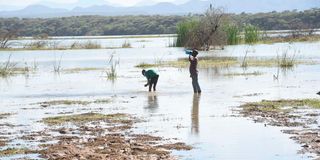
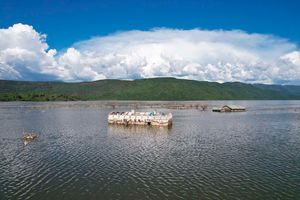
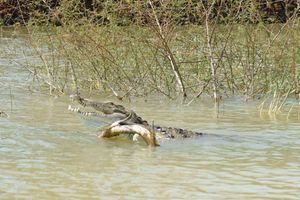
At Loruk in Baringo North, water stretches as far as the eye can see, swallowing farms and grazing fields and creeping towards homes that once stood safely away from the shoreline.
Yet just metres from the expanding lake, families are struggling to put food on the table.
For communities living along the shores of Lake Baringo, the greatest irony is not simply that rising waters have taken away their land and livelihoods, but that the same vast freshwater resource surrounding them remains beyond their reach.
They have the water. What they lack are the pipes, pumps, fuel and money needed to turn it into food.
For more than a decade, rising water levels have submerged farms, homes, roads, schools and grazing fields, stripping thousands of families of the land and livestock they depended on.
With farming disrupted and livestock numbers depleted by flooding and insecurity, some households now survive on relief food or a single meal a day, while others travel long distances in search of pasture and casual work.
Lake Baringo has expanded exponentially over the past 15 years, with government officials indicating that its surface area has grown from about 143 square kilometres in 2009 to approximately 270 square kilometres currently, with the rising waters swallowing settlements and infrastructure.
But for the people living around it, the numbers tell only part of the story. The real measure is in the acres lost, livestock sold or stolen, homes abandoned and meals skipped.
At Ng'asian, now almost entirely submerged, village elder Johana Chepyator remembers when the lake was several kilometres away.
Johana Chepyator, a village elder at Ngasian-Loruk in Tiaty, Baringo County points on September 03, 2026, where his home used to be, about 500 meters into water, before water levels in Lake Baringo rose and submerged his 5-acre farm.
Photo credit: Jared Nyataya | Nation Media Group
He was forced to leave his home in 2012 after the advancing waters swallowed his five-acre parcel — four acres he cultivated and another acre occupied by his homestead.
“The lake waters were initially four kilometres from Ng'asian village, where I was living, before they gradually increased, submerging my five acres of land, including my house. As we speak, the entire village is now approximately five kilometres inside the water. I have nowhere to call home and I am temporarily squatting on a well-wisher's farm as I look for an alternative,” said Mr Chepyator.
He said residents of Ng'asian have since scattered to neighbouring villages, with many living with relatives or on other people's farms.
Chesiran, Ng'asian, Chepkenion and parts of Loruk are among areas that have suffered some of the worst effects of the flooding.
Before the water came, his five acres were his insurance against hunger. He grew maize and kept livestock, relying on the farm to feed his family and generate income.
When the lake advanced, his crops disappeared beneath the water and his livelihood went with them.
“I lost everything because I used to rely on farming for my survival. After the displacement, it is a nightmare even getting a single meal because I am a squatter with nowhere to call home or cultivate. I am now relying on food aid, same as my fellow villagers. I have sold all my remaining livestock for survival and I have none anymore,” he said.
But even after losing his farm, Chepyator remains surrounded by water. The problem is that the water is within reach physically, but not economically.
Residents lack the pipes, pumps and generators required to draw water from the lake and convey it to farmland that has escaped the flooding.
“This is a semi-arid area where the rains are erratic but we have the lake water surrounding us which can be used for irrigation. However, many families cannot utilize the water because buying pipes and generators to pump water to their land is too costly,” he said.
Generators around the lake at Ngasian-Loruk in Tiaty, Baringo County on September 03, 2026, where farming used to take place before water levels in Lake Baringo rose and submerged hundreds of acres of farmland. The generators supply water for irrigation about two to three kilometes away.
Photo credit: Jared Nyataya | Nation Media Group
It is a contradiction repeated across the lakeshore. In Barichar village, Joshua Tallam lives about a kilometre from Lake Baringo but said the proximity has done little to improve his family's fortunes.
He said years of insecurity, livestock theft and displacement have stripped residents of the capital they would need to invest in irrigation.
“Most families here, including me, were affected by the perennial insecurity menace. Our livelihoods were stolen and we were displaced from our homes. The level of poverty here is very high. If we are struggling to put even a single meal on the table, how can we buy pipes to supply water to our farms?” said Mr Tallam.
Banditry and livestock theft have compounded the effects of flooding, leaving many households without the animals they once relied on as a source of food and income during difficult periods.
Joshua Talam Kiplimo shows where his one-acre farm is at Loruk in Tiaty, Baringo County on September 03, 2026, but was submerged after water levels in Lake Baringo rose. He cannot grow crops to feed his family.
Photo credit: Jared Nyataya | Nation Media Group
With farming disrupted, residents have become more dependent on food brought in from distant markets.
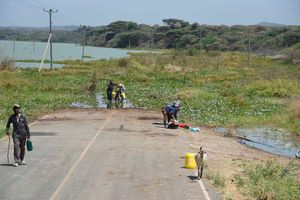
Mr Tallam said traders now have to use an approximately eight-kilometre diversion after the main road was submerged, further increasing the cost of transporting food and other commodities into the area.
The contradiction is particularly stark because residents already use the lake for domestic purposes.
They fetch its water for household use, drinking and watering livestock, but cannot afford the infrastructure required to move the same resource onto farms.
Goats graze at partially submerged farms in a parcel of land at Loruk in Tiaty, Baringo County, on September 03, 2026, after water levels in Lake Baringo rose, covering arable land. Some families who used to grow crops there were affected.
Photo credit: Jared Nyataya | Nation Media Group
At the Loruk irrigation scheme, 117 farmers cultivate more than 100 acres, but even here the potential remains untapped.
Esther Cherutoi planted an acre of maize this year, hoping for a harvest. Instead, part of the scheme was swallowed by the advancing lake, while crops on the surviving land later dried up during a dry spell.
“I live 500 metres from the lake but I have no capacity to harness the lake water for irrigation at my farm. All year round, I buy food despite the water being a few metres from my home,” said Ms Cherutoi.
With access to irrigation, she believes she could cultivate more than once a year, but the cost of reaching the water is beyond her means.
Esther Cherutoi shows where her one-acre farm is, on a parcel of land at Loruk in Tiaty, Baringo County on September 03, 2026, but it was submerged after water levels in Lake Baringo rose. She cannot grow crops to feed her family.
Photo credit: Jared Nyataya | Nation Media Group
“But I cannot afford pipes and a generator. Yes, the water is some few metres away, but I cannot use it because of poverty,” she said.
The contrast is visible in the landscape. In one section, the ground lies dry and bare, its exposed soil reflecting the harsh semi-arid conditions. A short distance away, a green farm rises from the otherwise brown surroundings, with rows of tomato plants heavy with green fruit alongside vegetables and other crops.
The lush plot offers a glimpse of what Lake Baringo could mean for communities if they had the capital and infrastructure to harness its water.
Joseph Cheboi is among the few farmers who have managed to bridge that gap. He cultivates about two acres of tomatoes using water pumped from the lake, after investing more than Sh400,000 in an enterprise he started two years ago.
Joseph Cheboi tends to his kale crop at his farm in Loruk, in Tiaty, Baringo County, on September 03, 2026. He pumps water at his farm from Lake Baringo. His neighbours' farms were submerged due to rising water in the lake.
Photo credit: Jared Nyataya | Nation Media Group
His farm is about 500 metres from the lake. He spent Sh150,000 on pipes and another Sh150,000 on a pumping machine. He uses about 14 litres of diesel every day, costing roughly Sh2,800.
“I have to irrigate the crops every day. For three months to harvest the tomatoes, I need more than Sh400,000,” said Mr Cheboi.
His farm is now green and productive while neighbouring plots remain bare. The difference, he said, is not the soil or the distance to the lake; it is money.
“People here have a big potential in agriculture, but they are not able to utilize the water for irrigation because of the high poverty levels, which have also been compounded by insecurity,” he noted.
Charles Bungei, another farmer at the Loruk scheme, said the cost of irrigation explains why many residents remain locked out.
Charles Bungei shows where his farm is at Loruk in Tiaty, Baringo County, on September 03, 2026. The farm was submerged when water levels in Lake Baringo rose. The water has since receded but is likely to come back with El Niño rainfall.
Photo credit: Jared Nyataya | Nation Media Group
A 100-metre length of pipe costs about Sh35,000, while a basic water pump and generator can cost approximately Sh150,000.
For farmers who have lost livestock to insecurity and repeatedly watched their crops fail, such an investment is almost impossible.
Mr Bungei said pumping water for an acre can also require about 20 litres of fuel a day, costing roughly Sh4,000.
“The area has good potential for agriculture but we have no capacity. How can I afford that if even getting food is a problem?” he asked.
The government is now seeking to turn the very water blamed for destroying livelihoods into an economic resource.
The State Department for Irrigation has been advancing a proposal to harness excess water from Lake Baringo through engineered tunnels and a network of primary, secondary and tertiary canals to support large-scale irrigation.
The latest proposal targets about 100,000 acres in Baringo and potentially Turkana, with the government projecting about 100,000 jobs and an economic value of nearly Sh40 billion.
The project is being explored under a private-sector investment model. The plan follows technical assessments and public participation led by the State Departments for Irrigation and Defence.
Irrigation Principal Secretary Ephantus Kimotho has said only excess water would be abstracted, to maintain the lake’s natural level while putting surplus water to productive use.
Communities in Tiaty would be among the first beneficiaries before water is conveyed to other areas with irrigation potential.
For residents, such a project could address the two problems confronting them at once — water that is destroying their livelihoods and water they cannot afford to use to rebuild them.
But they said large-scale plans must ultimately translate into affordable access for ordinary farmers.
The government has also proposed a five-kilometre dyke between Lakes Bogoria and Baringo to prevent saline water from Bogoria from mixing with Baringo's freshwater.
The interventions form part of broader efforts to manage the consequences of the lakes’ expansion while preventing the two water bodies from merging.
For communities around Lake Baringo, however, the immediate challenge remains how to turn water into food.
“We have water everywhere but it is hard to utilize because of poverty,” said Ms Cherutoi.
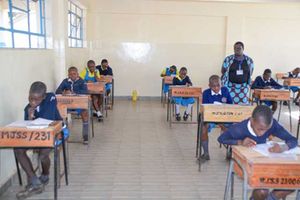
The flooding has already affected several schools, hotels, homes and businesses around Salabani and other lakeside settlements.
Tourism facilities including Soi Safari Lodge, Roberts Camp, Lake Breeze and Block Hotel have suffered major losses after cottages and guest rooms were engulfed.
But beyond the submerged buildings and lost infrastructure lies a deeper crisis. Lake Baringo keeps expanding, while the people living beside it remain unable to harness its water to feed themselves.
They are surrounded by one of the region’s most important freshwater resources, yet for many families, putting food on the table remains a daily struggle.