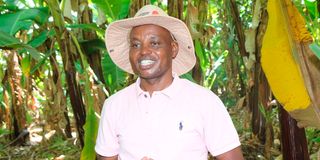
Taita-Taveta County is the second largest banana producer in Kenya. However, with unreliable markets, poor infrastructure and limited access to quality seedlings, smallholder farmers who are at the mercy of middlemen continue to suffer due to lack of bargaining power and market knowledge. Our writer spoke to Erickson Kyongo, an expert on Conservation Agriculture and Lead Consultant at Climate Smart Conservation Technologies Ltd.
Traders sort out bananas at the Wakulima Market in Nakuru Town on December 13, 2022.
Photo credit: John Njoroge | Nation Media Group
Based on sustainability and economic empowerment, what is the current situation of the banana industry in Taita-Taveta County?
The vast county is among the leading producers of bananas in the country, competing with Meru and Kisii.
Taita-Taveta is currently sitting as the second largest producer in Kenya after Meru, with bananas predominantly grown in Mboghoni and Mata ward, with over 6,000 acres of land put under cultivation.
Production is projected to be over 62,000 metric tonnes annually.
However, there is immense potential of increasing the area under cultivation if drainage of the swampy areas is given serious consideration.
For small holder farmers to diversify their banana production and seek new markets for their produce, which varieties are mostly cultivated?
Taveta grows several indigenous banana varieties, but with the introduction of tissue-culture seedlings, focus has shifted to Grand Nain, Williams and Giant Cavendish, among others.
These high-yielding varieties mature fast and are more resistant to pests and diseases, making them a reliable source of food, income and employment for thousands of households.
Farmers receive regular training and extension services from the Department of Agriculture and selected commercial partners as part of efforts to transform the banana sector in Taita-Taveta County.
The county is also finalising a previously stalled banana processing plant in Taveta, a move expected to boost farmer incomes. Installation of a sunflower processing plant in Taveta is at an advanced stage.
There is significant potential for value addition in other crops such as tomatoes, green grams and even banana waste.
Value addition significantly extends the shelf life of agricultural and food products through various processing and preservation methods.
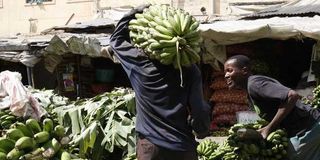
A man transports bunches of bananas along Chwele-Bungoma highway on June 17, 2020.
Photo credit: Isaac Wale | Nation Media Group
Banana diseases pose significant threats to both local and global banana production. Outline some of the most destructive pests and diseases.
Significant pests and diseases affecting bananas include weevils, nematodes, Sigatoka disease, Banana Bunchy Top Virus (BBTV) and Fusarium wilt.
When attacked, plants show symptoms such as yellowing and drying leaves, shrinking stems, rotting banana stools and weak suckers, all of which compromise plantation health.
In a bid to improve efficiency and cut labour costs, technology has driven major advances in precision irrigation, disease detection and resource management.
Farmers are trained on Good Agricultural Practices (GAP), with emphasis on conservation agriculture, Integrated Pest Management (IPM), and the safe and effective use of pesticides.
Training also covers organic farming, record-keeping, collective input purchasing and marketing, as well as mindset change to help farmers treat farming as a business.
In addition, fertiliser application and disease prevention are increasingly supported by smartphone-integrated systems that enable seamless connectivity between farmers and digital platforms.
Top on the list of challenges is limited knowledge, which poses a significant risk to the banana trade and underscores the need for regular training.
Poor drainage is another concern, with many farms turning swampy and marshy.
The absence of organised farmer groups or cooperatives for collective input purchase and marketing further constrains the sector.
In addition, the shortage of agricultural extension officers calls for training more lead farmers through Farmer Field Schools (FFS) to complement overstretched government staff.
Banana diseases also pose a major threat, spreading rapidly and causing significant economic and agricultural losses.
For optimal banana business have you put strategies to train farmers on the importance of soil testing and record keeping?
Sharon Mutiga at her banana farm.
Photo credit: Gitonga Marete | Nation Media Group
Soil testing is a critical practice in banana cultivation, providing vital information for optimising growth and yields.
Farmers are advised on its importance, though many shy away due to cost implications and the lack of reliable service providers. Testing becomes cheaper and more practical when done collectively by neighbouring farmers.
In Taveta, more than 90 per cent of farmers do not keep records, making it difficult to assess productivity, track the cost of production against income, ensure product traceability, or observe the pre-harvest interval (PHI) after pesticide application.
Record-keeping is a strategic tool that supports data-driven decision-making, optimises resource use and strengthens risk management.
You are also working closely with Rutgers University of the United States, what are some of the areas of intervention are you looking at to be better poised in the industry?
In collaboration with Rutgers University, the initiative seeks to improve the livelihoods of smallholder farmers in Taveta by addressing key interventions, including promotion of Good Agricultural Practices (GAP), formation and strengthening of farmer producer organisations, improved access to local and international markets, closer collaboration with government departments and agencies, and expansion into value addition.
With goodwill gestures from the government and stakeholders, where do you see the banana industry in Taita Taveta?
The potential for expansion and increased productivity across all crops is immense, but this will require coordinated intervention by the national and county governments, together with development partners, to drain canals to and from Lake Jipe using specialised floating equipment.
Bilateral talks with neighbouring Tanzania should also be fast-tracked to clear the river that serves as the lake’s feeder and outlet on the Tanzanian side.
Ironically, while Tanzania urgently needs the water for power generation and farming around the Nyumba ya Mungu area, the same water is in excess on the Kenyan side, where it is flooding and damaging farms in Taveta.