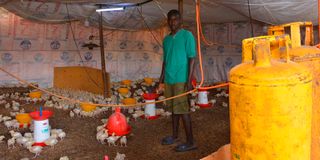
In Kisaju village, Kajiado East sub-county, Harrison Kanja, a 28-year-old man, is trying to reduce his family's poultry farm's reliance on charcoal as a heat source for their brooding chicks.
Instead, Harrison Kanja has turned to LPG gas, which is a more reliable option.
For the past five years, Harrison, a fourth-year automotive engineering student at Dedan Kimathi University, has played a pivotal role in the Kanja poultry farm. His parents started the farm 10 years ago in a dry part of Kajiado County.
Initially, the farm used to rely on charcoal heat for brooding.
Emannuel Kyalo, the manager of Kanja Poultry Farm in Kisaju, Kajiado East Sub County, is shown in this photo taken on October 8, 2025.
Photo credit: Stanley Ngotho | Nation
Over the years, logging of indigenous trees in Kajiado County for firewood and charcoal has been identified as a major contributor to the adverse effects of climate change.
Using gas as a heat source on poultry farms will be a major milestone in mitigating the effects of drought in this semi-arid county.
Brooding is one of the most critical stages in poultry farming. Day-old chicks are delicate and highly dependent on external heat sources to maintain their body temperature during the first few weeks of life.
Kanja told Seeds of Gold that the use of charcoal stoves, which were placed strategically around the brooding area, was becoming untenable due to the high cost of charcoal in the local market, which increased from Sh1,000 to Sh3,000 per bag, especially after the government first implemented a nationwide logging ban in 2018. President William Ruto lifted the logging moratorium in October 2025.
“When my parents roped me into poultry farming, using charcoal for brooding posed a challenge as it was difficult to regulate the temperature uniformly. There was plenty of production of carbon monoxide and smoke, leading to high mortality rates among the birds. It was also resource-intensive, requiring constant attention and refuelling, which needed more manpower,” said Mr Kanja.
Emannuel Kyalo, the manager of Kanja Poultry Farm in Kisaju, Kajiado East Sub-County, is shown in this photo taken on October 8, 2025.
Photo credit: Stanley Ngotho | Nation
The young farmer, who is very particular about the birds' feeding programme, runs two poultry houses metres apart on 50 by 100 metre plots owned by his parents. Currently, the two farms are home to 4,600 broiler birds.
Whenever he is away at university, a farm manager runs the farms with the help of two casual workers.
“I am a hands-on farmer, but when I am away at school, my manager runs the farm while I monitor it through CCTV cameras. Technology has eased the burden of running the farm as a full-time activity,” he added.
The farm is slowly turning into a demonstration farm for local aspiring farmers who are diversifying into poultry farming from cattle rearing, which is often affected by annual droughts caused by the adverse effects of climate change.
The young entrepreneur initially attempted to use electricity as a heat source for his chicks, but this became untenable due to the high cost of electricity and constant blackouts. He then switched to using liquefied petroleum gas (LPG) brooders to produce heat for his chicks during the first 21 days of their lives.
He believes that it takes the expertise of a technician to connect the LPG cylinders to the special burners, which are placed strategically in the poultry house. Each burner, which is readily available for Sh20,000, serves at least 1,000 birds. A 37-kilogram cylinder can be refilled locally for Sh 10,000.
The ideal brooding temperature ranges from 32°C to 35°C during the first week, gradually reducing as the chicks grow older to prevent mortality.
Emannuel Kyalo, the manager of Kanja Poultry Farm in Kisaju, Kajiado East Sub County, is shown in this photo taken on October 8, 2025.
Photo credit: Stanley Ngotho | Nation
Apart from locally assembled Jua Kali burners, there are more advanced burners on the market that often come with thermostatic controls for accurate temperature management.
"Choosing the right heat source for brooding can mean the difference between success and failure on your poultry farm." Gas is the most cost-effective, efficient and safe heating system,” said Mr Kanja. “In the wake of climate change, especially in Kajiado County, farmers need to mitigate the adverse effects of climate change by discouraging logging for charcoal.”
Kanja Farm Manager, the equally youthful Mr Emmanuel Kyalo, maintains that using LPG gas as a heat source has reduced the workload for poultry farmers during the critical period of rearing birds.
"With the use of regulated LPG gas burners, each poultry farm can be managed by a single employee. Using charcoal as a heat source forced farmers to employ workers to monitor the process around the clock,” said Kyalo.
The Nairobi City Market provides a market for this young farmer, although he says that the fluctuating market can be discouraging at times.
"Poultry farming is lucrative, but sometimes prices drop to Sh230 per kilogram. In better months, prices range between Sh320 and Sh350 per kg," he added, expressing his desire to market his birds via digital apps.
He added, "More young people are now embracing poultry farming. For me, it’s a leisure activity that allows me to feed and clothe myself and pay my school fees. After graduating, I have decided to become an engineer and a poultry farmer.”
He relies on his parents for additional capital to expand his poultry enterprise to at least 10,000 birds per cycle within the next five years.
Inadequate water sources have been another major impediment to the development of poultry farming in the region, as farmers are forced to outsource this scarce commodity from private boreholes.
“We usually collect rainwater in our farm houses, but it rarely rains in this region. We make use of the little we collect by mixing it with salty borehole water from the neighbourhood, for which we pay a fee."