A rusty iron gate with faded green paint, clearly weathered by years of sun exposure, welcomes visitors to a 20-acre farm in Olopito village, on the outskirts of Narok town in the Motonyi area.
From the outside, the bustling agricultural activity on the farm is concealed by a thicket, but upon entering, the smell of fresh and decomposing livestock droppings and urine greets you.
To the left and right of the gate are old buildings occupied by farm hands. In the middle is a raised dogs' kennel and next to it is a store. Beyond these structures is an old timber-walled and rusty iron-sheet-roofed main house.
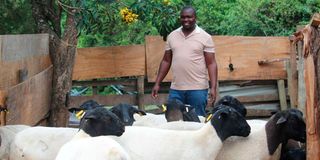
Approximately 100 Dorper sheep and goats are fed silage from troughs in a structure within the pen in which they sleep, which is located directly opposite the dog's kennel.
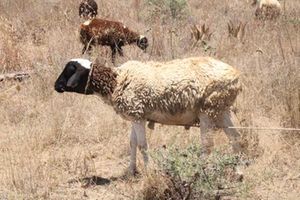
Visitors to the farm are struck by the healthy, clean, fat goats and sheep, which are busy feeding on dry matter. Fresh water is provided in troughs along the well-fenced, round structure, which keeps predators at bay.
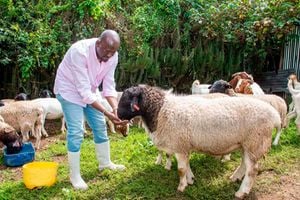
Mr Nick Koriata, the director of Mayfair Farms, breeds pedigree Dorper sheep and Red Kalahari goats here. These are imported from South Africa and sold to local breeders in Kenya, Uganda and Tanzania.
On arrival, we find three farmhands attending to the livestock while a local farmer had just supplied a bag of maize, which would later be ground and fed to the animals.
“Here, we only deal with purebred animals, which we import from reputable South African farms for breeding purposes only,” Mr Koriata told Seeds of Gold during a tour of the farm.
The farm is turning heads in Narok County and generating a lot of interest from East African farmers interested in pedigree goats and sheep.
Mr Koriata said he was driven to import livestock from South Africa due to a shortage of pure breeds in the country, which he discovered a year after venturing into livestock breeding.
He started his livestock business in 2017 by breeding locally available Kalahari Red goats and Dorper breeds, before transitioning to imports.
“I was inspired by a friend and mentor in Laikipia County, from whom I bought Kalahari Red goats. I fell in love with them, and I haven't looked back since,” Mr Koriata revealed.
He said that a year's experience of breeding the animals taught him that it was a good business, but that he needed to upscale it to maximise profits and feed a certain market niche that had emerged.
“I realised that it was better to go into purebred production, since the demand was — and still is — too high for us to be able to satisfy. The stock upgrade started with the realisation that the local animals were not thriving, growing slowly, and reproducing poorly,” he said.
Mr Koriata stated, "I did a lot of research, travelled widely to benchmark against other farms, and realised there was a shortage of pure breeds in the country."
For the last eight years, the breeder has been importing animals by air freight, shipping in six containers a year.
On average, a container with 70 animals costs more than Sh4 million, depending on their age: the older they are, the higher the purchase price.
Although transporting the animals by road is cheaper, it is strenuous for the livestock as they have to stand for several days, which sometimes leads to deaths.
Most of the Dorper sheep are sourced from the farm owned by Mr Rikus Demerwe, the president of the South African Dorper Sheep Breeders Society, with whom Mr Koriata has a long-standing association.
“A certified purebred ram can cost as much as Sh300,000, but it is worth every penny for a farmer keen to improve his stock and stand out in the market,” he said.
Among the animals on the farm at the time of the interview were 30 Dorper rams, 15 pregnant ewes, seven Meat Masters, White Savannahs and Boers, among others.
There are hundreds of other goats and sheep in the Ngoirowani area of Naro West, where the parent stock is kept. However, our team did not visit this area.
“Instead of taking a risk by buying livestock at the local market, it makes sense to save up and import pure stock. It is expensive, but makes business sense,” stated Mr Koriata.
"It is important for beginners to have a purebred ewe and to use a purebred ram or artificial insemination services to produce the best stock," he said.
“I plan to import semen from South Africa for use on my own farm and to supply to other farmers interested in upgrading their stock,” he said.
Mr Koriata said that prospective buyers do not have to book the animals in advance as it is a walk-in, walk-out arrangement.
“When we started off, there were few purebred animals in the country, so we decided to bridge the gap and make these animals available to farmers locally,” he said.
"We are breeding and selling ewes to farmers in Kenya, Uganda and Tanzania – a market with huge demand that we cannot satisfy," he stated.
Major challenge for farmers
The farm also sells meat masters, merinos, Hampshire and Savanna goats, among others, but only on order.
The animals are fed silage in the morning, released to forage for grass in the fields where water is also available, and then fed lucerne pellets, grains, and commercial feeds in the evening.
However, Mr Koriata says that the high cost of quality livestock feed is impeding the expansion of the business.
“The difference between Kenya and South Africa lies in how the animals are fed and vaccinated. We still have a long way to go to catch up with South Africa in those two areas,” he stated.
“Sometimes, we have to import concentrates from South Africa to maintain the same feeding standards for imported animals,” he said.
Formulating feeds is expensive, so the government should zero-rate animal feeds to boost production across agribusiness chains and increase farmers' incomes.
Livestock require huge volumes of cereals, especially maize, so the government needs to incentivise farmers to produce it in large quantities.
The availability of vaccines and the means of preserving them in rural areas has been a major challenge for farmers in these counties.
Most agrovets do not have vaccines, and there are few veterinary and livestock production officers in sub-counties to provide professional assistance to farmers.
Due to poor handling, a lack of preservatives, and uneven electricity distribution, some farmers are given expired drugs.
"The Kenya Veterinary Vaccines Institute (Kevavi) needs to be devolved so that vaccines can be made available across the country at a lower cost," he said.
Mr Robert Cheruiyot Langat, an animal health expert, said that biosafety is critical in the breeding of goats and sheep, and that farmers should take a keen interest in order to curb the spread of diseases that lead to the loss of stock or high production costs.
"Vaccinating animals against disease and regularly deworming them is key to livestock production. Black disease, pulpy kidney disease (enterotoxaemia), pizzle disease, pneumonia and ovine brucellosis are among the most common diseases affecting animals,” said Mr Langat.
Other diseases of which farmers should be aware include foot rot, anthrax, goat pox, Johne's disease, mastitis and milk fever.
He says that farmers should observe proper nutrition, parasite control and hygiene, and engage veterinary and animal health specialists to ensure that proper prevention and treatment measures are adhered to in order to prevent animal loss.
For security, the farmer relies on guards and dogs, which he keeps on the farm to prevent theft.
Several well-built German Shepherds and Rottweilers are kept in a cage during the day, fed and released at night to guard the goats and sheep on the farm, with the support of watchmen who ensure that no intruders access the farm under the cover of darkness.
“We place a high value on the dogs, which form an additional layer of security on the farm. They are vaccinated and dewormed regularly by veterinary officers to ensure they are healthy and safe to interact with people and livestock,” Koriata stated.