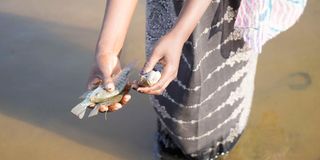
On a hot Tuesday afternoon in Chanaani Village, Galole Constituency in Tana River County, 26-year-old Habiba Ibrahim leans over the edge of a man-made pond filled with tilapia.
With her hands dipped in the water, she scatters feed made from maize bran and pellets, smiling as the fish's silver bodies ripple the surface. What started as a desperate attempt to generate an income has become the backbone of her livelihood and a lifeline for dozens of young men and women in her community.
Three years ago, Habiba, a diploma graduate, was unemployed and had little hope. Like many young people in the county, she had the right qualifications but couldn’t find work.
Her options were limited: she could try her luck in the boda-boda business, do menial labour or wait endlessly for elusive government jobs.
“I didn’t want to sit at home waiting to get married or relying on relatives for support. I wanted something sustainable that could also help other young people around me,” she recalls.
Her idea was fish farming. The River Tana, Kenya’s longest river, flows past her village, providing an abundant water supply.
Habiba Ibrahim in one of her ponds at Chanaani Village in Tana River County on September 17, 2025.
Photo credit: Stephen Oduor | Nation
With the help of her father and brother, and using some of her savings from selling vegetables, she dug a 30-by-10-metre pond on her family’s land and stocked it with fingerlings obtained with the help of a local organisation.
“I had saved around Sh86,000 from selling mchicha and sukuma wiki, which I intended to use to start a boutique. However, I changed my mind after attending a forum about aquaculture,” she explained.
Habiba told her father about it when she got home, and it became a family conversation. Inspired by her idea, her parents and siblings raised Sh211,000 to start her first pond.
Without any formal training, her first attempt was risky. She relied on advice from agricultural officers, online research and discussions with other farmers.
Her father, who had also invested in the venture, was determined to see her succeed, as were her siblings.
Within three months, the pond produced its first batch of fish, which she sold locally for Sh300 per kilogramme, making a profit of Sh73,000 in the first month. Encouraged by this, she reinvested her profits.
Today, Habiba has expanded to three ponds. What was once a solo project has become a youth cooperative, attracting young men and women from Chanaani.
Together, they rear and harvest fish, package the produce and supply the local markets. On a good week, she sells fish worth Sh35,000 from one pond, pricing each kilogramme at Sh500. This income pays her siblings' school fees and supports several families.
“This pond is not just mine anymore,” she says. “It belongs to the young people of this village. We share the benefits, and together, we have something to hold onto.”
Her journey has not been without challenges. In Tana River's conservative society, women who venture into what is considered men's work often face ridicule.
“When I started, many people told me that it was shameful for a woman to dig ponds and wade in mud,” she says. “Some even said that fish farming was for men or outsiders. But I decided to ignore the criticism and, with the support of my father and brothers, I persevered.”
Over time, as her ponds thrived and her business expanded, her critics turned into her customers and employees.
Meanwhile, more than 150 kilometres downstream on the shores of Kipini, 34-year-old Iqbal Mohammed runs a successful lobster farm that supplies luxury hotels in Malindi and Mombasa.
Packaged lobsters.
Photo credit: Pool
His farm is located on the Indian Ocean and comprises four large cages housing hundreds of lobsters. Every day, his team of 13 young people, including a farm manager, a marketing officer, boat operators and harvesters, work to meet the growing demand.
Live jumbo lobsters sell for over Sh3,500 each, and Iqbal supplies more than 10 kilogrammes of them every day.
This equates to hundreds of thousands of shillings in revenue every week — money that not only sustains his business, but also provides salaries for his young employees. Some of them are diploma and degree holders who had struggled to find employment elsewhere.
“I have graduates working as managers and marketers, and even a woman with a diploma in marine consultancy,” says Iqbal. “The reality is that jobs are scarce, and we must create our own.”
He dreams of expanding to hundreds of cages, exporting lobsters beyond Kenya and creating even more jobs for young people.
For Mwanajuma Hiribae, the County Executive for Fisheries, stories like Habiba's and Iqbal’s prove that the future of Tana River lies in the Blue Economy.
“The young people in this county are resilient, creative and eager for opportunities,” she says. “Our role as the government is to equip them with the right skills, resources and connections so their businesses can flourish.”
The county has partnered with the Kenya Marine and Fisheries Socio-Economic Development Project (KEMSFED) and the European Union to expand training provision and offer practical support.
Young people have benefited from receiving boats, fishing cages, nets and storage facilities, which has eased their entry into aquaculture and fisheries. Capacity-building workshops teach young people everything from pond construction and cage farming to financial literacy and market linkages.
“We are not just handing out equipment,” explains Ms Hiribae. “We are empowering the youth with knowledge. That is the only way to ensure sustainability.”
Yet the broader picture remains troubling: There are huge numbers of unemployed young people at risk of radicalisation.
An estimated 3,000 educated young people are unemployed, with many resorting to riding boda-bodas or clinging to the hope of joining the police or army — a lottery that benefits only a few.
Poverty rates remain high, with most households surviving on less than Sh100 a day. In such an environment, Habiba and Iqbal's ventures shine as rare beacons of hope.