Visitors to Kennedy Ong'aro's home in Nairobi's Ngara Estate are greeted by overgrown sugarcane. The tangy aroma of lime and ginger fills the air as the metallic gate opens onto a sprawling compound teeming with assorted ornamental plants.
Dr Ong'aro, a professor at Daystar University, has redefined urban farming with his lush sugarcane farm, located just a stone's throw from Nairobi's central business district. When the Seeds of Gold team visited, Dr Ong'aro was supervising a worker using a heavy-duty machine to squeeze sugarcane to produce juice.
“When I am not teaching sustainable development at the university, I am either producing sugarcane juice or delivering it to vendors operating sugarcane juice bars in downtown Nairobi,” he said.
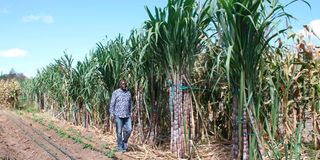
Kennedy Ongaro, a lecturer at Daystar University, shows a sugarcane farm at the university’s main campus in Machakos County on July 4, 2025. He grows sugarcane in drylands.
Photo credit: Pius Maundu | Nation
The process of delivering fresh juice to the city begins with harvesting a bundle of mature sugarcane behind Dr Ong'aro's main house. The sugarcane is then peeled to remove impurities that may contain germs, chopped into small pieces, and washed in clean water before being fed one by one into the machine to extract the juice in a clean environment. Dr Ong'aro uses the same machine to squeeze lime juice from fresh limes sourced directly from farmers in Makueni County.
“Sugarcane juice is 100 percent alkaline. This characteristic adds to its value. Multiple studies published in credible online journals show that sugarcane juice cleanses the kidneys and protects the body against certain diseases," said Dr Ong'aro.
“The alkalinity of sugarcane juice makes it delicate. It turns black and goes bad easily unless it is stored in a very cold environment. This change in colour is caused by oxidation. We add acidic lime juice to prevent this. We also add ginger to spice it up. We don't add water to our juice.”
Dr Ong'aro, an expert on sustainable development, grew up working on his father’s tea plantation in Kisii County. This is where he got his start. “As we toiled in the tea plantations, picking tea leaves all day long, my father would say, ‘If you want to be self-sufficient beyond office work, you need to have an agricultural activity to supplement your income’.”
This did not make much sense to the young Dr Ong'aro until he moved to India for secondary school and higher education. He has since realised that it is not necessary to own a large plot of land in order to practise agriculture.
Sugarcane juice.
Photo credit: File | Nation
When he recently addressed a forum on emerging agribusiness opportunities in Machakos County, Dr Ong’aro stressed the importance of urban farming in addressing food insecurity and creating employment opportunities for urban communities.
"Urban farming is more than growing vegetables and keeping chickens in the backyard. The market for sugarcane juice is insatiable. We supply vendors who run popular sugarcane juice bars in central Nairobi,” he said.
When asked how much he makes from the sugarcane juice business, Dr Ong’aro turned to a hypothetical scenario. "It costs Sh120,000 to buy 6,000 pieces of sugarcane from Kisii County. A truck charges around Sh40,000 to transport that cargo to Nairobi. On average, a single mature sugarcane plant produces four glasses of juice, each worth Sh400. Taking this into consideration, 6,000 pieces of sugarcane can produce 24,000 glasses of juice, fetching roughly Sh2,400,000. There are very few enterprises that are this lucrative. The return on investment increases significantly if you grow the sugarcane yourself,” he said.
Like many successful businesses, Dr Ong'aro's enterprise started small a decade ago. While driving home from an event in Kitui County, he collected some sugarcane cuttings that a vendor in Donyo Sabuk Township was planning to throw away. "My plan was to keep the cuttings fresh before transferring them to a 40-acre farm that I was setting up in Kajiado County. However, when they sprouted aggressively, I decided to let them be. They became the source of the seedlings that enabled me to establish a thriving sugarcane farm in an urban setting over the years,” he said.
Kennedy Ong'aro, a lecturer at Daystar University, at his sugarcane farm in Ngara, Nairobi.
Before long, the sugarcane threatened to replace the creepers, assorted palms, snake plants and other ornamental plants that Dr Ong’aro had used to landscape his property. Once there was no more space for sugarcane in his own compound, he moved onto his neighbours'. Today, he boasts approximately a quarter of an acre teeming with sugarcane. This is a major milestone in Nairobi. Apart from selling sugarcane juice, Dr Ong'aro has found another source of income: selling sugarcane seedlings. “A single cutting goes for Sh100,” he said.
Agronomists advise farmers in dry areas to grow sugarcane in pits to promote growth and collect rainwater.
Dr Ong'aro grows sugarcane in pits measuring 4 feet by 4 feet by 4 feet. Topsoil is returned halfway into the pits before the cuttings are introduced. "Each pit should hold four sugarcane cuttings, which are planted at a 45-degree angle. They are covered halfway with soil, with the buds of the stalk facing upwards, to enable them to develop into shoots easily. The loose soil in the pit promotes the smooth growth of the sugarcane roots, while the moisture it holds sustains the sugarcane's growth during dry spells. Heavy mulching on top of the pit further promotes growth by conserving moisture. Sugarcane requires minimal management. It matures in a year,” said Dr Ong’aro.
Kennedy Ong'aro prepares sugarcane juice in Ngara, Nairobi.
Photo credit: File | Nation
The Dean of the School of Applied Human Sciences at Daystar University has established a lush sugarcane farm on the university’s main campus in Machakos County to demonstrate his idea. The farm depends entirely on rainfall. “We have successfully demonstrated that sugarcane can thrive in dry areas such as Kitui, Machakos and Makueni counties, where rainfall is scarce. Farmers in these regions have another reason to grow sugarcane: a ready market for sugarcane juice, which is in high demand in dry, hot regions. Unlike maize and pigeon peas, which have seasonal demand, sugarcane provides farmers and entrepreneurs with a steady source of income,” said Dr Ong’aro.