The status of food security around the world has long been viewed not as a question of if, but when, a looming challenge that continues to demand constant vigilance.
Over the years, various innovations have been introduced to prevent widespread hunger and system collapse.
In a country facing the triple threat of land degradation, climate change and food insecurity, two university students have joined forces to find a solution.
Bravin Kulei and Dion Nekesa, who study Information Science and Computer Science respectively at Kabarak University, aim to address one of the country’s most pressing issues: growing more food in less space with greater precision.
Through an AI-powered smart hydroponic system, they are working to bring modern farming technology directly to farmers to help them grow food and support the growing population.
Bravin Kulei and Dion Nekesa display their demo hydroponic system at their stand at the Nakuru Agricultural Society of Kenya show.
Photo credit: Boniface Mwangi | Nation
Kulei and Nekesa have combined their technical expertise and lived experience to develop a system that can address both issues using the most effective tools at their disposal – technology.
According to them, their innovation – a compact smart hydroponic unit – uses sensors and data to automatically manage irrigation, monitor soil conditions and optimise fertiliser use in real time.
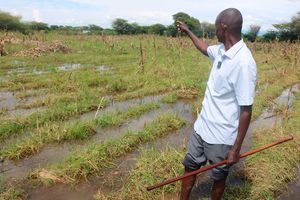
Kulei, a final-year student, is concerned that population growth is outpacing agricultural production. He notes that, while more mouths need feeding, the amount of land available for farming continues to shrink due to flooding, rising water tables and unplanned development.
“The idea came from observing that, although our population is growing, the amount of land available for farming is actually decreasing. Rising water levels and other factors are taking away more and more farmland, yet one thing remains constant: people must eat,” he says.
“At the moment, Africa is struggling with food production. We need to innovate in a way that balances these challenges so that we can produce enough food, even when the climate is not on our side.”
Nekesa, on the other hand, wanted to develop an agricultural system that would enable her father to monitor his farm remotely.
“Despite my father’s passion for farming, he often struggles to manage his crops because of his busy work schedule. This innovation will help him to monitor his crops and balance his life,” she says, alluding to the fact that the system caters to many ‘telephone farmers’ (farmers who are always following up on their farm’s productivity while away).
Bravin Kulei and Dion Nekesa tend to their seedlings at their demo hydroponic system at their stand at the Nakuru Agricultural Society of Kenya show.
Photo credit: Boniface Mwangi | Nation
The system, developed earlier this year, can be controlled remotely via a laptop using a microcontroller that analyses data collected from sensors.
“One of its core functions is smart irrigation, where Internet of Things (IoT) components capture information from the soil, water, pH levels, fertiliser and the surrounding environment, including humidity levels. This data is then transferred to a laptop so that we can view it,” says Kulei.
According to the innovators, the network of sensors tracks soil moisture, pH levels and humidity, only triggering irrigation when necessary. This reduces water wastage and ensures crops receive precise care based on their actual needs.
In addition to irrigation, the system can detect pests, analyse soil and use a built-in AI component to scrape data from government and research sources such as the Kenya Agricultural and Livestock Research Organisation and the Ministry of Agriculture, providing farmers with personalised growing recommendations.
Nekesa explains that users simply select a crop on the digital dashboard and the system automatically adjusts to provide the ideal growing conditions.
“We have already tested the system with coffee and tomatoes, and the results have been promising. We have also tested the machine learning models and are currently trialling them on our school farm to gain real-time experience,” she says.
Dion Nekesa tends to seedlings in the demo hydroponic system at the Nakuru Agricultural Society of Kenya show.
Photo credit: Boniface Mwangi | Nation
Dr Andrew Kipkebut, the Coordinator of Innovation and Business Incubation at the university, says that such innovations represent a critical shift in how farming will be done in the future.
He adds that this kind of innovation demonstrates the future direction of agriculture, and, echoing his student’s sentiments, says that, as land becomes increasingly scarce, precision farming in controlled environments enables farmers to achieve higher yields with fewer resources.
“What makes this project stand out is that it supports farmers who may not always be present on their farms and brings accountability through remote monitoring. If scaled up, such technologies could play a vital role in enhancing food security in Kenya and across the continent,” he says, adding that they have patented the innovation with the Kenya Copyright Board.
Hydroponics is gaining global attention as a way of coping with challenges to food production in diverse environments.
This type of farming enables crops to be grown without soil. Instead, plants are supplied with all the necessary minerals through a nutrient solution – a mixture of water and soluble fertilisers. The plants are supported by structures made from various materials as they grow.
This method is particularly advantageous in regions with poor soil quality or limited arable land. By eliminating the need for soil, hydroponics offers a solution that is efficient in terms of inputs and saves water for growing crops, enabling year-round production even in the most challenging climates when coupled with protected cultivation technologies.
The major advantages of such a system are the absence of weeds and other soil-borne pests, the elimination of toxic pesticide residue, more efficient use of water, greater control over nutrients and oxygen, and improved crop quality and yield.
The global hydroponics industry has grown into a multibillion-dollar market. Verified Market Reports estimates that the hydroponic vegetables sector will be worth $5.4 billion in 2024, projecting growth to $20.5 billion by 2033.
Dion Nekesa tends to seedlings in the demo hydroponic system at the Nakuru Agricultural Society of Kenya show.
Photo credit: Boniface Mwangi | Nation
Countries such as the Netherlands, the US and Japan are investing heavily in smart farming technologies that enable crops to be cultivated year-round, often with higher yields and reduced environmental impact.
In Africa, South Africa and Rwanda have begun piloting hydroponic systems on a commercial scale with positive results. South Africa, for instance, uses vertical farming units in urban schools and hospitals, while Rwanda has invested in hydroponic fodder systems to support its dairy sector.
However, uptake of the technology in Kenya remains slow, despite its potential to play a key role in closing the food security gap, especially in urban areas where land is limited.
Hydroponics also offers a sustainable solution for arid and semi-arid regions where traditional farming is disadvantaged due to climate change.
Kulei and Nekesa hope to expand their system to larger farms and integrate it with drone technology and a robotic arm for crop surveillance, disease detection, and harvesting. Their vision is to create a digital farming ecosystem that puts data and automation at the heart of agricultural decision-making in Kenya’s efforts to feed its population in the future.