Plastic pollution is a major concern as it poses significant threats to ecosystems and human health.
It contributes to climate change by releasing greenhouse gases during production and degrades vital ecosystems, reducing their ability to support life and adapt to other environmental stressors like climate change.
As countries around the world continue enforcing the ban on plastics, and at the same time moving away from synthetic fibre, one entrepreneur in Nyamira County is mitigating plastic use in the beauty industry with the production of biodegradable hair extensions from banana stems.
Askah Kerubo’s journey in banana innovation is a good example of how banana waste can be used to reduce environmental pollution by promoting sustainable waste management practices.
Ms Kerubo is one of the founders of Wefahson Banana Farmers’ Cooperative Society, which was founded in 2006.
The company, based in Getare, along the Kisii-Nyamira Highway, processes bananas and adds value to them to create products such as wine, flour, cookies and other products.
But beyond that, there is some uniqueness that sets it apart from other organisations that equally process banana fruit to create similar products.
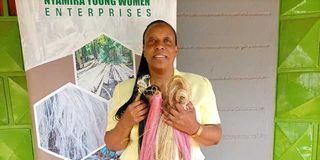
Askah Kerubo is spearheading a green beauty revolution by creating biodegradable hair extensions from discarded banana stems. This offers a sustainable alternative to synthetic braids.
Photo credit: Wycliffe Nyaberi | Nation
This is the making of banana braids. These biodegradable hair extensions are quickly gaining traction not only in Kenya but also outside countries where their demand is even higher, according to Ms Kerubo.
Seeds of Gold visited Ms Kerubo at her firm for insights about what it entails in the production of these biodegradable braids.
“We started in 2006. By then, we were processing bananas by adding value to the fruits. We were grinding banana flour to make biscuits,cookies, wine, vinegar and other products. But after gaining enough knowledge in this industry, we realised that banana stems, which we often threw away or fed to livestock, were gold that can boost our economy,” Ms Kerubo said.
The entrepreneur added that they did more research on how to achieve this, and after a few years, they started the journey.
She explains that the process of making banana braids is not a sophisticated one as long as you have skilled personnel and the right machinery.
According to Ms Kerubo, banana stems are cut according to the length of braids that one desires to have.
Once cut, the stems are cleaned and their skins peeled. Using knives or sharp objects, the banana leaves are
“In the machine, the stretched tissues or fibers are treated with salt and other products to soften them and give them the desired texture and color. Once removed from the machine, they are allowed to dry before being packed ready for market,” Ms. Kerubo said, adding that the process of making these braids can take up to five days.
The entrepreneur remarks that apart from being environmentally friendly, there are many more advantages of using biodegradable braids as compared to synthetic ones.
The entrepreneur points out that once someone feels tired of having them on her head, she can remove them and put them in a bin. When they finally get into the soil, they decompose and form organic matter, which enriches the soil.
Ms Kerubo also adds that compared to synthetic braids, biodegradable banana hair extensions have no side effects to the user.
“Many people often get itchy when they plait their heads using synthetic fibre braids. But in our case, we have not had customers who have tried them complaining about them. This is proof that they are one of the best,” Ms Kerubo added.
In addition to making braids, Ms Kerubo says they make other products such as baskets, necklaces, earrings and carpets from banana stems.
Wefahson Banana Farmers’ Cooperative’s innovation is not only an income generation activity for the pioneer members but is also a good example of how a well-thought-out idea contributes to environmental protection at a time when the world is increasingly facing climate change, which has been largely caused by human behaviour, such as pollution.
Apart from the local market, Ms Kerubo argues that they have a large market in foreign countries, but they do not meet the demand.
She encourages other people, especially women and youth groups, to get involved in such an activity, as it is the surest way of earning a living out of it.
“I believe that if women and youth in the villages gain knowledge on how to make such braids, they can change their lives considering that job opportunities in our country are becoming scarce every day,” Ms Kerubo explained.
The entrepreneur explains that they have not received enough support from the county and national governments to further empower them.
“If we can get modern machinery, we can make many things out of the banana stems, but at the moment, we do not have enough machines and we have to contend with the little that we have,” the entrepreneur remarked.