For the past decade, the name of 30-year-old John Njogu has been synonymous with mboga za kienyeji (indigenous vegetables) in the towns of Mlolongo and Athi River in Machakos County, as well as in the neighbouring town of Kitengela in Kajiado County.
What began as a test of resilience and determination has evolved into a thriving enterprise that feeds thousands and earns him substantial returns from the Kasoito slum. The informal settlement is located upstream of the River Athi within the Athi River township.
A normal day for the KCA University graduate begins at 5am, when customers start streaming onto his seven-acre plot, which boasts an assortment of vegetables, including amaranthus (mchicha), black nightshade (managu), spider plant (mwagani), kale, and spinach.
The crops are strategically planted to ensure a consistent supply throughout the year. Indigenous vegetables are fast-growing, maturing within 30–45 days, and are also drought-resistant.
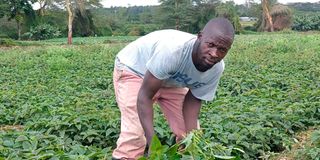
John Njogu, a 30-year-old accountant and a professional farmer in his leased farm within Kasoito slum in Athi River Sub-County, on April 18, 2026.
Photo credit: Stanley Ngotho| Nation Media Group
Recent data from the Ministry of Agriculture indicates that indigenous vegetables (AIVs) are experiencing a significant resurgence in Kenya, transforming from neglected 'poor man's food' into valuable 'green gold'.
This shift is driven by their exceptional nutritional value, climate resilience and the rising demand in urban areas for healthy, locally sourced food.
However, the young farmer’s journey has not been easy.
When 'Seeds of Gold' visited him on April 18, 2026 at his farm, he was mingling freely with at least ten casual workers and attending to customers, despite the chilly afternoon.
Njogu, who is 23 years old, said that after graduating in 2016, he was forced to return to his Lari village in Subukia Sub-County in Nakuru County due to the limited availability of white-collar job opportunities. There, he joined his parents in subsistence farming.
The following year, he moved to the Kasoito slum in Athi River, where his uncle, who grew assorted seedlings for a living, accommodated him.
"My profession as an accountant did not stop me from working as a casual labourer for my uncle for a year, until I got on my feet.
“I started growing vegetables in the small plots of land that my uncle had given me, but the income was barely enough to support myself. I saved enough to lease my own plot of land. I persevered and ended up falling in love with farming. When I arrived in the slum, I spotted an untapped opportunity and seized it,” said Njogu.
Like several other farmers, Mr Njogu has leased arable land along the edge of the slum, on the clean upstream stretch of the River Athi, paying 15,000 shillings per acre per year. They practise furrow irrigation there. Pioneer settlers in the slum usually lease out community land.
The area also borders the Kaputiei wildlife conservation area managed by the Kenya Wildlife Service (KWS) and a wildlife migration route.
Through organic farming, Mr Njogu has established a niche market supplying local vegetables to the towns of Mlolongo, Athi River and Kitengela, targeting domestic consumers through mama mboga traders and high-end restaurants serving indigenous produce.
A kilogram of indigenous vegetables retails at between Sh25 and Sh40 depending on the season, while common vegetables retail at an average of 15 shillings per kilogram. On a good day, he said he earns between 10,000 and 20,000 Kenyan shillings.
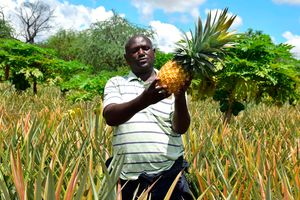
He has also diversified into banana farming, and the crop is now at an advanced stage of maturity.
"Small-scale traders usually begin arriving by 5:30am. They pick the vegetables themselves. I have hired several boda boda riders to deliver vegetables to my customers, particularly in residential areas and hotels. Demand for indigenous vegetables is higher than supply. There is a ready market due to the growing population in nearby towns,” said Njogu.
He said that he had used earnings from farming to build a home in Noonkopir Estate in Kitengela town, where he now lives with his wife and seven-year-old son.
“My fellow young people should know that farming is a worthwhile profession. It's not just for the uneducated, as is often perceived,” he added.
However, the high cost of farming supplies and insufficient water during the dry season have been major setbacks for Njogu and other farmers. Counterfeit seeds have also been a major challenge.
"Due to climate change, River Athi has been drying up during the dry season in recent years, leaving us with very little water for farming. Sometimes we fall victim to suppliers selling counterfeit seeds that reduce our production,” said Njogu.
He added, "Sometimes animals from Nairobi National Park stray onto farms and destroy crops."
The young, hands-on farmer told Seed of Gold that he plans to expand his farming activities by an additional 10 acres within five years, as well as purchasing land in the neighbourhood in order to adopt drip irrigation and target the export market.