A simple Google search for regions that produce pineapples reveals that Kiambu, Kwale, Kilifi, Murang'a and Nyeri are among the top results. However, a businessman from Kiambu has added Makueni County to the list.
Joseph Karimi has established a pineapple plantation in the quiet village of Muangeni in the Masongaleni ward. This is turning heads in a region known for its maize, pigeon peas, mangoes and citrus fruits.
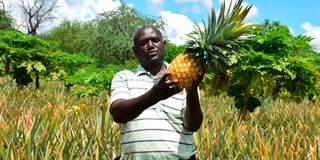
“This is smooth cayenne,” Mr Karimi tells 'Seeds of Gold', referring to a popular pineapple variety prized for its size. A small piece crumbles into a mouthful of distinctive pineapple juice. “Smooth Cayenne is not acidic. It has a strong, distinctive pineapple aroma”.
Joseph Karimi displays a pineapple at Muangeni Village in Makueni County on March 26, 2026.
Photo credit: Pius Maundu| Nation Media Group
With a 10-acre pineapple plantation to his name, Mr Karimi is the quintessential Ukambani pineapple kingpin.
Growing pineapples starts with preparing the land through conventional tilling. Mr Karimi uses furrows to direct water from a robust irrigation system, which is replenished by the nearby River Athi. “An acre of farmland takes up to 12,000 pineapple suckers,” he said.
Pineapple, known scientifically as Ananas comosus, is a good source of sugar, fibre, manganese and vitamins A, B and C, and is eaten either fresh or processed.
According to agronomists, pineapples thrive in warm regions with well-drained, sandy loamy soil that is rich in organic matter. Pineapples grown in cold regions such as Nyeri County tend to be sour. When grown in dry regions, they tend to be sweet due to a high sugar concentration.
Mr Karimi’s enterprise has shone a spotlight on one of the driest regions in the country, which nevertheless has attracted Del Monte, a multinational company that grows pineapples in Kiambu County.
The company has settled on a plot of land a stone's throw from Mr Karimi’s pineapple plantation, as part of an ambitious expansion plan to grow the fruit. Top Del Monte officials revealed this information when they paid President William Ruto a courtesy call in January.
According to the Agriculture and Food Authority, producing a hectare of pineapples costs around Sh318,950. The majority of the production costs are incurred in sourcing planting materials.
A hectare of pineapples produces 70 tonnes of fruit, fetching Sh1,081,050 for the first crop. The cost of subsequent crops steadily decreases while income remains high.
Joseph Karimi displays a pineapple at Muangeni Village in Makueni County on March 26, 2026.
Photo credit: Pius Maundu| Nation Media Group
While access to land is a critical factor in commercial pineapple production, Mr Karimi agrees with scientists that patience is paramount. "Before venturing into pineapple production, a farmer should know that it is a long-term investment which requires not only capital, but also patience. Once planted, it takes around two years to harvest.
The good news is that you can then harvest for 10 years without replanting. This is the kind of information that farmers lack," says Dr Bramwell Wanjala, a biotechnologist who has studied pineapple production extensively.
Another major challenge in pineapple production is the availability of planting materials and exploitative middlemen. A farmer requires 12,000 seedlings for an acre of land. Scientists are exploring tissue culture technology to overcome the challenge of accessing planting materials.
Mr Karimi’s pineapple enterprise is centred on the expansive Githurai Market in Kiambu County. He delivers fruit to wholesalers at the market, which fuelled his journey into pineapple production.
Mr Karimi began selling pineapples at the market immediately after completing secondary school. Seeking to increase his profits, he left the market to set up pineapple plantations on leased farmland in Kiambu County.
However, over the years, Mr Karimi struggled to acquire sizeable plots of land on which to expand his pineapple enterprise, as land in Kiambu County became increasingly scarce.
As the population grew, residents used their shrinking plots of land for avocado farming and dairy cattle. This setback prompted Mr Karimi to move to Kilifi County, where he continues to grow pineapples on leased land.
“Kilifi County is ideal for pineapple production. The only problem is that we depend on rainfall. When it fails, all your investment is lost. This makes the pineapple enterprise unreliable. Irrigation gives farmers the confidence they need to thrive,” he said.
Mr Karimi admits that setting up a pineapple plantation in Makueni County was beyond his means. Some of his neighbours thought he was crazy when he started the project. "We decided to grow papayas as a fallback plan in case the pineapple project failed. Luckily, both crops have succeeded,” he said
. Those who initially doubted him have become part of his support system. “Mr Karimi’s pineapples taste just as sweet as those grown in Kiambu County,” said Regina Daudi.
Mr Karimi has since established that arid and semi-arid lands are among the most suitable zones for pineapple cultivation. Pineapples grown in Makueni County, for example, take at least three months less to mature than those grown in other counties.
He attributes this to the region's long hours of sunshine.
“We have found that the income a farmer earns from short-lived crops such as onions and tomatoes pales in comparison to pineapple profits,” says Benjamin Mwania, a farmer who grows tomatoes and onions near Mr Karimi’s pineapple plantation. Mr Karimi has offered to support farmers like Mr Mwania by providing them with seedlings, as he seeks to expand the enterprise in the region.