When I chose to study the biological sciences in high school many years ago, I naively believed I would spend my years in laboratories solving problems for the health of humans, animals and the environment. I strongly believed my class master when he authoritatively gave me the assurance.
I was fascinated by the idea of I, in white protective attire, scanning through a microscope and seeing minute enemies invisible to the naked eye and determining that my latest molecule innovation was destroying the microscopic bad guys to save humanity and animals. I had a dream to become a pharmaceutical research scientist to discover drugs and treatment methods for diseases.
My class master in the last year of secondary school buttressed my interest in veterinary medicine when he emphasised to me that human drugs were first tested and developed in animal models before being advanced to humans. Thus veterinary medicine and human medicine were closely related disciplines. I am happy that I confirmed his assertion years later when I studied veterinary medicine and practiced it.
My rethinking of a long career in biomedical research began in the early 1990s when I was a lecturer at the University of Nairobi, teaching pharmacology and toxicology to 3rd year veterinary students and carrying out research.
The Moi regime had become very oppressive to university staff leading to an academic strike that lasted close to a year. The experience of the strike quickly taught me that there was more to life than careers. There were leadership and governance decisions made by the highest ranking people in the nation and they could very easily obliterate one’s career objectives or even lives.
After close to a year of striking, I lost any further interest in university teaching, research and laboratory science. I went into private practice in 1997 and United Nations employment in 1998 to 2003. Later I returned to private practice and intermittent consultancy work with the United Nations, the Africa Union, non-governmental organisations, governmental organisations and the private sector.
I have gone down memory lane because the experience has taught me that leadership and governance errors of omission and commission by leaders, public servants, business people and any other person may seem mundane as they happen.
But they always come back to haunt other people and the whole nation in ways they may never know or even imagine.
Two incidents I had last week got me really thinking about the old adage that what goes around comes around. My first incident was an observation on Kangundo Road in Nairobi. I noticed every group of traffic police officers I saw while I was driving along the road were wearing face masks.
We all know the face masks became common-place during the Covid-19 pandemic in 2019. Nowadays people wear the masks if they have a cold or persistent cough – a desirable legacy of the Covid-19 pandemic. My question was then how come all the police officers could be having a reason to wear masks.
My friend we were driving with commented it could be that the police were attempting to conceal their identity in case they were caught on a random camera collecting a bribe from a motorist.
My research mind urged me to find out what could be the reason for the masks but the road was very busy. My governance mind argued I could not engage the police on a busy road because I would disrupt their operation.
I got a break on a stretch where the traffic was light but the two police officers on the road also had their face masks on. I stopped on the side of the road and walked up to them. They immediately looked anxious, alert and ready to respond to any eventuality. Their situational awareness and threat analysis was impressive – as it should be.
My security training kicked in and I stretched both my hands in front with the palms up indicating I was peaceful with good intentions and no weapon. At the same time I uttered my greetings. They answered and visibly eased up. I congratulated them in my mind for their training reflexes.
I told the officers I was interested in understanding why they were wearing face masks like all the others I had seen at different points. They asked me why and I explained it was my public health training that had prompted me to enquire.
My response put them fully at ease. They told me their working environment was too harsh for their health. They frequently got headaches, respiratory illness and coughing if they worked without the masks. They attributed the phenomenon to dust and irritating vehicle exhaust. They said sometimes they also got eye irritation and infection. They hoped the masks would help. But the environmental pollution was killing them slowly.
I was happy my curiosity had been satisfied credibly. Actually, the eyes of both officers were very red meaning they had been irritated. I explained to the officers their problems were due to bad leadership and governance especially corruption. It was the work of the county government and the National Environmental Management Authority (Nema) to ensure that Kenyans had clean air. Their combined failure was now causing the problems to the police officers and other Kenyans.
I told them neglect of public duty and corruption eventually causes all the citizens to suffer or even die. I reminded the officers that the National Police Service had topped the corruption charts in the country for many years but they never knew how it affected them and their families. They told me they had understood.
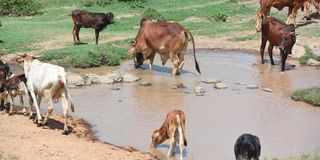
The next incident was at Mwalimu Farm in Ruiru along the Nairobi River. I saw three large herds of well-fattened cattle make a beeline for the foamy, smelly, dark-coloured river. As I watched them drink to their fill, I could not help but imagine the amount of harmful chemicals and microorganisms the cows were ingesting. The micro-organisms may be deactivated by the cattle’s digestive and immune systems but most of the chemicals would mainly end up in the meat and milk. The meat and milk would end up on our tables and the chemicals in our bodies once we consume the cattle products.
Surely, what goes around comes around. We pollute the environment out of our neglect and corruption only to eventually poison ourselves.