Hello

Your subscription is almost coming to an end. Don’t miss out on the great content on Nation.Africa

Ready to continue your informative journey with us?

Hello

Your premium access has ended, but the best of Nation.Africa is still within reach. Renew now to unlock exclusive stories and in-depth features.

Reclaim your full access. Click below to renew.

Seraphin Wanjiku
Caption for the landscape image:

From rotting bananas to crisps: Farmer fries her way out of losses

Scroll down to read the article

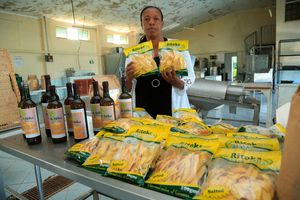
Seraphin Wanjiku showing crisps made from plantain bananas, during the EAC MSMEs Trade Fair 2025 at Uhuru Gardens, Nairobi, on November 14, 2025. 

Photo credit: Sammy Waweru | Nation Media Group

Ms Seraphin Wanjiku, a Kirinyaga County–based farmer, has been growing bananas for over a decade.

Like many smallholder growers across the country, her journey has not been without challenges, particularly when it comes to marketing her produce.

Bananas, being a highly perishable horticultural crop, are vulnerable to price fluctuations and post-harvest losses, with middlemen and brokers often taking advantage of farmers’ desperation to sell quickly.

Wanjiku grows the plantain banana variety, popularly known as Mkono wa Tembo, in Kerugoya, Kirinyaga County.

She recalls in 2023 how she lost produce worth thousands of shillings after failing to secure buyers willing to offer fair prices.

At the time, market conditions were unfavourable, and large volumes of her harvest went to waste.

“On average, a month, I would harvest sizable volumes but fail to get a good market,” she says.

According to Wanjiku, every two weeks, she could harvest about 150 kilos of plantain bananas from her farm.

Previously, a bunch weighing about 10 kilos sold for around Sh100, but during the market decline, prices dropped drastically to as low as Sh30 per bunch.

“Getting Sh300 from a whole bunch is a huge loss to a farmer,” she adds, recalling painful moments when ripe bananas rotted on her farm because buyers never showed up.

For a crop that takes months of careful tending, such losses were demoralising and financially draining her.

Wanjiku’s experience is a replica of the challenges facing many farmers growing perishable horticultural crops across the country.

Most face similar challenges, including exploitation by middlemen, lack of reliable buyers offering competitive prices, and inadequate cold storage systems and infrastructure.

According to the Ministry of Agriculture, post-harvest losses account for about 30 per cent of total production, a reality that continues to undermine farmers’ incomes.

For Wanjiku, these persistent losses became a turning point, forcing her to rethink her approach to banana farming.

Having seen banana crisps being sold in other regions, she began to consider value addition as a possible solution.

With no formal training and limited capital, the farmer decided to experiment using whatever was available at home.

However, with time, she has undergone several capacity building training enabling her to polish her skills in processing.

“Most people do not believe me when I tell them I started with kitchen items—simple equipment like a carrot grater,” she tells Seeds of Gold.

With basic tools and determination, she began slicing a few bananas and frying them into crisps in her kitchen.

In her first attempt, in an exclusive interview, she stated that it was promising. “I produced 10 packs of 200 grams each and sold every pack at Sh200 to neighbours within my locality,” she stated.

The response was encouraging, and more importantly, the figures immediately made sense to her.

“Selling the bananas as raw pieces would have earned me about Sh200, but processing them into crisps gave me Sh2,000,” she explained.

That realisation marked the beginning of a new chapter. Encouraged by the results, Wanjiku refined the process, improving quality and consistency.

She later learned that from one kilo of plantain bananas she could produce five 200-gram packs of crisps, significantly multiplying her earnings.

Bananas

Traders sort out bananas at the Wakulima Market in Nakuru Town on December 13, 2022.  

Photo credit: John Njoroge | Nation Media Group

What started as a small experiment quickly evolved into a viable business.

Two years down the line, Wanjiku has diversified her product range.

She now processes plantain bananas into golden crisps, banana flour mixed with maize flour for ugali, and porridge flour blended with millet and sorghum.

The diversification, she says, has helped her spread risk while tapping into different consumer markets.

Currently, she processes about 50 kilos of plantain bananas into crisps at a time, with a kilo of crisps retailing at Sh400.

In addition, she processes about 30 kilos of banana–maize flour, selling each packet at Sh500. For the farmer, the lesson is clear: “The secret of money is in value addition,” she emphasises.

Her enterprise has since moved beyond the village market. Today, her products are supplied to supermarkets across Kirinyaga, Embu, Nairobi, Nyeri and Nakuru.

Certification by the Kenya Bureau of Standards (KEBS) marked a major milestone for the business, opening doors to formal markets and boosting consumer confidence.

Having started with one acre, Wanjiku now grows plantain bananas on two acres.

She estimates that from each acre she harvests about 300 kilos, all of which she processes.

Even so, her own production is no longer sufficient to meet demand. To bridge the gap, she works with 10 contracted farmers.

One supplies her with about 200 kilos every two weeks, while the rest deliver between 30 and 50 kilos each.

“I pay them between Sh50 and Sh100 per kilo, offering a reliable market,” she said.

The agripreneur was among the exhibitors at this year’s East African Community (EAC) Micro, Small and Medium Enterprises (MSMEs) Trade Fair, held from November 7 to 16 at Uhuru Gardens, Nairobi.

The 25th edition of the fair was themed ‘25 Years of EAC Integration: Advancing Innovation and Regional Value Chains for Competitive MSMEs towards Sustainable Development’.

The platform, Wanjiku said, provided her with exposure, networking opportunities, and access to potential regional markets.

Her long-term vision is to upgrade to modern chopping, frying and packaging machines to increase efficiency and production volumes.

However, limited capital and a shortage of skilled workers remain key challenges.

What began as a one-woman effort has grown into a small enterprise that employs four people.

The mother of four says her journey proves that smallholder farmers can turn losses into profit with the right idea and with the support of industry players.

She no longer fears harvesting. Every banana on her farm now has value.

Follow our WhatsApp channel for breaking news updates and more stories like this.