When Sylvia Wangui enrolled in Form One at Elburgon DEB Mixed Secondary School in 2023, she planned to take Agriculture as a subject before pursuing it commercially in the future.
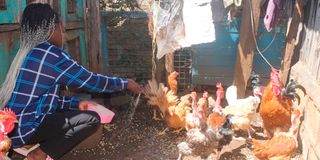
“I later found myself in a group of students who were to study either Computer or Business, but I opted for the latter,” said Sylvia as she fed her kienyeji chickens at Mastima Estate in Elburgon.
She added that she was not perturbed when she was not among the students clustered to study Agriculture.
The Form Three student started rearing chickens in Form Two after meeting a poultry farmer who kept them for sale.
“I was inspired by the farmer, who advised me that the business was viable and that, as a student, I could run it and meet some of my basic needs. When I shared the idea with my parents, they agreed to support me and immediately bought the chickens for me,” said Sylvia.
She added that with Sh1,000, she bought five mature chicks and housed them in a poultry structure that cost Sh1,500.
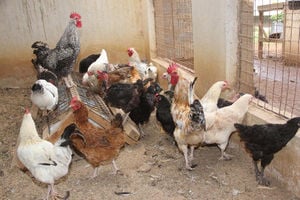
The simple structure, made of wood and wire mesh and covered with iron sheets to keep away animals and hawks, can hold more than 500 chickens.
During an interview at her parents’ home, Sylvia said that within two months, she began collecting eggs daily.
Sylvia Wangui, a Form Three student at Elburgon DEB Secondary School holds a cockerel in Elburgon, Nakuru County.
Photo credit: John Njoroge | Nation Media Group
She noted that one advantage of keeping kienyeji chickens is that they can feed on green vegetables, food remains, and cereals, unlike other types of chicken that require specific feeds.
With good management and proper feeding, the birds laid eggs daily and soon began hatching, increasing the flock.
“After a few months, I started selling mature cockerels at between Sh800 and Sh1,200, depending on size. By then, eggs were plentiful, and each retailed at Sh20 at the local market,” said Sylvia, adding that chickens lay more eggs during warm seasons than in cold weather.
She noted that her parents play a key role in supporting the project, especially when she is in school.
To ensure the project runs smoothly, the student, who aspires to become a nurse, says she follows a timetable that helps her balance schoolwork and the poultry business.
“I also keep records of my kienyeji chickens every two days to track progress. Except during disease outbreaks, the birds are rarely affected by illness in my area, which is an advantage for small-scale farmers,” she said.
During the festive season, Sylvia says the business thrives due to increased demand, especially for cockerels.
In December last year, she recorded her highest sales and production since starting the project.
“A mature cockerel sold for between Sh1,500 and Sh1,800, while a hen fetched about Sh1,300. From the proceeds, I increased my flock, bought books, met other requirements, and saved the surplus,” she said, adding that the earnings helped clear a small school fees balance owed by her father.
Sylvia Wangui, a Form Three student at Elburgon DEB Secondary School, feeds her chickens in Elburgon town, Nakuru County.
Photo credit: John Njoroge | Nation Media Group
Before pursuing higher education, Sylvia plans to increase her flock from the current 200 to 1,000 birds.
“I am optimistic I will reach that target through hard work. During school breaks and holidays, I visit poultry farmers and engage extension officers in the area,” she said, adding that she has also gained skills through online learning.
Former Nakuru Livestock Officer Eunice Nginya advises poultry farmers to avoid the misuse of antibiotics and drugs, noting that poor hygiene is a significant contributor to disease outbreaks.
“We urge farmers to use water disinfectants, observe biosecurity measures, and limit access to poultry houses,” said Ms Nginya, adding that regular spraying of structures helps maintain cleanliness.
She said using recommended and locally available feeds, alongside proper management, boosts production.