James Nyagwala surveys his rice farm in Oriang Kogweno Village, Rachuonyo North, and smiles.
In a few days, he expects to receive at least Sh85,000 in his mobile wallet from his first harvest.
Four months ago, the same land earned him nothing.
For decades, the land was only used by cattle herders.
The 54-year-old farmer says that grass grew on the land, so it was used as a communal grazing field.
James Nyagwala at his rice farm in Oriang Kogweno Village in Rachuonyo North in Homa Bay County on June 30,2026.
Photo credit: George Odiwuor | Nation Media Group
For more than 60 years, Nyagwala’s farm and those of his neighbours have lain fallow.
The area is adjacent to Ondago Swamp, which is waterlogged and moist throughout the year.
During the dry season, herders would bring their livestock to the village because the grass stayed green for longer than in the surrounding areas.
However, to crop farmers, the soil seemed useless.
This changed last year, however, when officials from the Lake Basin Development Authority (LBDA) approached residents about starting rice farming.
“We own the land, but we didn’t use it to generate an income. The LBDA showed us that it could be used to grow rice,” says Nyagwala.
Oriang Kogweno Village, with its large tracts of unused land, was among them.
Moist soil is ideal for rice production as it provides the vital aquatic conditions needed to meet the plant's high water requirements, while also suppressing weeds and preventing essential soil nutrients from leaching away.
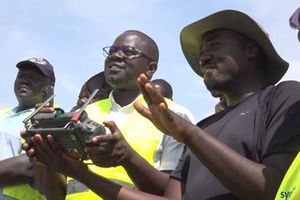
Lake Basin Development Authority Managing Director Wycliffe Ochiaga (in glasses) is shown rice paddies at Kimira Oluch Smallholder Farmer Improvement Project in Oriang Kogweno Village in Rachuonyo North in Homa Bay County on June 30,2026.
Photo credit: George Odiwuor | Nation Media Group
Rice roots also rely on these saturated conditions to develop properly and access necessary soil minerals.
Nyagwala, who previously grew groundnuts, planted rice on one acre in February.
“I spent a total of Sh4,000, which was mainly used to hire labour. The rest of the resources were provided by the LBDA and other support partners, who will be repaid after the harvest,” says the farmer.
“Had I not tried growing rice, I would be staring at an empty field now. Now the land has value,” he says.
Several neighbours have followed his example, converting grazing land into paddies.
His farm is located near Nyagwala, and he planted his crops on 27 May.
He notes that rice production has transformed the lives of some residents who were struggling with unemployment.
In the village, some farmers hire local youths to scare away birds. They are paid at the end of the week.
“Besides, we are sure of getting food,” says Mr Otieno.
According to LBDA officials, the project targets areas that have long been considered unsuitable for growing other crops. The area in Oriang Kogweno village is one of the schemes that the agency is supporting.
The others are the Ahero, Kuja Migori and Budalangi irrigation schemes.
According to LBDA Managing Director Wycliffe Ochiaga, there are many areas that lie fallow with no agricultural activity taking place.
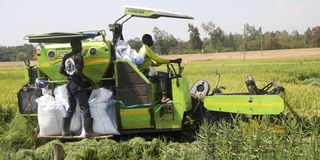
A combine harvester harvests rice at Kimira Oluch Smallholder Farmer Improvement Project in Oriang Kogweno Village in Rachuonyo North in Homa Bay County on June 30,2026. Rice farming in the area is supported by the Lake Basin Development Authority.
Photo credit: George Odiwuor | Nation Media Group
These include wetlands that could be converted into rice paddies to feed families, but which have not been well managed, including the Ondago sub-scheme, which is part of the Kimira Oluch Smallholder Farmer Improvement Project (KOSFIP).
According to the agency, Kenya only produces half of the rice consumed in the country.
Ochiaga says his organisation aims to reduce the need for rice imports by increasing local production and consumption.
“We support our farmers so that we can boost local rice production,” he says.
He adds that the agency is mandated to catalyse socio-economic development within the Lake Victoria catchment area.
As part of the programme, the agency cultivated 200 acres of land that are ready for harvest this month.
“Cumulatively, we have cultivated more than 5,000 acres of land. KOSFIP has the potential to produce rice on over 20,000 acres of land, and we hope to achieve this within a year,” he says.
Based on the rice variety supplied by the agency, they expect to produce up to four tonnes of rice per acre.
“Beyond increased production, the venture creates employment opportunities for young people and women,’ he said.
The agency has a rice milling plant in Kisumu where it buys paddy rice, mills it, and sells the packaged product across the country.
The Rachuonyo North venture is supported by other partners, including Greentech Hub Limited, which helps farmers acquire the best agronomic practices.
Greentech Hub Limited also helps farmers to identify the correct seed varieties for different areas.
Other organisations involved in rice production in the scheme include Syngenta, which offers crop protection services; Tingalinks, which supports farm mechanisation; and the Department of Agriculture in Homa Bay County.
Hellen Orwa, Chief Operations Officer at Greentech Hub Limited, says her organisation has the ability to support farmers in producing rice to sustain national demand.
The organisation’s Chief Executive Officer, John Kanyi, notes that farming can be more lucrative than other careers, but only if it is approached seriously.
He encourages farmers in Ondago to use machinery for rice production, explaining that manual farming, to which some people are accustomed, leads to a 30 per cent loss.
“Embracing technology is one way of avoiding losses. Using machines ensures farmers get maximum profit,” he says.
Joash Aloo, the Homa Bay County Agriculture Executive, says the devolved unit is ready to provide KOSFIP farmers with a tractor to facilitate mechanisation.
He wants them to join local farming cooperatives, which they can use to lobby for support.
“We have ward extension officers who can help farmers learn about the best farming practices. Farmers should also take advantage of our climate information centre, which provides important weather information for different farming practices,” says the county executive.
Interior Principal Secretary Raymond Omollo says that President William Ruto's decision to prioritise investment in production agriculture was initially met with scepticism by some.
However, he says that the results are increasingly evident across the country, with KOSFIP demonstrating how deliberate investments in agricultural productivity are strengthening food security, creating jobs, and empowering rural communities.
“The project operates under a clear management framework in which the National Government retains ownership of the scheme, oversees the core infrastructure, maintains the main gravity-fed canals, and finances major rehabilitation works to ensure sustainable agricultural production,” says Dr Omollo.
KOSFIP comprises two interconnected irrigation schemes: Kimira, which draws water from the Kibuon River and covers 808 hectares of irrigable land across 44 blocks; and Oluch, which relies on the Awach Tende River and spans 666 hectares across 53 blocks.
The scheme has an estimated production potential of approximately 9,000 hectares.
Currently, 809 hectares are ready for harvest, highlighting the significant potential for future expansion.
Dr Omollo notes that, through extensive canal rehabilitation, the project has reclaimed over 2,000 acres of previously waterlogged swampland and transformed it into productive agricultural land.
“The gravity-fed irrigation system eliminates the need for costly fuel or electric pumps, significantly reducing production costs and enabling over 1,500 smallholder farmers to start commercial rice farming,” he says.
In addition to Oriang rice, the year-round water supply supports the cultivation of maize, tomatoes, kale, watermelons, soybeans and sunflowers, enabling farmers to capitalise on peak market opportunities throughout the year.
The project directly benefits over 3,000 farming households and contributes to food security and economic activity for more than 400,000 people across the wider Nyanza region.
Dr Omollo says that the State Department for Internal Security and National Administration continues to work closely with local leaders, administrators, and communities to protect public investments, strengthen coordination among stakeholders, promote peaceful coexistence, and create a secure environment in which farmers and agribusinesses can realise the project's transformative potential.
However, they cite a number of challenges which may prevent them from maximising their profits, including bird invasion and insufficient water in the rice paddies.
It was also noted that some community members sabotage the farmers by blocking the movement of water from the KOSFIP canals, causing some rice paddies to dry up.
However, he calls on support partners to offer solutions to some of the problems farmers face.
"Farmers should expect maximum support from the government. We have had issues with market access, but we are addressing this. We are also working to secure support from the private sector,” says the LBDA boss.