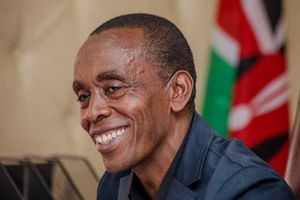
Homa Bay Governor Gladys Wanga on January 22, 2025 flags off 20 motorcycles that agricultural extension officers will use to reach farms to advise farmers on best agricultural practices

Every farmer aims to achieve the highest possible yield when planting crops or rearing animals.
However, mistakes made at various stages of the agricultural value chain often lead to losses.
Agricultural research suggests that up to 35 percent of the world’s food is lost or wasted throughout the entire value chain. Around 13 percent is lost after harvest but before retail, while a further 19 percent is wasted at retail and consumer levels.
Therefore, to ensure the success of their agribusiness ventures, farmers are advised to consult agricultural experts who can advise them on producing, processing and distributing their produce.
These experts also help farmers to make timely decisions and implement research-based information. This ensures that farmers become familiar with changes taking place in farming and are always ready to make adjustments to avoid losses.
However, most experts, especially those employed by county governments, do not have access to every farmer.
In some regions, it takes agricultural field extension officers days to reach places where they are needed, even in times of emergency. This delay is one of the contemporary challenges that farmers face.
In Homa Bay County, farmers say that the slow response of agricultural officers has been a major factor in losses.
This changed when the government invested in the mobility of the agricultural officers by purchasing motorcycles for them to use to travel between locations.
Ager Kirowo, the chairperson of the Lolwe Farmers’ Cooperative Society, says that farmers in his area have been seeking help from extension officers based in Kendu Bay Town.
Until four months ago, it took most officers up to three hours to reach farms when assistance was required, whereas, with proper transport, the journey would take less than 30 minutes.
“Farmers are always tempted to engage in trial and error while waiting for extension officers, who sometimes take a long time, causing farmers to lose patience. This often leads to mistakes being made, resulting in the death of animals,” says Kirowo.
The cooperative society has more than 1,200 members who are involved in poultry and sorghum production.
Kirowo says that private agricultural extension officers respond more quickly to emergencies because they are self-employed and can go wherever they are needed.

Motorcycles that agricultural extension officers in Homa Bay use to tour farms.
However, he notes, that private individuals charge higher fees, unlike officers employed by the county government, who sometimes work for free.
“Private practitioners ask for transport and consultation fees, as well as other charges, which most small-scale farmers cannot afford. This causes some people to try to use unprofessional means to address the problems they face,” says the farmer representative.
For a long time, agricultural officers in Homa Bay used public service vehicles to attend to farmers.
Despite receiving numerous calls, they would struggle to reach those in need of their services.
Others walked, which took even longer.
Earlier this year, the county government decided to address this challenge by purchasing motorcycles for the officers to use.
In 2024, the county government distributed 20 motorcycles to agricultural extension officers in selected wards through the National Agricultural and Rural Inclusive Growth Project (Narigp). These motorcycles have already made a significant impact, enabling agricultural staff to visit farms, provide on-site training, and facilitate connections between farmers and markets.
The Homa Bay County Government received further support from the National Agricultural Value Chain Development Project (NAVCDP), which provided 20 motorcycles to enable the extension officers to travel to the field quickly and easily.
Each motorcycle comes with two helmets for two occupants and a carrier box for samples and other tools.
The NAVCDP is a community-driven development project that seeks to increase market participation and value addition for targeted small-scale farmers in Kenya, engaged across 33 counties.
Kirowo says there have been improvements in the time it takes for extension officers to reach farms.
“Some of the regions they visit have poor road conditions, which is the main reason for the delays. But generally, their response time has greatly improved because they have transport,” says the farmer.
Henry Nziga, the project coordinator in Homa Bay, says that, besides the delays experienced by the extension officers when going to farms, many people are struggling to adapt to new farming technologies.
Sometimes, when new technologies are introduced, farmers acquire them but do not receive comprehensive information on how to use them.
Homa Bay Governor Gladys Wanga on January 22, 2025 flags off 20 motorcycles that agricultural extension officers will use to reach farms to advise farmers on best agricultural practices
Nziga notes that many farmers lack knowledge of how to use technology in modern agricultural production.
“Another challenge facing the sector is the low number of extension officers compared to the number of farmers they are supposed to serve,” he says.
To address these issues, farmers within the same value chain are encouraged to form groups and use these to seek help from experts.
Nziga explains that it is easier for an expert to engage with groups than with individuals.
Climate change is also a major factor that can affect farm production.
Unpredictable and changing weather patterns can sometimes lead to losses.
In the past, Nziga says, farmers would predict the weather and have successful planting seasons.
However, most people today cannot tell when the best time to plant crops is, especially in areas where farmers rely solely on rain-fed agriculture.
“Too much or too little rain can affect plant growth. It is, however, uncertain when this will happen,” says the NAVCDP officer.
He adds that climate change enables certain pests and diseases to thrive, which can result in entire crops being wiped out.
Field extension officers are required to advise farmers on how to overcome these challenges.
Homa Bay County currently has an agricultural officer in each of its 40 wards. They all have motorcycles, which they use to travel between locations.
They ensure that no farmer makes a mistake that could lead to losses.
Governor Gladys Wanga explains that providing the officers with motorcycles will transform agricultural extension services in the county.
She says that the motorcycles symbolise her administration’s determination to ensure that no farmer is left behind.
“This is yet another milestone in our journey to empower farmers and promote agricultural development, which remains the backbone of our economy and the lifeline for thousands of families in our county. Agricultural extension is the foundation of agricultural development,” says Ms Wanga.
The officers are responsible for disseminating technologies, innovations, and management practices.
Through this, farmers can unlock their potential, increase productivity and improve quality, as well as accessing better markets.
Wanga says that her government has prioritised equipping the county’s agricultural extension officers to deliver extension services effectively.
“This initiative, made possible through the NAVCDP project, ensures equitable access to agricultural extension services across all 40 districts of our country. Additionally, we are introducing five motorcycles dedicated to collecting and disseminating market price data,” she says.
One advantage of the initiative is that it ensures farmers have access to accurate and timely market information, empowering them to make informed decisions about selling their produce.
Wanga says that the initiative’s success depends on the active participation of farmers.
During a recent farmer registration exercise in the county, 240,000 individuals were registered as either crop or livestock farmers.
The county’s agriculture department is currently focused on organising them into groups.
According to Ms Wanga, only 84,000 farmers have joined the community-driven development project under the NAVCDP.
“There are still many farmers out there who have not been mobilised into our CDDCs. Organised farmer groups will enable easier access to training, financial support, and marketing opportunities,” she says.
She wants CDDC officials to intensify their mobilisation efforts so that the county achieves its target of registering 200,000 farmers.
“My government remains committed to providing the resources, partnerships and policies that will enable our farmers to thrive. Together, let us make agriculture the foundation of food security, economic empowerment, and sustainable growth in Homa Bay County,” says Governor Wanga.
Nziga says that the NAVCDP will now focus on establishing agricultural demonstration farms, which he explains will be set up in each ward in collaboration with farmer groups.
These farms will serve as learning hubs.