Before graduating from Kenyatta University with a degree in Communication and Media in 2021, Daniel Kanyoro worked with Autism Lights Incorporated, a non-governmental organisation (NGO), for three years to raise awareness of autistic children in the community and set up autism centres in various counties. However, the job came to an end after the outbreak of the Coronavirus pandemic.
After graduating, the 30-year-old started a grocery business in Kikuyu, Kiambu County, which was successful despite the presence of brokers affecting his business.
“In 2022, I visited a neighbour who reared 200 pigs and 3,000 chickens on a plot of land measuring about 100 metres by 100 metres. His project motivated me, and I immediately started researching online the cost of production and what a good structure should look like, as well as which pig breeds endure in cold and warm areas,” said Kanyoro. He added that he also started a Kienyeji poultry project, which he has maintained to this day.
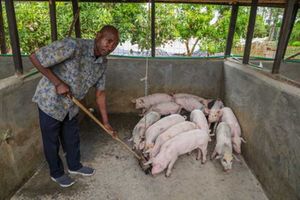
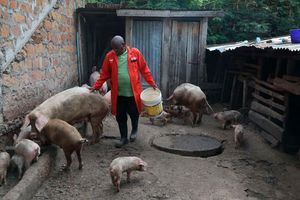
During a recent interview at his home in Landi, Molo, Nakuru County — a few kilometres from the Elburgon–Molo road — Kanyoro said that he used an initial capital of Sh250,000 to buy construction materials, set up a pig shelter with a capacity of 200 pigs partitioned into 24 cubicles, including a maternity section, and purchase sows from Baraka Agriculture College, which cost Sh30,000.
The sow was a Large White breed, known for giving birth to many piglets at a time, being disease-resistant and large in size. To feed his pigs, he sourced food waste from restaurants and markets, as well as green vegetables from farms, due to the high cost of certified feed.
“After one month, the sow gave birth to 12 piglets. Within seven days, the piglets received an iron vaccine and the male piglets were castrated to prevent inbreeding and fattening. I also ensured that their sharp incisors were cut. As the flock was growing quickly, I started making my own feed from farm waste, such as potatoes, wheat bran and machicha, and mixing it with commercial feed to reduce production costs following the high prices in animal feed shops,” said Kanyoro, adding that he dewormed his animals one month after birth and gave them a multi-vitamin injection every two months.
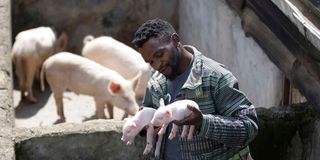
Daniel Kanyoro holds some of the piglets at his plot of land where he rears pigs for sale at Landi area in Molo, Nakuru County on August 1, 2026.
Photo credit: John Njoroge | Nation Media Group
Pigs are ready for the market from the fifth month, but can be slaughtered after six months. From his first litter, he sold pork at Sh320 per kilo and one-month-old piglets at Sh2,500–3,000 each to willing buyers, depending on the breed. A female pig ready for breeding was sold for between Sh30,000 and Sh40,000, depending on size and breed, and the business continued to do well.
Mr Kanyoro revealed that pig farming is labour-intensive but can be practised in a small area so long as it is efficient and has sufficient feed. "Feeding time is important for every farmer, since pigs are usually fed in the morning and evening. With an initial investment of Sh70,000, small-scale farmers can construct a simple cubicle, buy enough feed and purchase a female pig to start with,” said Kanyoro, adding that, to succeed, farmers must know where to source feed and breeding stock and understand the market.
In 2024, the number of pigs rose to almost 200 because he had not planned when to serve his female pigs. Currently, he orders a served mother every four months, since the gestation period is three months, three weeks and three days.
The farmer, who sells his pigs at the local market, says that it is a good market because many farmers in the area have not taken up pig farming. He encourages other farmers to try pig farming, as this would allow them to share skills, set prices for their products and benchmark against each other. Currently, he sells pork at Sh400 per kilo, while local butchers sell it at Sh800. A litre of fat sells for Sh400 at the local market. As an agri-business expert, Kanyoro sells at least two mature pigs every month. He uses the profits to buy more feed and expand his poultry farming, which has grown to include 100 improved and Kienyeji chickens.
He prepares compost manure from the droppings for at least one month before using it on his farm. He adds that the smell also helps to keep moles, aphids and whiteflies away from the crops. He sells the surplus manure to local farmers for Sh500 per 60kg bag.
Mr Kanyoro visits Baraka Agriculture College in Molo, agricultural shows and Egerton University exhibitions in Njoro, among other places, to improve his farming skills. He notes that pigs become sick and are mostly attacked by pneumonia due to the cold when the shelter is not constructed well, and they become infected with skin diseases when the structure is dirty and unclean. “The house should be cleaned at least three times a week to prevent disease and infection,” he added.
His vision is to rear more than 1,000 pigs within the next year, with the aim of selling at least 100 pigs every month. He says this will enable him to produce more manure, which is in high demand, and satisfy his customers who prefer to fertilise their crops using livestock manure. “I hope to access better markets in the future with pig processing companies, Farmer's Choice and other major companies when my herd grows.
I encourage other farmers to adopt this farming method, as it will enable them to access better markets with different companies,” said Kanyoro, adding that pork businesses find it challenging to thrive, especially given the limited number of pork centres in the area.
Daniel Kanyoro holds some of the piglets at his plot of land where he rears pigs for sale at Landi area in Molo, Nakuru County on August 1, 2026.
Photo credit: John Njoroge | Nation Media Group
Mr Kanyoro adds that his pig project has grown to over 200 pigs and that he has no brokers, allowing him to deal directly with his clients, unlike other farming practices which are dominated by middlemen. Currently, one-month-old piglets are sold for between Sh3,500 and 4,000, depending on the breed. Thanks to these sales, the farmer has been able to pay his children's school fees, pay bills and cover other basic expenses.
Nutritionists highlight the health benefits of pork, such as its high-quality protein content and its richness in B vitamins and key minerals that support muscle growth, energy levels and overall immune health, among other benefits.
According to the Kuresoi North Livestock Officer, Mr Nicholas Rono, pig housing should be spacious and well ventilated, with good drainage. It should be built from durable materials because pigs are very destructive, and it should be partitioned according to the pigs' ages.
“About 70 per cent of production goes towards feed, which is paramount for pig farming. We urge farmers to formulate their own feed for different age groups to improve production," said Mr Rono, adding that keeping records of their animals helps them to track important issues such as the number of piglets born in a certain month and sales.
He noted that the Duroc breed, which is large-framed and gains weight quickly, is good for rearing, as are the Landrace and Large White breeds. Mr Rono highlighted the lack of extension officers in the area as the main challenge, but called on livestock farmers to liaise with them to learn more about feeding, disease control, waste management, and so on.