With the Kenyan agricultural sector contributing about 22 per cent to the country’s GDP, according to data from the Kenya National Bureau of Statistics (KNBS), the sector urgently needs transformation – from conventional ways of growing food to modern approaches.
Precision agriculture is at the centre of this debate, and the use of drones is one of the most powerful tools driving this transformation.
The University of Eldoret, one of the higher learning institutions in Kenya offering agriculture-related courses and even biotechnology, trains farmers on the importance of drones.
The training was introduced at the university in 2023, with the aim of sensitizing farmers in the North Rift Region to adopt the technological solution.
“Leveraging the technology of drones make farming work easier and more efficient,” says Dr Hake Kamau, a lecturer at the University of Eldoret.
Drones are increasingly transforming modern farming by making it more efficient, precise, and sustainable.
They are widely used for crop monitoring, where high-resolution images and sensors provide real-time data on plant health, pest attacks, and disease outbreaks.
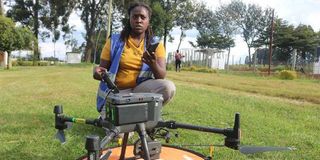
A data drone in flight at the University of Eldoret farm in Uasin Gishu County.
Photo credit: Sammy Waweru| Nation Media Group
According to Dr Kamau, farmers can also rely on drones for soil and field analysis, crop health analysis, spraying of chemicals, application of fertiliser in crops, tree and crop counting, and mapping.
They generate detailed maps that reveal soil conditions, moisture levels, and nutrient variations, which help in planning planting and irrigation.
“It is one of the technologies in precision agriculture. With drones, if there is a disease on the farm you do not have to spray the entire field – it helps you spray the specific area, know the inputs required, gives the topography of the farm, provides answers on where cover crops are needed, among many other activities. Basically, it helps a farmer to make informed decisions,” explains Dr Kamau, who is also the Coordinator of the University of Eldoret’s Outreach Centre.
The university has a demonstration farm, where different types of crops are grown, including horticulture, fruits, and cereals.
“The world is moving very fast; technology has come up, and everything has been overtaken by it, including agriculture. As an institution, we are keen on positioning ourselves with technological advancements, making sure we help farmers transition from conventional agriculture to modern methods,” the expert said in an exclusive interview during a recent visit to the Uasin Gishu County-based University.
The university partners with different stakeholders to offer training on climate-smart agriculture and delivering technologies to farmers, including Customized Aviation Solutions Limited (CASL).
CASL, a Nairobi-based company, provides drone and aerial services across industries like agriculture, construction, and cinematography.
Their services include aerial surveying and mapping, Remote Operator Certificate (ROC) support, drone sales, consultancy, and aerial cinematography.
Natasha Mwangi, a young drone pilot working with the University of Eldoret, analyzes farm data collected by a drone.
Photo credit: Sammy Waweru| Nation Media Group
“Through the use of drones, the farmer will be able to accurately and efficiently address challenges facing crops and know what to administer,” says Alex Mugane, Customized Aviation Solutions Limited’s Commercial Director.
For analyzing a crop, for instance, a drone is placed 2 feet above the plant. A photo is taken, and the data is then processed for analysis.
If the crop requires nutrients, or if there are diseases or pests, Mr Mugane said in an interview that the challenges are independently addressed.
In irrigation management, on the other hand, drones equipped with thermal cameras identify water-stressed areas, enabling farmers to apply water only where needed, thus saving resources.
“In agroforestry, if you discover some trees did not successfully germinate, you will be able to know the specific areas using drones and replant. They also assist in counting the number of trees, including measuring their length and diameter,” he explained.
In agriculture, Mr Mugane revealed that the company hires out drones at Sh1,000 to spray an acre.
With their key use being spraying pesticides, herbicides, and fertilisers, drones deliver chemicals with great accuracy, hence reducing wastage of farm inputs and minimizing human exposure to harmful substances.
“For spraying, a drone covers 70 to 100 acres in a day – though it depends on what you are spraying. We mostly work with unions and cooperatives to reach farmers, and the uptake, especially among large-scale farmers, is slowly growing,” Mugane stated.
With the University of Eldoret now exploring the use of drones in planting, some specialized ones (in advanced countries) are already used for planting and seeding, dropping seeds directly into the soil, especially in large or hard-to-reach areas.
Dr Kamau adds that they also assist in yield estimation and harvest planning by collecting data that helps predict production levels and determine the best harvesting time.
“Apart from supporting precision agriculture, drones provide data-driven insights, lower production costs, and increase production,” he explains.
According to Mr Mugane, one must acquire a license from the Kenya Civil Aviation Authority (KCAA). Additionally, one should be trained on the use of drones, and the device must be registered and insured by its owner.
Youth engagement in farming in the country is still low, as most view it as a tedious job. The younger generation is tech-savvy, and it is attracted to innovations such as drone use.
Natasha Mwangi, a young drone pilot working with the University of Eldoret, controls a drone in flight on August 28, 2025.
Photo credit: Sammy Waweru| Nation Media Group
“Drones in agriculture are a game changer,” Natasha told Seeds of Gold in an interview while demonstrating how the equipment works.
Her commitment demonstrates that youths are getting excited about drones in farming, hence being drawn to agriculture.
It is one of the approaches to creating job opportunities for young people, a move that is said to help boost food systems and address food insecurity and hunger. Annually, the university organizes an exhibition – the Agri-business Trade Fair, aimed at disseminating the importance of embracing modern technologies in farming.
Last year, the event, according to Dr Kamau, attracted over 18,000 visitors, with the youths showing great interest in drones. This year, the exhibition will be held from September 11 to 13.