The future of agriculture in Kenya hinges on the active engagement of young people. The strategy focuses on providing access to finance, knowledge, networking opportunities, and market links. Seeds of Gold writer Richard Maosi spoke to Mariatu Kamara , the International Fund for Agricultural Development's (IFAD) country director and representative in Kenya.
How are you investing in smallholder farmers, rural women and marginalised groups in order to eradicate poverty and enhance food security?
Our core mandate is to invest in rural communities, helping smallholder farmers, pastoralists, fishers and rural entrepreneurs overcome poverty and foster food security.
We lend directly to governments on concessional terms and administer grants from development partners such as the governments of Finland and Germany, the European Union and the Green Climate Fund.
Our focus areas include improving the productivity, income, and nutrition of rural households; expanding access to rural finance, markets, and technology;
We bridge the gap between public financing and rural potential by financing the final stage of the process, which most financial institutions are reluctant to undertake.
How are you incorporating youth and men into agribusiness, both in Kenya as well as regionally and globally?
Youth and women are at the heart of our operations. In Kenya, for example, our Green Financing for Youth Employment (GFYE) programme, which is funded by the Finnish government, is investing €8 million to help 8,000 young people and 500 youth-led agricultural enterprises and micro, small and medium-sized enterprises (MSMEs) access green finance, training and mentorship in 14 counties.
In East and Southern Africa, we are collaborating with the German government to establish Agribusiness Hubs, centres of excellence that connect young people and women to finance, innovation and regional markets.
IFAD has also made youth and gender inclusion a core part of all its investments, ensuring that at least 50 per cent of programme beneficiaries are women or young people.
These groups are not an afterthought; they are the driving force behind change in the transformation of food systems.
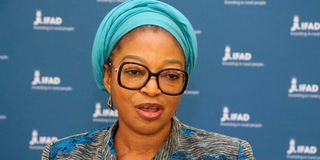
Mariatu Kamara, the Country Director of the International Fund for Agricultural Development (IFAD) Kenya, during the launch of Boost Sustainable Food Production in Kenya, held in Kapsabet, Nandi County on September 25, 2024.
Photo credit: File | Nation
In Kenya, agriculture contributes 26 per cent to GDP and employs more than half of the workforce. Yet most smallholders still operate on less than one hectare and lack access to credit, markets or mechanisation.
Our transformation journey is about creating rural systems that work effectively from production to processing, marketing and finance.
First, we increase productivity through improved inputs, extension services, and e-voucher systems.
Next, we connect producers to value chains. Finally, we strengthen county and national institutions to sustain progress.
We don't see transformation as a project, but as a process that begins with empowering communities and ends with building self-reliant, resilient rural economies.
How can some of the key policies and strategy guides that have been put in place to steer project implementation and achieve better results on the ground be expedited?
IFAD’s support is anchored in national and county policy frameworks that drive agricultural transformation in Kenya.
Our interventions align with key policies, such as the Agricultural Sector Transformation and Growth Strategy (ASTGS) and Vision 2030.
Through policy collaboration, we have advanced initiatives such as the e-Voucher system, which strengthens input delivery and traceability, and the Livestock Bills, which promote market regulation, resilience, and climate-smart production.
Our organisation also collaborates closely with the National Treasury, the State Departments of Agriculture, Livestock Development, Environment and Climate Change, Forestry, Water and Sanitation, Cooperatives, the Blue Economy and Fisheries, and County Governments, to ensure coherent policy implementation.
At county level, Project Steering Committees serve as coordination platforms, linking policy to practice and accelerating results on the ground.
To make agriculture more lucrative and solve challenges in agri-food systems, how have you embraced innovation?
Through GFYE, we are integrating innovation and technology into every aspect of rural enterprise. We are training youth and women entrepreneurs in digital agriculture, mobile banking, renewable energy systems and climate-smart practices.
We have partnered with microfinance banks and SACCOs to digitise loan products and connect them with youth-friendly credit scoring tools.
Farmers are also using e-vouchers to transparently purchase certified inputs, reducing leakages and increasing yields.
Innovation is not just about technology; it's also about mindset. We are helping young people and women to see agriculture as a space for entrepreneurship, creativity and climate solutions.
Outline some of the ambitious agricultural programmes targeting young people that you are spearheading.
Kenya’s implementation of IFAD-supported programmes such as KeLCoP, RK-FINFA, INReMP and GFYE provides valuable insights into aligning youth employment strategies with agri-food system transformation.
The Youth Training and Internship Placement Programme on Animal Health under the Kenya Livestock Commercialisation Project (KeLCoP) has demonstrated the value of practical, demand-driven skills development.
The programme has created pathways for self-employment while improving livestock productivity and service delivery in rural areas by placing trained youth with private veterinary enterprises, county extension units, and producer cooperatives.
The Green Financing for Youth Employment (GFYE) initiative, implemented across 14 counties, has demonstrated how blended finance and bespoke financial instruments can facilitate the growth of youth-led agribusinesses, particularly in climate-smart ventures.
Similarly, the Rural Kenya Financial Inclusion Facility (RK-FINFA) has demonstrated how rural credit guarantee schemes can improve access to finance for young entrepreneurs and women.
Together, these Kenyan initiatives demonstrate that combining technical skills, finance and policy support within an integrated ecosystem, similar to the ABH model, increases youth employability, inclusivity and the long-term sustainability of agri-food systems.
The Agribusiness Hubs, supported by Germany, provide incubation, mentorship and trade linkages for youth-led enterprises across Eastern and Southern Africa.
IFAD incorporates youth and gender inclusion into all its investments. Global programmes in Latin America, Asia, and West Africa share lessons with Kenya through South-South and Triangular Cooperation, ensuring that youth-led innovation travels across borders.
Mariatu Kamara, the Country Director of the International Fund for Agricultural Development (IFAD) Kenya, during an interview with Seeds of Gold on October 15, 2025.
Photo credit: Richard Maosi | Nation
How are you advocating for climate-smart agriculture and resilience to address the interlinked challenges of food security and climate change?
Climate resilience is at the core of our mission. We promote solar irrigation, water harvesting, drought-tolerant seeds and reforestation.
Through the Kenya Cereal Enhancement Programme – Climate Resilient Agricultural Livelihoods (KCEP-CRAL), we have demonstrated to smallholders how they can adapt to changing climates while improving their productivity and income.
The programme promotes conservation agriculture, soil fertility management and crop diversification, as well as digital e-voucher systems that connect farmers to certified inputs, advisory services and insurance.
To date, it has helped tens of thousands of smallholders to adopt sustainable land and water management practices, while also increasing their yields and reducing their vulnerability to droughts and floods.
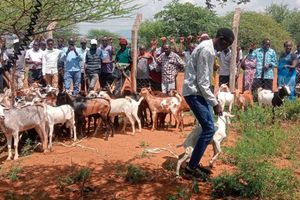
In the livestock sector, the Kenya Livestock Commercialisation Project (KeLCoP) enhances the resilience of pastoral and agro-pastoral communities by supporting rangeland rehabilitation, fodder production, climate-smart water management and disease surveillance.
The project also promotes livestock insurance and value-chain financing to help farmers safeguard their herds and incomes in the face of climate shocks.
Based on your strengths, what are some of your achievements?
The Integrated Agribusiness Hub Programme (ABH) has achieved remarkable success in tackling rural youth unemployment across nine African countries, including Kenya, by connecting young people to agribusiness skills, entrepreneurship, finance and markets through an ecosystem-based approach.
The programme has empowered over 43,000 rural young people, almost doubling its initial target of 22,000, while maintaining a strong focus on the economic empowerment of young women, institutional partnerships, inclusive innovation and local economic transformation.
It has strengthened capacities in policy dialogue, implementation, monitoring and evaluation, and fostered systemic change in rural economies.
The Government of Finland offers financing for green youth employment initiatives. The Government of Germany supports the agribusiness hubs programme.
The European Union and the Green Climate Fund co-finance climate resilience programmes. We also collaborate with the private sector and development partners, including the ILO, Visa Foundation, FAO, AGRA, Cordaid and FSD-Kenya.
Ecosystem-based approaches that integrate training, finance and market access are the most effective way of linking rural youth to meaningful employment.
The programme also highlighted the importance of inclusive and gender-responsive frameworks to ensure the active participation and benefit of young women, young people with disabilities, and other marginalised groups.
Furthermore, the Policy Labs showed that policy and institutional reforms are vital.