Enock Kimosop, 26, from Baringo South, attended the annual Kimalel goat auction and cultural fair in December 2023, like any other local. Little did he know that this would inspire him to start a business that would later transform his life for the better.
As usual, the annual goat sale was presided over by President William Ruto and other dignitaries, including political leaders.
At the time, he said that transforming the livestock sector and advancing from the usual physical sale of goats to online sales in order to keep up with advancing technology was a key theme in several speeches by local leaders.
In a bid to improve the living standards of farmers in Baringo County, who depend mainly on livestock farming, the Kimalel goat auction was started in 1986 by the late President Daniel Moi.
By the time it was stopped, over Sh50 million had been raised from the sale of approximately 31,863 goats, 2,518 sheep, and hundreds of cows.
Ezekiel Barng’etuny, the late former nominated MP and Moi’s ally, organised the auction, which saw over 8,000 goats sold in just one day, many of them through lots of bidding.
Following devolution, the county government revived the auction in 2014, introducing a cultural element to create a fun-filled event that has raised millions of shillings to support farmers.
Inspired by the dignitaries’ speeches at the event, the young people said that the idea of selling goats online had emerged as a way to modernise the traditional goat farming business and address the issue of limited market access.
“On 14 December, 2023, I was seated in one of the tents at the annual Kimalel goat auction when several leaders took to the podium and discussed ways to modernise the event, including selling goats online. Among them was Kapseret MP Oscar Sudi, who tasked former MSMEs CS Simon Chelugui with helping anyone with that idea. I promised myself that I would take that opportunity because I could see that it was feasible,” said Mr Kimosop.
He added, “Together with three other young people from Baringo South, where I am from, we developed a robust website in January 2024 with the clear vision of revolutionising goat trading. We officially launched it on 2 April of the same year. However, the initial challenge was securing the necessary capital to operationalise the programme. Through resource mobilisation, we raised the funds to test the idea, raising Sh600,000 in the process,” he noted.
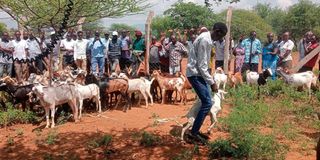
County auctioneer Max Kimitei auctions a goat during the first bi-weekly Kimalel goat auction on September 5, 2025.
Photo credit: Florah Koech | Nation
He said that former CS Chelugui also helped them to link up with Mercy Wanjau, the CEO of the Communication Authority of Kenya (CAK), because she had experience with bidding matters. She helped them by assigning one of her officers to help the young people develop a website called Efarmer.
“The website was up and running, but the main challenge was that there was no money to cover the costs of a holding ground, buying the goats, and making enquiries about prices and deliveries to several destinations within the country. Using the initial funds, we started buying and selling goats, but we were selling fewer than 100 in Nairobi, which incurred higher transportation costs and reduced our profit margin,” said Kimosop.
However, the youths did not give up. They started penetrating the market slowly because they wanted to advance in their venture during the next Kimalel Goat Auction in December 2024.
“During the Ramadhan celebrations last year, a group said they wanted to test the website by buying goats online and paying us afterwards. Muslims normally want to see the goats in person before purchasing, and that is why they ordered online — to see what they were buying,” he explained.
“At the time, I delivered to many mosques in Nairobi and sold more than 200 goats, and I have been making slow but steady progress since then,” he added.
During last year’s annual goat auction, he was given the opportunity to present his business venture to other young people and locals, and he caught the attention of President William Ruto, who attended the event and supported him with Sh2 million.
“Getting the President’s attention meant that our market grew. At the time, we had holding grounds in Rongai and Rumuruti in Laikipia County, and we penetrated international markets,”’ noted the youth.
Today, Efarmer has a strong presence in international markets and exports goats weekly to Dubai and Saudi Arabia via a reliable client.
“When we got the President’s attention, we gained access to markets outside the country. Some of these were in Saudi Arabia and Dubai, and they introduced us to their suppliers. Someone in Dubai saw the website and was interested in the goats,” said the Efarmer executive officer.
He said that the supplier normally places an order for 1,000 goats per month. They slaughter 300 goats weekly, which are then exported.
“That is where we are currently, but we still sell to our local clients, including our partners in Nairobi. When the president invested Sh2 million in our business, it gave us a real boost. Initially, we used to transport 100 goats to Nairobi, but now we transport 300. We have expanded our business and our market,” he said.
Some locals participate in the first bi-weekly Kimalel goat auction in Baringo South on September 5, 2025.
Photo credit: Florah Koech | Nation
“Currently, I buy the goats directly from the farmers, but my vision for this website is that, by next year, a farmer in Baringo will be able to upload his goats to the website and receive orders from anywhere in the country. My role will be to coordinate the client interested in the goat with the farmer in the village. Once the buyer has paid, I will instruct the farmer to release the goat, but the money will be held in escrow at a bank such as Kenya Commercial Bank (KCB), and the farmer will receive the money once the goat has been delivered to the client. That is my vision,” Kimosop explained.
“Most farmers and clients trust our website. Some clients order and pay, and then wait for me to deliver the goats. Over time, I have gained their trust. Once established, farmers can leverage the ICT hubs to upload their goats to the website and find clients in the region,” he noted.
Efarmer has expanded its reach to Nairobi, selling both online and offline. However, the initial phase was marked by significant challenges, including high transportation costs.
Despite having only a few goats per trip, transporting them using large trucks inflated operational costs, the youth said.
They also faced challenges sourcing goats due to inconsistent and high purchase prices in some regions, which negatively impacted profitability.
“Over time, we established reliable sources of goats, ensuring a consistent supply at competitive prices. However, the next challenge was market penetration. On 17 December 2024, we returned to the Kimalel Goat Auction to present our project. With the backing of the president and other stakeholders, we gained significant visibility, enabling us to break into the market at an accelerated pace,” he added.
“Despite our progress, transportation costs remain a significant challenge. Renting trucks for transporting goats is expensive and inefficient. To address this, we are exploring the option of acquiring our own lorry, which would greatly reduce logistics costs and enhance profitability.”
Efarmer plans to launch a mobile application where farmers can upload their goats for sale directly to the platform, connecting them to local buyers. This platform will be cost-effective, with farmers only paying a small application fee to use the website. We also aim to exploit global opportunities fully, increasing our export capacity to handle goat sales in bulk,” said Mr Kimosop.
“At Efarmer, we prioritise reliability and efficiency. Our mission is to build trust with clients while empowering local farmers through sustainable practices and innovative solutions. The future of goat farming in Kenya lies in technology, collaboration and a relentless pursuit of excellence — values that Efarmer embodies as it continues to grow and transform,” he noted.
“What we normally do, selling physical goats at the annual Kimalel goat auction, is a legacy of the late President Daniel arap Moi. My vision is to transform that auction into a digital platform, because at the moment we only sell goats once a year. My vision is to see goats being sold throughout the year so that any farmer with goats can sell them online at any time and get a good price without any hassle,” he said.
He told the Nation that he is working to remove the intermediaries that have affected the market. “From the farmer to the final consumer, the goat has often been sold more than five times, resulting in the farmer making a loss. I want to create a bidding website,” he said. However, he challenged young people to seize the available opportunities and make the most of them.
“Opportunities go to those who work for them. If you have an idea, write it down and take action, and don’t worry about the logistics. The moment you implement your idea, you will have more ideas, and God will open doors,” said Kimosop.