In the vast plains of Bura, where the sun scorches the soil and the wind carries dust more often than rain, a quiet revolution is sprouting, one seed at a time.
Young people who once worked for daily wages in other people’s farms are rewriting their stories, and Kenya’s agricultural future.
Ibrahim Warsame remembers the first time he stood in a rice field at Bura Irrigation Scheme, armed only with a machete and a dream.
It was 2017. Fresh from finishing secondary school, he dreamt of a better life beyond the parched fields of Tana River.
Word had spread across the country about opportunities in Turkana, where the discovery of oil promised a boom. He packed a small bag, left home, and set off to chase what he thought would be his big break.
For a year, Ibrahim lived through hardship, working as a casual labourer at construction sites, sleeping on floors, and going for days without food. But the oil dream was elusive.
“It was a hard year. I realised the jobs we were chasing were far beyond our reach. It was survival, nothing more," he recalls.
He returned home to Bura, the same place he had left behind, dusty and poor. But this time, he came back with a different kind of ambition: to make a life out of the soil everyone else ignored.
“I wanted to try farming, but the cost of fertiliser, water, and land rent was too high,” he says.
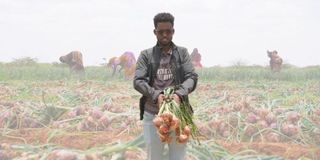
Ibrahim Warsame holds a bunch of onions harvested from his farm in Bura, Tana River County in this picture taken on October 14, 2025.
Photo credit: Stephen Oduor | Nation
So, he started at the bottom, as a casual labourer. By day, Ibrahim chased birds from rice fields for Sh400. At night, he guarded maize farms against thieves and buffaloes for another Sh400.
“I barely slept, but I knew every sunrise brought me closer to my goal,” he says.
After nearly 18 months of toil, Ibrahim had saved Sh150,000, a fortune for a man who had never earned more than Sh800 a day.
Determined to make his money work, he sought advice from agronomists from the National Irrigation Authority (NIA), who offered free training on crop selection, irrigation, and pest management.
In 2019, he leased a small plot and planted onions, applying every piece of knowledge he had learned.
He did the manual work himself—irrigation, weeding, spraying, and even harvesting—to cut labour costs.
When harvest time came, his sweat finally paid off. From 10 tonnes of onions, he made Sh600,000, more money than he had ever seen in his life.
“That first harvest changed everything, I knew there was more I could get from it. It taught me that the soil rewards those who respect it,” he says with a smile.
Four years later, Ibrahim, now 29, owns 12 acres of onions, employs over 40 people, and earns up to Sh800,000 per acre.
Immaculate Mboya uproots weeds from her rice farm at the Bura Irrigation Scheme, Tana River County in this picture taken on October 14, 2025.
Photo credit: Stephen Oduor | Nation
A few kilometres away, another dream was sprouting, that of Immaculate Mboya, a 30-year-old farmer who grew up balancing school and farm labour on her parents’ small piece of land in Bura.
“After classes, I would rush to the rice paddies to help my mother. During holidays, I was a full-time labourer,” she recalls, her hands stained with the soft brown clay of the paddy fields.
After finishing secondary school at Hirimani, she joined other youth working in rice farms, earning Sh300 a day. But while others spent their pay, Immaculate saved hers, determined to change her destiny.
It took her 20 months to save Sh90,000. In 2020, she leased 1.5 acres, hired friends as casuals for Sh500 a day, and planted rice under the guidance of NIA agronomists.
Her first crop cost about Sh70,000, and when harvest came, she sold five tonnes and earned Sh150,000.
Instead of buying new clothes or furniture, she reinvested all the profits. The second season brought Sh250,000, thanks to a new rice variety that allowed her to harvest twice from one planting.
Today, Immaculate manages 11 acres of rice, employs 12 people, and supplies bulk rice to local markets.
“The same hands that once earned me Sh300 a day now employ others. That’s the beauty of farming; it transforms you quietly, one harvest at a time,” she says.
Casual labourers harvest onions from Ibrahim Warsame's farm in Bura, Tana River County in this picture taken on October 14, 2025.
Photo credit: Stephen Oduor | Nation
For both Ibrahim and Immaculate, the road to success has been paved with exhaustion, risk, and sacrifice.
“There were days I almost gave up. Sometimes water pumps broke, or fertiliser prices shot up overnight. But every challenge taught me something new,” Ibrahim admits.
Immaculate’s journey has been no easier. During her first season, water shortages almost destroyed her crop.
“I would wake up at 3am to check water flow in the canal. The sun rise by 6am, but I was already drenched and tired,” she recalls.
The introduction of the gravity canal system in Bura has since reduced irrigation costs, giving farmers like her a lifeline.
“It used to cost me Sh7,500 a month to pump water. Now it’s half that,” she says.
Both farmers credit the National Irrigation Authority for technical support, though they feel more needs to be done to protect young farmers from exploitation.
Standing between rows of onions glistening in the afternoon sun, Ibrahim now speaks like a man who has earned his wisdom the hard way.
“The government cannot employ everyone. The real opportunities are in places that look impossible – Turkana, Garissa, Tana River. Those are the gold mines, but you have to dig through dust and doubt to find your fortune,” he says.
He urges fellow youth to abandon the comfort of waiting for white-collar jobs and instead get their hands dirty.
“Farming isn’t poverty; it’s potential. You just need to be intentional with your life,” he adds.
“People think success in farming is instant. It isn’t. You fail, you lose money, and sometimes you cry, but you learn and grow stronger,” she says.
Her dream is to establish a rice milling factory in Bura and launch her own brand of locally produced rice for export.
“Our rice tastes and smells just as good as Mwea’s, but brokers take it at a throwaway price, repackage it, and sell it as Mwea Pishori,” she laments.
She calls for government investment in local milling and branding, and for youth-friendly financing models.
“Funds like Nyota should go to youth groups, not individuals. A group can grow bigger, faster, and offer each other accountability,” she says.
Experts from the National Irrigation Authority guide Immaculate Mboya and other farmers at Immaculate's rice field in Bura, Tana River County in this picture taken on October 14, 2025.
Photo credit: Stephen Oduor | Nation
According NIA's Chief Executive Charles Muasya, Kenya consumes close to one million tonnes of rice annually, but produces less than 200,000 tonnes locally.
“This means we import over 800,000 tonnes every year to meet demand. If we expand irrigation schemes like Bura and Hola, Kenya could easily produce 70 percent of its rice needs within five years,” he explains.
“One acre of rice can employ up to six people directly, imagine the potential if 10,000 youth replicated what Ibrahim and Immaculate are doing,” he says.
The Principal Secretary State Department for Agriculture, Dr Paul Ronoh, recently revealed that Kenya spends over Sh50 billion annually on rice imports.
The government, he said, is now investing in modern irrigation infrastructure, subsidised fertiliser, and youth training to reduce dependency on imports.
“The future of food security and employment lies in agribusiness. We are working on policies to eliminate brokers and connect farmers directly to domestic and international markets,” said Dr Ronoh.
In Bura, the sight of youth tilling the land is no longer strange. Motorcycles ferry sacks of onions and rice instead of passengers.
Small groups of young farmers cluster near canals, discussing water flow and fertiliser schedules rather than football or politics.
For Ibrahim and Immaculate, these scenes are signs of hope; proof that a silent movement is taking root, with them spearheading the genesis in Tana River County.
“The soil doesn’t lie. If you give it time, it gives back more than you imagine,” Ibrahim says, gazing over his field as labourers load fresh onions into sacks
Immaculate, adjusting her headscarf under the afternoon heat, adds softly: “I used to think success was somewhere far, in Nairobi, or in big offices. Now I know, sometimes, it’s right where you are, in the dust under your feet.”
From chasing birds in the heat of Bura to hiring workers of their own, Ibrahim and Immaculate represent a generation rewriting the story of youth unemployment.
Their message is simple: the land beneath your feet could be your next hustle, if only you have the courage to start.