The first thing that stands out at Del Monte Kenya’s vast pineapple plantation in Thika, Kiambu County is the quiet transformation taking place beneath the crop canopy.
The giant sprinklers that once sprayed water across entire fields have largely disappeared, replaced by drip irrigation lines that deliver precise amounts of water directly to the pineapples' roots.
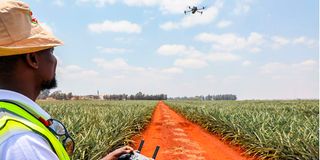
Above the fields, drones fitted with advanced cameras scan thousands of hectares, generating detailed images that reveal crop health, water stress, and areas requiring attention.
“Across the plantation, reservoirs store millions of cubic metres of water collected during the rainy season, ensuring a bountiful harvest even during prolonged dry spells,” says Wayne Cook, Del Monte’s managing director.
For a farm operating in a region where rainfall is increasingly unpredictable, ensuring a steady supply of water has become essential for keeping pineapples alive.
The company’s 10,000-hectare plantation supplies fruit to an integrated processing complex comprising a cannery, juice production lines, a concentrate plant, a frozen fruit facility and a can manufacturing unit.
According to Mr Cook, the complex produces between 170,000 and 200,000 metric tonnes of pineapples annually, with around 90 per cent of the produce destined for export markets.
He says that canned pineapple is mainly shipped overseas, while fresh fruit is supplied locally and exported, particularly to the growing market in the Middle East.
However, behind this global supply chain is a farm that is adapting to a changing climate, where droughts, intense rainfall and declining river flows threaten agricultural production.
Mr Cook says that water management has become one of the company’s most important investments. “Climate change is one of the biggest challenges facing agriculture today,” he says.
Photo credit: Dennis Onsongo | Nation Media Group
The company has adopted a holistic water management strategy centred on harvesting, efficient irrigation, recycling, and the continuous monitoring of water quality. Its farms are located in an area characterised by low and erratic rainfall.
Climate change has intensified the challenges of water scarcity, making storage infrastructure critical for year-round production. To improve water availability, Del Monte has constructed a network of dams and ponds to capture rainfall, stream flows and surface runoff during the wet season.
“The reservoirs currently have a combined storage capacity of 10.7 million cubic metres of water — equivalent to about 4,280 Olympic-size swimming pools,” the company boss tells Seeds of Gold .
He notes that the stored water supports irrigation, factory operations and domestic use for employees living on the premises. Mr Cook says that this investment became essential as rainfall patterns changed.
“When we started, rainfall patterns were much more predictable. Today, we experience shorter periods of intense rainfall followed by longer dry spells,” he explains.
For decades, Del Monte relied heavily on overhead irrigation, whereby large sprinklers watered entire fields. However, this system used a lot of water because it also wasted water on roads, drainage channels and the spaces between crop rows. Since 2010, the company has dramatically reduced its dependence on this method of irrigation.
The proportion of land under overhead irrigation has fallen from 95 per cent in 2010 to around 20 per cent today, while drip irrigation now covers around 75 per cent of irrigated land.
This has improved water-use efficiency by delivering moisture directly to plant roots and reducing evaporation losses.
An aerial view of pineapples growing at Del Monte Kenya Limited farm.
Photo credit: File | Nation
Compared with conventional overhead systems, drip irrigation can reduce water consumption by between 50 and 80 per cent. At Del Monte, this shift has contributed to a 30 per cent reduction in total water use between 2020 and 2024.
The company also uses pivot irrigation systems in selected areas where appropriate. Young pineapple plants are given extra protection in the form of polyethylene mulch, which suppresses weeds and reduces evaporation of soil moisture.
The farm’s irrigation strategy is supported by digital technology. As part of the Smart Farm initiative, drones collect imagery, which is processed into Normalised Difference Vegetation Index (NDVI) maps using Geographic Information Systems (GIS). These maps reveal variations in plant health, water stress, and disease pressure across the plantation.
Rather than applying water uniformly, managers can target specific areas requiring intervention. This reduces unnecessary irrigation, lowers input costs, and enables problems to be identified before they affect yields.
The need for precision farming has become more urgent as the company faces changing weather conditions.
Jane Murage, a long-time resident of the Del Monte community who has lived and worked in the area since 1994, has witnessed this transformation first-hand.
“Heavy storms created gullies across pineapple fields, washing away valuable topsoil and causing waterlogging,” she says.
These saturated conditions increased cases of Phytophthora root rot, a disease associated with poorly drained soils. “Before, we struggled with too much water. Today, the challenge is not having enough,” she observes.
Over the last three decades, prolonged droughts have become more frequent, forcing the company to strengthen its water conservation measures.
She says that rivers which used to flow all year round are gradually drying up as wetlands and riparian areas are affected by human activities. 'When rainfall fails, the dams drop to critically low levels, forcing us to ration water for irrigation. This means the crops receive less water than they need, which ultimately leads to lower yields,” she explains.
In order to protect catchment areas, Del Monte has invested in tree planting, establishing bamboo and rehabilitating riverbanks.
Bamboo stabilises soils, reduces erosion and conserves moisture around water sources. Meanwhile, vegetative buffer zones around dams and streams act as natural filters.
In an exclusive interview with 'Seeds of Gold', Jane said that environmental changes can be seen through the disappearance of species such as the whirligig beetle, popularly referred to as 'njururi' in Kikuyu, which was once common in local streams.
“The njururi used to be common in our rivers, but today it is rarely seen because people have destroyed much of the natural vegetation around streams,” she stated.
Apart from conserving water quantity, Del Monte has also focused on maintaining water quality. Simon Bunyasi, the company’s Research and Development Manager, says that every litre of water collected from rivers is monitored.
The Thika River remains the company’s main water source. “We ensure that every litre of water abstracted from the river is metered,” he says. ‘The data is shared quarterly with the Water Resources Authority to ensure our collection remains within approved limits.’
After being used in production, wastewater passes through a dedicated treatment facility before being reused or discharged. This system comprises lagoons and a constructed wetland, where contaminants are removed through sedimentation, biological treatment and natural filtration.
Del Monte Kenya Managing Director Wayne Cook during the interview on August 13, 2025.
Photo credit: Dennis Onsongo | Nation Media Group
Most of the treated water is recycled for irrigation, thereby reducing reliance on freshwater sources. Water quality monitoring includes testing for pesticides, microbial contaminants and heavy metals at the points where the river enters and exits the facility.
Mr Bunyasi says that protecting water resources and protecting biodiversity go hand in hand. “Approximately 3,100 hectares, or about 31 per cent of Del Monte’s 10,000-hectare property, has been set aside for conservation,” he reveals. These areas include forests, wetlands, wildlife corridors, riparian zones, and buffer zones around reservoirs.
These ecosystems reduce erosion, prevent sediment from entering water sources, and support pollinators that are important for the company’s mango and avocado enterprises. Del Monte currently grows 211 hectares of mangoes and 42 hectares of avocados.
The company’s Agriculture Manager, Moses Mulili, explains that maintaining production for more than six decades requires protecting the soil that supports the crops. “We produce compost from cannery waste and plantation residues, which we then return to the fields to replenish nutrients,” he says. He adds that regular soil testing guides fertiliser application, while erosion control and deep tillage help maintain productivity.
Del Monte grows the MD2 pineapple variety, which is marketed globally as Del Monte Gold. This variety was chosen for its sweetness, vitamin C content, flavour, and suitability for processing.