After growing pineapples and bananas on a five-acre plot in her rural home in Roret village, Kericho County, Ms Josphine Murey noticed that her yields were decreasing and that the soil was becoming unproductive due to growing crops for a long period without crop rotation because there was not enough land.
When she moved to her current home at Sirikwa Farm in Kuresoi North, Nakuru County, approximately 12km off the Molo-Mau Summit road in 2006, Ms Murey started growing potatoes on a large scale to pay her children's school fees.
"When I consulted my husband, we decided to start a dairy farming project, as we had enough land to rear cattle. I bought an Arshey cow from local farmers for Sh38,000. A few months later, she gave birth to a female calf,” she recalls, adding that she milked 20 litres of milk every day, selling it at the local market for Sh25 shillings per litre.
Producing milk from this breed eased her burden of buying milk for domestic use from other farmers, and motivated her to rear more dairy cows. Using the money from the sales, she bought food for the cow and prepared a five-acre plot of land on which to grow maize silage, reducing the need to buy expensive feed from shops.
During a recent interview at her home, Ms Murey revealed that she could not compare maize or potato farming to dairy farming, as the latter is labour-intensive, provided there is sufficient feed and grazing land. She noted that her breed was large and continued to produce better calves through artificial insemination. In 2011, she began selling her milk to Kenya Cooperative Creameries (KCC) despite the delay in payment, as production had increased.
As her flock grew, Ms Murey used medium-sized bulls to plough her land, reducing the cost of hiring tractors. While waiting for milk payments, she would occasionally sell five-year-old bulls to brokers for between Sh25,000 and Sh30,000 each, while mature bulls retailed at between Sh120,000 and Sh130,000, depending on their size. She used the proceeds from these sales to pay her children's school fees, as her husband's salary as a teacher could not cover the family's basic needs.
Currently, the herd comprises about 30 dairy cows of both the Friesian and Arshey breeds, as well as a number of calves. Interestingly, the first cow she bought has calved 19 times, compared to an average of 16 calvings for other cows, according to the Kuresoi North Livestock Officer, Mr Nicholas Rono.
She is currently collecting over 100 litres of milk every day from six cows, as the rest have dried up, with some of them expected to calve in the coming weeks. "My plan is to rear over 200 dairy cows in the future using zero-grazing techniques, with the aim of harvesting at least 3,000 litres, averaging 15 litres per cow. This target is achievable so long as I get good breeds, because I have the land to keep them,” said Ms Murey. She adds that she wants to quit farming completely, as it has become expensive due to the higher cost of seeds, fertiliser, and other farming supplies.
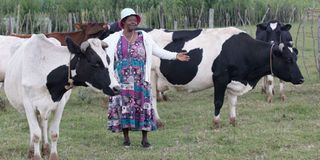
Ms Josphine Murey and one of her dairy cows at Sirikwa Farm in Kuresoi North, Nakuru County on August 12, 2026.
Photo credit: John Njoroge | Nation Media Group
The farmer grows her own feed, including maize for silage and nappier grass, and buys dairy meal. She also intends to grow lucerne to complement the feed. She added that managing a dairy farming project is easier than employing casual workers on a potato farm. Ms Murey attributes her success in dairy farming to good management and better breeds. "I deworm the cows and calves every month and rely on private officers to vaccinate my livestock. I am calling on the government to dispatch enough veterinary officers to educate us on how to combat and prevent diseases in the event of an outbreak,” said Ms Murey, adding that she uses artificial insemination technology for breeding, which she says is of poor quality because the extension officers who should educate them about better breeding systems rarely visit the farms anymore, unlike in the past before devolution.
She says that many farmers have not embraced dairy farming technology due to a lack of skills, which is partly due to a lack of livestock officers in the area. However, according to the Livestock Chief Officer in Nakuru County, Ms Jane Waititu, the livestock extension officers do visit farmers individually on their farms, but mobility issues prevent them from reaching farmers at the grassroots level. “We encourage farmers to visit our ward offices to discuss any issues they may have, as we have officers based at the grassroots level who can provide the necessary support,” said Ms Waititu. She added that these officers can advise farmers on diseases affecting their livestock and the appropriate treatments to use in the event of an outbreak.
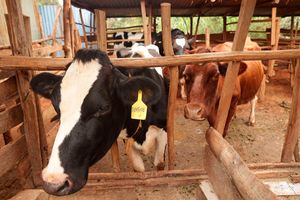
In the past, the farmer used to visit agricultural shows to learn about dairy farming and other agricultural technologies, but she now relies on her own knowledge and sometimes learns online. On one side of the farm, Ms Murey has built temporary sheds for feeding and milking the cows and protecting them from the rain. "To manage the cows, especially during the dry season, I dug two boreholes on the farm with the help of the NG Constituency Development Fund (NG-CDF) water project. However, my plan is to drill extra boreholes to combat water shortages," she said. She added that cows produce more milk during the dry or warm seasons, provided there is enough feed, unlike in the rainy and cold seasons when production is low.
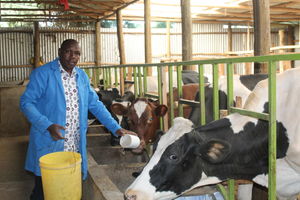
Ms Josphine Murey feeds some of her dairy cows at Sirikwa Farm in Kuresoi North, Nakuru County on August 12, 2026.
Photo credit: John Njoroge | Nation Media Group
The farmer calves her dairy cows three months after birth and milks them up to two months before they calve again. To prevent infections such as mastitis, particularly during the rainy season, Ms Murey regularly cleans the shelters and collects manure for use on the farm. She also rears sheep and plans to increase their numbers if she can obtain better breeds.
She currently sells milk to a cooperative for Sh 48 per litre and to local buyers for Sh 50, while mature bulls are sold to brokers for between Sh 130,000 and Sh 190,000, depending on their size and breed. She urges other farmers to ensure their cows get enough feed and vaccinations to improve milk production.
Ms Catherine Wangari, a small-scale dairy farmer in Mau Summit, says her goal is to breed at least ten purebred dairy cows within the next two years. “I have four Arshey cows that produce over 40 litres of milk every day, especially after calving. I have planted enough feed on the farm, which makes me optimistic about my plans, as I am interested in dairy farming,” she said, adding that it is challenging to provide green pastures during the rainy season, which reduces milk production. However, she supplements their diet with hay and dry maize stalks, despite these being difficult to obtain in the area.