Joy Farm, situated in Muwa Estate in Lanet, Nakuru County, is a prime example of innovation in sustainable agriculture.
The mutualism between plants and animals is an example of an ecological interaction that benefits both species, typically in terms of nutritional needs.
During our visit, we meet Francis Mwangi, a teacher by profession, who is busy feeding some of his livestock.
Spanning more than five acres, the farm is home to a successful dairy business, complete with lucerne fodder and maize crops, as well as a modular cow barn that shelters calves and Friesian and Ayrshire breeds.
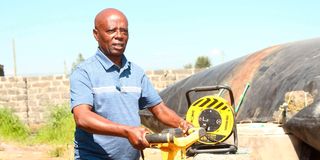
Francis Mwangi at his Joy Farm, Lanet in Nakuru County.
Photo credit: Richard Maosi| Nation Media Group
This creates employment opportunities not only for casual labourers, but also for those involved in processing, transportation, and the supply chain.
In addition to dairy farming, Mwangi has installed a biogas production unit to manage waste and reduce daily operational costs. "Over the past few years, rising fuel prices have directly impacted production expenses for most smallholder farmers, driving up the budget for electricity and essential agricultural inputs," he reflects.
He also mentions that feed manufacturing is another important initiative that consumes a significant amount of energy, as concentrated feed production often relies heavily on electricity.
Farmers also face financial difficulties as they rely heavily on energy for operating machinery, irrigation and transportation. Energy costs often cut into their profit margins. Anaerobic digesters filled with cow dung break down organic waste to produce methane-rich gas.
He explains that this process converts farmyard waste into renewable energy for use in generating electricity, providing heating and fuel, while also producing nutrient-rich slurry that can be used as an organic fertiliser.
“This organic fertiliser is then applied to the farm to grow lucerne and maize, which are used as highly nutritious animal feed,” he says.
Mwangi claims that this closed-loop system has significantly reduced farm expenses while boosting productivity.
The innovation provides diversified income streams through renewable natural gas, while reducing reliance on commercial energy and chemical fertilisers and lowering costs.
Mwangi, who owns around 100 cows at various stages of development, says the idea was born out of necessity. “At one point, the amount of waste produced on the farm was overwhelming. I had to find a sustainable and profitable way of managing it,” he explains.
He reinvested some of his earnings in the project, purchasing modern biodigester air bags made of high-density polyethylene. These are connected to a network of pipes that channel gas to different parts of the farm, depending on its intended use.
Mwangi also underwent rigorous training in biodigester management, including procedures for feeding waste and removing slurry. The gas produced is now used to power animal feed processing machines, provide lighting for security purposes, heat water and operate milking equipment.
A key by-product of the process is slurry, a liquid mixture of organic matter and water, which is used as fertiliser for crops.
He explains that the production of biogas involves a step-by-step process starting with the collection of cow dung from the livestock rearing area. This is followed by sorting to remove unwanted materials, such as stones and sticks, from the mixture.
Francis Mwangi, the owner of Joy Farm Lanet in Nakuru County, inspects the bio digester that enables him to carry out sustainable agriculture.
Photo credit: Richard Maosi| Nation Media Group
In the collection chamber, mix the sorted organic waste with water in roughly equal proportions to achieve a slurry consistency. The temperature should be kept between 30°C and 40°C using insulation or heat exchange, and the mixture should be stirred daily to boost bacterial activity and maximise gas yield.
The gas is then directed into high-density polyethylene (HDPE) bags, which are used for storing methane produced by biodigesters and offer a durable, gas-tight solution.
The digested slurry is then drained out via gravity. This liquid discharge, known as bioslurry, consists of 93% water and 7% dry matter rich in nitrogen, phosphorus, and potassium, and is used as an organic fertiliser.
"Using slurry improves soil fertility and reduces production costs by replacing synthetic fertilisers," notes Mwangi. He adds that slurry contains high levels of readily available nitrogen, which supports rapid plant growth. However, he cautions farmers to apply it at the right time to maximise nutrient uptake and minimise losses.
"Proper timing ensures crops utilise the nutrients before they are lost through volatilisation, leaching or runoff, especially during heavy rains," he advises.
Mwangi’s initiative demonstrates how integrating renewable energy into farming systems can promote sustainability, improve efficiency and increase farm profitability.