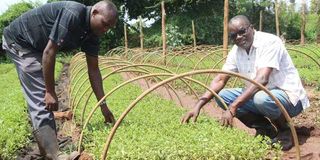
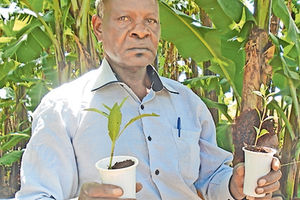
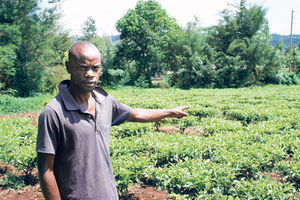
Caption for the landscape image: Meet the pioneer farmer growing South American stevia in Taveta Saturday, January 10, 2026 Scroll down to read the article Joab Barasa (left) an agronomist and Peter Mtawa, a stevia farmer from Msengoni village Taveta town tending to Stevia plant on November 21, 2025. Photo credit: Richard Maosi | Nation Media Group By Richard Maosi Contributor Article Related The stevia plant is originally from South America and has long been used as a natural sweetener. Extract from its leaves serves as a zero-calorie substitute for table sugar and is used globally to enhance the flavour of coffee and tea. PREMIUM Double rewards from farmer growing wonder crop stevia Stevia stays in the seedbed for 30-40 days after which one can transplant to a well-tilled land whose soil is evenly drained. PREMIUM Stevia not so sweet to farmers’ pockets The quarter-acre farm in the middle of expansive tea estates in Kabianga, Kericho was once an envy of many. . Recommended for you PREMIUM Kisumu cement industry expands with new factory PREMIUM Inside the three-acre farm creating jobs for families in Lamu PREMIUM Why court wants answers on Sh154bn JKIA deal but won’t stop project PREMIUM Regulatory gap blocks Hustler Fund pension billions Login to join the discussion Please enable JavaScript to view the comments powered by Disqus. In the headlines Elections News Counties Business Opinion Sports Life & Style Health Podcasts Photos Newsletters Puzzles PREMIUM How Kenya’s running legends are building fortunes beyond the track Champions who have channeled their sporting fortunes into shopping centres, hotels, schools. PREMIUM Mosiria exposes bitter fallout with Sakaja Nairobi County Chief Officer declares intention to challenge Governor Sakaja in 2027. PREMIUM Civil servants face vetting over Sh6.2bn payroll fraud State renews push to identify irregular recruitment and weaknesses in management of public funds.
PREMIUM Double rewards from farmer growing wonder crop stevia Stevia stays in the seedbed for 30-40 days after which one can transplant to a well-tilled land whose soil is evenly drained.
PREMIUM Stevia not so sweet to farmers’ pockets The quarter-acre farm in the middle of expansive tea estates in Kabianga, Kericho was once an envy of many.
PREMIUM How Kenya’s running legends are building fortunes beyond the track Champions who have channeled their sporting fortunes into shopping centres, hotels, schools.
PREMIUM Mosiria exposes bitter fallout with Sakaja Nairobi County Chief Officer declares intention to challenge Governor Sakaja in 2027.
PREMIUM Civil servants face vetting over Sh6.2bn payroll fraud State renews push to identify irregular recruitment and weaknesses in management of public funds.