For long, farming has been associated with what your grandparents did and what you do when there is no other option. It is backbreaking work for little pay, a last resort for those who failed to find something better.
In Meru, however, young people are leasing land, calculating profits and counting harvests like paydays.
Three years ago, Daisy Kathure was 17 and working as a barmaid in Kibiricho. Kathure’s mother died when she was young, leaving her and her younger sisters under the care of a father who was not financially stable. He is battling cancer.
Daisy Kathure, 20, inspects her potato farm in Kibiricho, Meru County on August 6, 2026.
Photo credit: Wanja Mbuthia Nation Media Group
She dropped out of school in Class Eight for lack of fees and took up menial jobs. At 20, she is a farmer. In about a month, she will be harvesting her potatoes and expects to make around Sh150,000. She runs a thriving salon business on the side, but farming is her anchor.
It started in 2024 when her mother’s friend found her working at a bar and introduced her to a programme for young people.
Kathure trained as a hairdresser and got a start-up kit. After a year, she watched her peers who had ventured into farming making money. She gave it a try in 2025.
“I used my savings from the salon and a little help to lease a quarter of an acre,” she says.
She got trained on the best crops to plant and was given climate-resistant seedlings. Today, Kathure pays school fees for her sisters, aged 12 and 18. She has also taken in an orphaned girl and pays her father’s medical bills.
Kathure’s goals include leasing a bigger piece of land, educating her sisters to the highest level and ensuring her father gets drugs.
Her highest profit has been Sh70,000. Potatoes take at least three months to mature, meaning she can do three seasons in a year.
It has not been rosy, though. Water scarcity is Kathure’s biggest challenge. She suffered losses in her second season last year. Her father was hospitalised, and most of her time and resources went to his care.
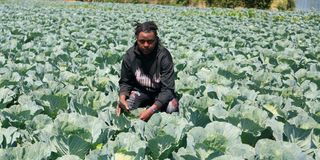
Clinton Kirimi, 22, inspects his cabbage farm in Machaka village, Meru on August 5,2026.
Photo credit: Wanja Mbuthia | Nation Media Group
Clinton Mworia, 22, is a resident of Machaka village. He has been farming for two years and is currently tending to his half-acre cabbage farm – his first attempt at cabbages. He grew potatoes, carrots and maize before. His biggest profit is Sh205,000 from potatoes.
Mworia cleared high school in 2023 but could not proceed to college or university. He and his two younger siblings were brought up by their grandmother. He did farm work for other people before being informed by the area chief of a programme targeting young people.
He got trained on healthy soils and received potato seedlings to start with. From the earnings, Mworia has bought two motorbikes. One is involved in boda boda, but the other is for his errands. He has also built a two-room house for his grandmother and sisters.
Mworia has six sheep and two donkeys. He is building himself a house and has already bought 20 iron sheets. Mworia is in the process of buying a piece of land.
When we catch up with 18-year-old Yvonne Gacheri, she is busy weeding her three-quarter-acre onion farm in Kanyoro. Yvonne has been farming since 2024, and her highest profit was Sh150,000.
“My four siblings and two-year-old son depend on me,” she says.
They all used to live with her grandmother, who died last year. Thanks to farming, Yvonne gave her a decent send-off.
“Onions need a lot of water, but this area is almost dry. I pay for a generator and pipes to pump water from far,” she says.
Pumping water to her farm costs Sh9,000 a week. The onions also need pesticides and other care.
“Thankfully, I am in a merry-go-round group, so I take loans that I repay promptly,” she says.
“I used to be a househelp, a job I began at only 16.”
She got pregnant at that time, and the man responsible took off.
“We get good meals, something that was alien to us just two years ago. I have also bought mattresses, and we dress decently,” she says.
She hopes to install electricity or a solar system at the farm. She also plans to expand the land under onions.
Yvonne dropped out of school in Std Seven due to lack of fees. Her dream is to see her siblings study up to university.
Ezekiel Muchui, 20, tends to his tomatoes in Limauru, Meru County on August 5,2026.
Photo credit: Wanja Mbuthia | Nation Media Group
Ezekiel Muchui, 20, is a tomato farmer in Limauru, Tigania West. He expects to sell his produce in a month’s time. He also has half an acre of hybrid onions about two kilometres away. Both pieces of land are leased.
“I made and held my first Sh100,000 in August last year – proceeds from farming,” he says.
Muchui’s mentor advised him to reinvest the amount in leasing a larger piece of land. The firstborn in a family of three now helps his parents, who are casual labourers. He pays fees for his siblings and chips in on house expenses.
Bessy Wanja, a resident of Luuria, is smiling to the bank. Early this month, she sold onions harvested from her one-acre leased parcel. It was her third onion harvest.
She made Sh100,000 in her first season and reinvested the amount in farming. Wanja even took a loan to lease more land. She got more than double the amount in her second harvest – an amount she used to buy two heifers, build a two-roomed simple house for her mother, a kitchen and settle her siblings’ school fees. She has even installed a solar system at home.
Wanja is 18 and still lives with her mother and three siblings. She dropped out of school in Grade Seven due to lack of fees.
These young people are part of an effort to change perceptions about farming. Through Zoe Empowers Kenya, they are trained on the basics of farming. Specialists are brought in to help them understand how to take care of crops.
Emphasis is on cost analysis – which crop is best and which one gives the highest returns. Soil testing helps determine which crops do well in an area.
“We do training on farming as a business,” says Reegan Kaberia, the organisation’s CEO.
Reegan Kaberia, CEO, Zoe Empowers Global South speaks on government partnerships to enhance food security in Meru on August 6, 2026.
Photo credit: Wanja Mbuthia | Nation Media Group
“This is what food security looks like – not just full stomachs, but dignity and thriving.”
“We discuss with them which crops can give you the highest return. If you take maize and onions, which one can you get more money from?"
The young people are grouped into support groups of about 20 to 25 households, each with an adult mentor from the same village. Programme staff are embedded in the community, spending most of their week doing home visits, checking on families and their projects. “Our staff only come to the office on Mondays and Fridays; the rest of the weekdays they are out there with these young adults, guiding them on different dimensions.”
Funding is not standardised. Each person's project is different, and the funding depends on what they want to do. They develop business plans - which they are trained to do- and present them to their groups for discussion. The funding is given in stages; first for land preparation, then for seeds and manure, and later for post-harvest care.
"Once you decide for yourself, there will be a lot of negotiation," Kaberia explains. "What do you want to use this money for? You explain this and this and this. Can we give you a small bit?" This is deliberate. The idea is to avoid the common pitfall where organisations decide at a table what amount to give without involving the beneficiaries.
There is also a lot of follow-up. "Without follow-up, some of our youths get excited, just as is human nature. Some will want to experiment with experiences such as alcohol. They want to do things that they have been admiring, and so we do a lot of targeted follow-up to ensure that the money is being used for what it was intended for.
It would be dishonest to paint a picture of smooth sailing because the challenges are real. Water scarcity is the most common complaint. In Meru County, nearly 60% of the county faces semi-arid conditions, with each dry season bringing severe losses. Young farmers like Yvonne are forced to rent generators and pipes to pump water, spending thousands of shillings every week just to keep their crops alive.
Markets are another headache. When farmers harvest at the same time, the market gets flooded, and prices drop. “To counter this, young people are trained on post-harvest care and the importance of timing. In some areas, they have common stores where they can keep their produce and sell when the price is right. If they need immediate cash, they can borrow from the group and pay back after selling,” shares Reegan.
Despite this, the results speak for themselves. “Success rates are consistently high. Impact assessments have shown that young people in the programme can feed themselves, pay school fees, and meet their basic needs,” he further offers.
“One assessment on our initiative by George Washington University found remarkable outcomes. While another baseline report conducted by Kisii University produced equally encouraging results,” he notes.
“In a nutshell, this is what food security looks like. Not just full stomachs, but dignity and thriving beyond survival. “