A casual conversation over opportunities in agribusiness has given birth to a thriving vegetable and fruit seedlings business in Bomet. A couple has grown an enterprise inch by inch, learning from mistakes.
Cosmas and Pamela Langat, who reside in Kimenderit village, Nyang'ore's ward, now produce seedlings for cabbage, kale, spinach, African nightshade, capsicum, tomato, bulb onion and other fruits and vegetables.
The enterprise, trading as Chumek Nursery, now deals in Hass avocado, tissue culture banana, dragon fruit, apple, grapes, pawpaw, mango, pixie oranges, coffee, among others.
It demonstrates how an idea can turn into a booming business, starting small and upscaling over time.
“The journey began with a friend who was interested in buying and selling passion fruits,” Langat reveals what inspired him to start the enterprise.
“We discussed the matter and he started the business. Later, he told me there were opportunities in raising seedlings and I pondered over it before taking the decision to give it a try.”
In 2020, Langat raised a small vegetable seedbed in an open-air system, but it did not do well. Never the one to give up, he attempted again.
“A farmhand told me there was an opportunity in raising vegetables in a greenhouse since demand was high. I did not give it much thought because I thought selling a seedling for Sh2 would not make economic sense,” Langat says.
It later turned out for Langat and his wife that the enterprise would be the goose that laid the golden egg. They used part of their savings to start and expand the business.
“I bought materials for a small greenhouse and propagated 10,000 cabbage seedlings. Unfortunately, I lost the crop. Less than 500 seedlings germinated,” he says.
The couple then went back to the drawing board and undertook some research. The Langats invited an agronomist to the farm, who advised them to use trays and adopt different media in raising seedlings.
“We resorted to using peat moss – a soilless and bacteria-free media – to raise the seedlings in what would be a breakthrough for us after several failed attempts,” Langat says.
Raising seedlings in a greenhouse and using soilless media was the game-changer for the business. The seedlings grew faster and were hardy, besides being free of disease and pests.
A greenhouse also insulates the seedlings from excess rain, hailstones and animals while providing a conducive environment for growth.
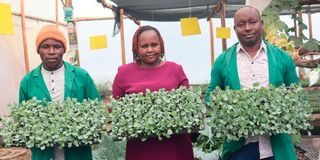
Cosmas Langat (right) and his wife Pamela display vegetables seedlings at Chumek nursery in Kimenderit village, Bomet County on October 24, 2026.
Photo credit: Vitalis Kimutai | Nation Media Group
The 99 per cent germination rate encouraged the couple to scale up their production, moving from 10,000 to 20,000 and to the current capacity of 350,000 seedlings per month.
Recently, they sold 250,000 vegetable seedlings for Sh2.50 each; 20,000 coffee seedlings for Sh50 each and 10,000 avocado seedlings for Sh250 each to farmers and organisations across the Rift Valley and Western Kenya.
The Langats sell the seedlings to farmers in Kakamega, Vihiga, Uasin Gishu, Nandi, Bomet, Nakuru, Narok and Elgeyo Marakwet counties, with some orders coming from as far as Eastern Kenya.
The initial 1,000 crafted Hass Avocado seedlings in the nursery were bought by an agency that was supplying farmers. They sold them for Sh150 apiece, fetching Sh150,000. That made the couple realise the investment was worth the effort.
They then raised the production to 2,000 and have been increasing since then.
The couple bought seeds for rootstock and started crafting with scions from Hass avocado that were more than seven years old.
The success of the project led the Langats' venture to other fruit trees, expanding to 20 seedling varieties of vegetables and fruits.
“I almost gave up on the business in the initial stages, but Pamela encouraged me. We started all over again on realising consistency was a virtue in business,” Langat says.
Businesspeople dealing in the supply of seedlings to government and NGOs, including the Kenya Forest Service (KFS), have been buying the vegetable and fruit seedlings from Chumek Nursery.
“We work closely with the Ministry of Agriculture and the devolved government of Bomet, involving agronomists in our undertaking. We also conduct research,” Mrs Langat says.
Despite the high production, Chumek Nursery still cannot satisfy demand. The Langats are seeking to expand production lines while upscaling marketing strategies.
“We started with word of mouth to friends, family and neighbours before adopting digital marketing. We mostly use Whatsapp and keep adding new customers,” he says.
“It has given us visibility and a chance for customers to track production in real time and know when to place orders or book. We also propagate for farmers at a fee.”
Ms Langat, a teacher, says after several false starts and a resolve not to give up, they found their footing in agribusiness and will keep expanding and adopting modern technology.
“I like to encourage women and young people to get into farming as business and not just for subsistence. There is a big market for fresh produce in the country she says.
“In this county, for instance, there are 12,000 students at Bomet University, another 8,000 at Sot Technical Institute, more than 3,000 at Chepalungu Technical Institute, boarding schools, hospitals and urban centres. They all require vegetables, milk, cereals among others. That is a ready market for farm produce.”
The couple runs the nursery professionally, complete with budget lines. The Langats evaluate the investment and production levels and factor in inputs and incomes so as to know the viability of the project through loss or profit margins.
“We deal with the most difficult part for the farmers – nurturing the vegetables and fruits in nurseries that are free of pests and diseases. What remains is for the prospective farmers to transplant and grow them and reap from the readily available markets,” Mrs Langat says.
“There is absolutely no reason for Kenya to import food when we have the capacity to produce surplus for export. There should be no food insecurity in this country.”
The teacher asks the government and agricultural institutions to support farmers in raising production, accessing credit and embracing technology and mechanisation while embracing agribusiness.
To ensure water is available throughout the year, the two have set up two pans in the compound.
They drain stormwater and use gutters to harvest rain from iron sheet-roofed structures in the homestead.
Dr Kibet Sitienei, a farming expert, says growing seedlings in a greenhouse and using soilless media is one of the best methods of nurturing seedlings.
“Importantly, the system ensures the seedlings are free of pests and diseases, are hardy and improve their maturity rates,” Dr Sitienei says.
“With good agronomic practices, production is high. There is potential to fetch high prices in the market.”
Dr Sitienei, who is the Bomet County Chief Officer for Agriculture, says propagation of seeds in a greenhouse ensures vigorous and uniform growth and better moisture and water regulation.
“The greenhouse is also weed and rodent-free,” he says.
Small and large-scale farmers, Dr Sitienei adds, should adopt modern practices for improved yields and better income.