When Sister Mildred Akinyi, Head of Institution at St Anne's Sega Girls Comprehensive School, visited a neighbouring school for a regular training of institution heads, she took more than the intended teaching.
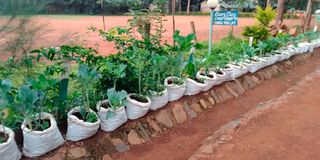
From the gate, she saw that the school had abandoned the old culture of planting flowers along the drives, instead, there were healthy vegetables that did not only appear beautiful but also healthy for consumption.
She later learned that this was permaculture, which simply means the concept of utilising land, resources, people and the environment in a manner that doesn't produce any waste.
Instead of the flowers that make the compound beautiful, the vegetables ensure sustainability by providing food to the learners as well as, occasionally, bringing income when sold to the neighbouring community.
When you step into Sega Girls Comprehensive School, you are invited by a well-maintained column of sukuma wiki and other vegetables.
“This type of farming is promoted through a programme known as Schools and Colleges Permaculture Programme (SCOPE), where institutions are encouraged to utilise the available land within in the production of food crops,” said Sis Akinyi.
Other than sukuma wiki, the school has cultivated cucumber, green tree grass, sunflower, green onions and spinach among others.
“When the crops are maintained well, they also offer what other ornamental flowers would offer. This is an aspect of killing two birds with one stone,” she added.
Sukuma wiki planted in sacks at Sega Girls Comprehensive School in Ugenya sub-county in this photo taken on October 8, 2025.
Photo credit: Kassim Adinasi | Nation
All the learners are involved in the cultivation of the crops, and with the Competency Based Education (CBE), permaculture offers a great opportunity for learners to integrate what they have learned in class practically.
“There are important things that the learners have achieved through permaculture. They understand what they learn in class practically. For instance, they know how long it takes for a crop to grow to maturity and how to take care of them,” she said.
“Permaculture has also taught the learners the aspect of being patient – it takes time to plant a cucumber, ensure they grow, until harvesting. This is very important to the learners.”
As a way of conserving the environment, permaculture encourages the use of organic manure instead of chemical fertilisers.
“The use of organic manure does not only protect our environment, it also reduces the cost of producing the crops. The funds that would have been used in buying the chemical fertilisers are rechannelled elsewhere.”
Within the compound, the school also has the poultry unit where they have chicken; the famous improved kienyeji breeds.
“The poultry unit has chicken, which the learners feed on when mature. They also have rabbits, which are like their children. All the learners who have rabbits have given each a name. For instance, there is a white chinchilla breed named angel. They have developed attachment with the animals, they feed them, ensure they drink enough water, and also ensure they are in good health.”
The neighbouring community loves the vegetable from Sega Girls Comprehensive School; the institution has a ready market for the surplus.
“Our sukuma wiki and cucumbers are the best because we produce them organically. The vegetable vendors from Sega Market normally flock to our school to get them. This has enabled us to generate some income for the school,” said Sister Akinyi.
According to the institution’s boss, they use natural ways to keep pests away from their crops.
“There are no pesticides that we use to keep away pests from our crops. We have integrated crops that naturally repel the pests; green tree grass serves this purpose. It not only keeps mosquitoes away, it also keeps pests away from other crops,” she said.
Occasionally, when the funds to run school delay, the learners are often assured of food courtesy of the permaculture.