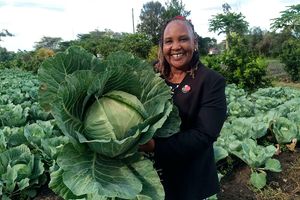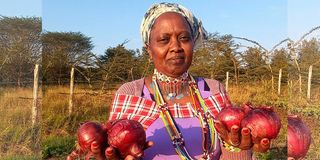
Florence Matayen displays freshly harvested onionsfrom her Kitengela farm on August 4 2026.

For Florence Matayen, the devastating 2020-22 drought was a turning point. She watched helplessly as at least 100 family animals died. It made her rethink her dependence on livestock.
What began as a response to the drought has transformed a once-bare stretch of rangeland on the outskirts of Kitengela, Kajiado County, into a thriving onion and pepper farm.
The deputy headteacher of Kitengela Prison Primary School has carved a niche in hot-pepper production, turning to a crop that she says requires relatively little water and labour.
Matayen’s three-acre pepper farm has earned her a growing clientele among eateries and traders, giving her confidence to expand the venture.
According to the National Drought Management Authority, the 2020-22 drought was one of the most severe and prolonged in decades. It was driven by five consecutive failed or below-average rainy seasons, which hit Arid and Semi-Arid Lands and left millions of families devastated.
For Matayen, the drought was a blessing in disguise. Her husband owned expansive rangelands on the outskirts of Kitengela. She approached him to set aside at least 15 acres for crop production.
“Diversifying from livestock rearing to crop husbandry, especially in a semi-arid area, was no mean feat. It meant getting capital, water and engaging in research,” the teacher says.
“I was determined, no matter how many times I stumbled. My husband gave me some money as initial capital, which I supplemented with loans from women groups.”
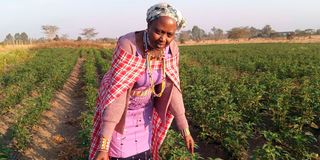
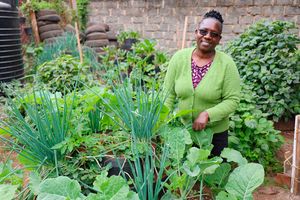
Florence Matayen at her three acre pepper farm in Kitengela on August 4 2026.
She has been juggling classwork and farming, waking up around 6am to get a report from her farm manager, who supervises labourers.
Matayen sources irrigation water from a borehole. Neighbours pay for water.
She prefers bulk harvesting, usually on weekends when schools are in session, as this enables her to supervise the work and sales.
A kilo of onions retails for Sh70 to Sh80, with wholesale prices ranging from Sh60 to Sh70. When the Seeds of Gold team visited the farm around 7am, retailers and wholesale customers had arrived to buy the onions harvested the previous day.
Hot pepper farming is what stands out for the tutor. She ventured into chilli farming on three acres two years ago.
Though many households in Kajiado are turning to crop farming due to the erratic weather patterns, few grow pepper.
Neat rows of thriving pepper plants form a vivid ribbon of green across the terrain.
Matayen says chilli plants are relatively drought-tolerant, require little water and can give a yield of 2,000 kilos to and 4,000 kilos per acre in a season, depending on the seed variety.
The crop can be harvested for more than six months.
She harvests once a week, making the crop a constant source of cash. The farm’s proximity to the fast-growing Kitengela town gives Matayen an advantage when marketing her produce. Traders and hotels are her main customers.
Green pepper is a low-calorie vegetable containing vitamin C, vitamin B6, vitamin K, potassium and other nutrients.
Matayen applies animal manure on her land before planting. She focuses on high-demand varieties like the African bird’s eye and wants to try Cayenne varieties.
“Pepper farming is lucrative,” Matayen says, adding that it is not labour-intensive and control of pests and diseases is easy, compared to other crops.
“One worker can take care of the entire crop with ease. I only require labourers when harvesting, especially during sorting and grading. At harvest, I engage at least 50 casuals,” she says.
After retiring from teaching, Matayen intends to go fully into pepper growing, aiming to tap into the export market and value-addition.
According to the Ministry of Agriculture, Kenya produces 10,745 tonnes of chilli a year, with dry pepper hitting 2,989 tonnes.
European and regional export markets absorb around 3,000 tonnes of specialised hot pepper.
Follow our WhatsApp channel for breaking news updates and more stories like this.