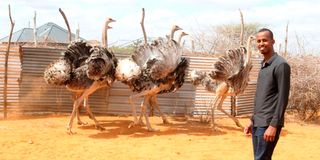
In the sweltering heat, Waso Farm on the outskirts of Garissa town has become an attraction as residents stream in to have a glimpse and document interactions with ostriches.
Most have only seen the giant birds in the bush as they drive or walk across the expansive Garissa County.
Of the five birds at the farm, the male appears more attractive than the females. Nasirudin Hassan, the farm owner, explains that it is due to their nature and mating patterns.
“For ostriches, it is the female that chooses a mating partner. That is why the male appears more attractive,” he says.
The only breed at Waso farm is the Somali ostrich. The other breed of the bird in Kenya is the Maasai, which has pink skin.
Hassan started the farm in 1999. He has had many challenges in keeping the world’s largest bird, with climate change complicating matters.
“We have had problems, including a shortage of land and space for these birds. They need a huge area. We also have to contend with water and food scarcity,” he says.
Hassan feeds his flock on maize, sunflower and poultry feed. A bird can consume two kilograms of meal in a day.
Hassan acquired a permit to keep the birds from the Kenya Wildlife Services. He renewed the licence in 2013 and 2015.
“I had to seek permission from the community and the area chief before asking KWS to allow us to venture into this business. We sought permission from the community because the birds were to be kept in a residential area,” he said.
Ms Halima Gure, a neighbour, says the farm has given her children a chance to interact with ostriches.
“We live with the birds here. I have never taken my children to game parks or reserves to see ostriches,” she says.
An ostrich can grow up to three metres tall, with the neck accounting for almost half the height.
Ostriches on the Waso Farm in Garissa town on September 30, 2025.
Photo credit: Manase Otsialo | Nation Media Group
From the time Waso Farm was established, Hassan has sold several ostriches to interested farmers. An adult goes for Sh200,000 to Sh250,000.
“We sell an ostrich after calculating the costs incurred in taking care of it and considering the age,” he says.
Ostriches can withstand different climatic conditions and are immune to many diseases. The birds are active during sunny and dry days. Hassan goes to look for ostrich chicks in the bush.
“I keep them for meat, feathers, eggs and skin. Our religion accepts ostrich meat, though I have not found a customer locally,” he says.
“It is said that ostrich oil can treat allergies and reduce the effects of tuberculosis and other diseases.”
One can acquire ostrich chicks or eggs from a reputable breeder or hatchery, as it provides birds that have been vaccinated against diseases. Birds from hatcheries have a good genetic history.
Ostriches require a balanced diet of grains, grass and supplements to maintain health and growth. The giant birds need care including vaccinations, deworming and grooming.
Peter Otieno, an avian veterinarian, says medication could be due to infections. Antibiotics are used to treat bacterial infections.
“The ostrich is the cheapest bird to keep as far as treatment is concerned,” he says, adding that one should control internal and external parasites.
“An ostrich can have a respiratory disease. There are drugs for this infection,” he said.
Injuries are treated using anti-inflammatory drugs or pain relievers, according to Otieno.