In the semi-arid plains of Rongai, Kajiado County, a vertical lake is a ground-breaking aquaculture project that utilises vertical space to create a closed freshwater system.
This innovative approach maximises water efficiency and land use, enabling high-yield aquaculture in areas where water is scarce.
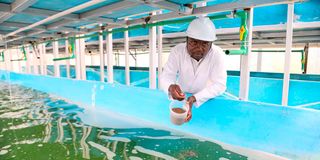
Vertical Lake Co-founder Jack Oyugi pictured at the Vertical Aquaculture System plant in Rongai, Kajiado County on September 2, 2025.
Photo credit: Bonface Bogita | Nation
Co-founded by Kenyan innovator Jack Oyugi and UK-based entrepreneur Dr Jez Lofts, Vertical Lake is revolutionising sustainable, clean, and organic protein and plant food production.
The project features a unique, vertically stacked aquaculture system that utilises proprietary, organic, circular biofiltration technology to raise fish while simultaneously producing natural, organic fertilisers for both local and global markets.
“I previously ran Biofit Feeds, a company that manufactured animal feed. But during processing, we faced a recurring challenge of limited access to high-quality protein sources to supplement our feeds,” says Oyugi.
Vertical Lake Co-founder Jack Oyugi displays fish waste turned into organic fertiliser at the Vertical Aquaculture System plant in Rongai, Kajiado County on September 2, 2025.
Photo credit: Bonface Bogita | Nation
Covid-19 disrupted global supply chains, one of the hardest-hit sectors. Being in the animal feed industry, he says that sourcing quality raw materials, especially protein, became a major challenge.
Prices skyrocketed, ingredients became scarce, and maintaining a steady production line was nearly impossible.
That was when he began exploring an alternative by producing his own source of protein through aquaculture. The goal was to develop a controlled system that could grow fish quickly and sustainably — fish that could then be processed into high-protein feed for livestock.
With support from the Royal Academy of Engineering in the UK, the Vertical Lake pilot received £100,000 in funding.
“Our first pilot involved trying to grow Nyanza barbs (omena) and Ngege (Oreochromis niloticus ) outside Lake Victoria in open tanks, but the results were disappointing. The fish did not adapt well to the environment, and survival rates were poor,” he explains.
Vertical Lake Co-founder Jack Oyugi displays fish waste turned into organic fertiliser at the Vertical Aquaculture System plant in Rongai, Kajiado County on September 2, 2025.
Photo credit: Bonface Bogita | Nation
They then moved to a second pilot, this time using closed containers to simulate controlled aquaculture systems. For six months, they faced one failure after another.
But during those trials, a few tilapia survived the transport process and adapted remarkably well to the new environment. They grew faster than expected, which pushed them to dig deeper.
That observation marked the beginning of a new phase of designing a system specifically suited for tilapia and other fish species.
Together with his team, they had to consider every factor from water temperature, pH levels, oxygenation, feed type, waste management, and fish density.
They studied how water chemistry affects fish growth, while also exploring ways to build a system that wouldn’t depend on expensive, capital-intensive infrastructure.
Vertical Lake Co-founder Jack Oyugi pictured at the Vertical Aquaculture System plant in Rongai, Kajiado County on September 2, 2025.
Photo credit: Bonface Bogita | Nation
After three years of rigorous research and experimentation, they developed Vertical Lake — a fully integrated, stacked-container aquaculture system that mimics the natural conditions of a lake within a compact, vertical space.
The technology combines water recycling, organic bio-filtration, solar energy, and smart feeding systems to raise fish efficiently in both urban and semi-arid environments.
The result is a low-footprint, closed-loop system designed not only for fish production but also for high-quality protein extraction, supporting animal feed manufacturing.
“Think of it like hydroponics for fish. We have built a vertical ecosystem that allows us to grow healthy, organic tilapia while using a fraction of the space and water of traditional fish farms,” he notes.
Oyugi says they currently operate one commercial facility with two active modules and are in the process of scaling up by adding two more.
Each container in the system can house between 500 and 1,000 fish, depending on the setup. The water is continuously cleaned through biofiltration, which treats wastewater, making the system both circular and highly water-efficient, while upcycling all waste into organic plant food.
Vertical Lake Co-founder Jack Oyugi pictured at the Vertical Aquaculture System plant in Rongai, Kajiado County on September 2, 2025.
Photo credit: Bonface Bogita | Nation
As synthetic fertilisers become increasingly expensive, environmentally damaging, and unsustainable, and as aquaculture continues to rely on cage systems and artificial ponds that contaminate lakes, disrupt ecosystems, and generate toxic waste, Vertical Lake offers a transformative alternative.
“We discovered that fish excreta, when processed properly, can be used as an effective organic fertiliser and even as a natural biopesticide. So now, we are serving both livestock and crop farmers with one solution,” he explains.
He adds that they also produce edible freshwater fillets and whole fish for the Kenyan market, along with fish-skin collagen and protein derivatives from by-products.
These serve the super-premium organic protein segment, which they intend to take to global markets.
Their closed-loop, gravity-fed vertical aquaculture system transforms fish waste into BlueHarvest, a gel-based, organic bio-fertiliser that restores soil, improves yields, and supports climate resilience.
Oyugi says that each fish grown in their system becomes a natural, self-sustaining fertiliser engine. Water flows through multi-layered tanks stacked vertically, mimicking the motion of a river.
At every level, biofiltration and sedimentation extract nutrient-rich waste, which is then fermented into the fertiliser.
The gel retains moisture, releases nutrients gradually, and contains NPK nutrients, trace minerals, beneficial microbes, and chitin (a natural biopesticide). It helps heal degraded soils, strengthen crops, and lower input costs for farmers.
“One Vertical Lake module produces five tons of the fertiliser per year. By 2026, we plan to scale to over 50 tons annually, with decentralised refill stations where farmers can use reusable containers to access affordable fertiliser,” he says.
Vertical Lake Co-founder Jack Oyugi pictured at the Vertical Aquaculture System plant in Rongai, Kajiado County on September 2, 2025.
Photo credit: Bonface Bogita | Nation
These smart hubs, he adds, will eliminate plastic waste, reduce transport emissions, and support community-led soil regeneration systems.
Their current phase can accommodate up to 60,000 fish. To enhance efficiency and ensure optimal fish welfare, the team is implementing advanced technologies, including Artificial Intelligence (AI) and robotics.
These systems monitor fish behaviour, regulate feeding schedules, and maintain ideal environmental conditions throughout the facility.
AI-powered sensors are integrated into each tank layer, providing real-time data on water quality, fish movement, and overall system health. This precision approach improves not only fish productivity but also the recovery of nutrients for fertiliser production.
They are also launching BlueHarvest Soil & Crop AI, a mobile-based tool that provides farmers with precise dilution and application instructions tailored to their crop type, soil conditions, and local climate, making it the first intelligent fertiliser solution specifically designed for smallholder farmers.
“While fertiliser is our core business, we ensure nothing goes to waste. We sell clean, low-carbon fish fillets locally and process fish skin into collagen biomaterials for wound care and biodegradable packaging,” he says, adding that their collagen is already undergoing tests in Nairobi hospitals with excellent healing results.
In the future, he says they plan to deploy automated, AI-powered mini-units to undernourished and climate-stressed communities, enabling local production of both food and fertiliser — regenerating people, soil, and ecosystems simultaneously.
Vertical Lake’s fish are raised in a controlled environment, reducing exposure to environmental pollutants common in wild-caught or lake-farmed fish, such as chemicals, heavy metals, toxins, and parasites like lice.
Unlike traditional pond farming, which can suffer from low oxygen levels and disease outbreaks often treated with antibiotics, this system maintains stable water quality and fish health.
The fish are sustainably farmed, organically raised, and fully traceable throughout the production process.
Their vision goes beyond profit. He wants to see communities being empowered through the open-source distribution of this technology.
“Our goal is to localise food production and reduce dependence on imports. If every county had the vertical lake, we could ensure food security, improve livelihoods, and protect our environment,” he concludes.
Vertical Lake has been nominated for the 2025 Earthshot Prize, a prestigious global award that recognises ground-breaking solutions to the world’s most pressing environmental challenges.